Showing posts with label events. Show all posts

Saturday, July 31, 2021

Ambridge parade on First St. 1955

Ambridge Golden Jubilee's Miss Greater Ambridge, Helen Witek
National Electric float
intersection First and Merchant Sts.
background: Karas Place, Balkan Restaurant, 291 First St.

Patrick Escoto* let me scan some photos that belonged to his late father, Phillip "Pippy" Escote.* Among the photos were some from a parade along what I recognized as Ambridge's First St. before the the neighborhood was razed, beginning with the Marshall Alley buildings in the mid-1950s, then more extensively in the early 1970s, when the entire area was cleared for redevelopment. 

The photos didn't give the date of the parade, or identify the parade participants or the spectators.

However, I am pretty certain that the photos were of Ambridge's Golden Jubilee parade on July 2, 1955, even though I haven't been able to find photos showing the same participants in the news photos of the parade that Ambridge's Daily Citizen called "a massive spectacle."

My best clue so far that these photos are of the Golden Jubilee parade is the Miss Greater Ambridge parade float above, on which Helen Witek, who was chosen for that honor as part of Ambridge's Golden Jubilee celebration, was riding with her court.

None of the different majorette or drum major uniforms in any of the photos match the ones worn at Ambridge High School in the mid-1950s according to photos in the 1954, '55, or '56 Bridger yearbooks. But there were many many marching units in the parade. Recognize anyone?

The very long parade was staged along the 100 and 200 blocks of First St., and then north on Park Rd. But the parade officially started at the intersection of First and Merchant Sts., which once began between the 200 and 300 blocks of First St. So the lucky residents of First St. got to see the parade before those watching elsewhere in Ambridge did.

If you can provide identifying information (people, float sponsors, businesses), or memories of the parade traveling up First St., please leave a comment.

Here are the rest of the Escoto parade photos in no particular order:

All photos in this post are courtesy of Patrick Escoto.
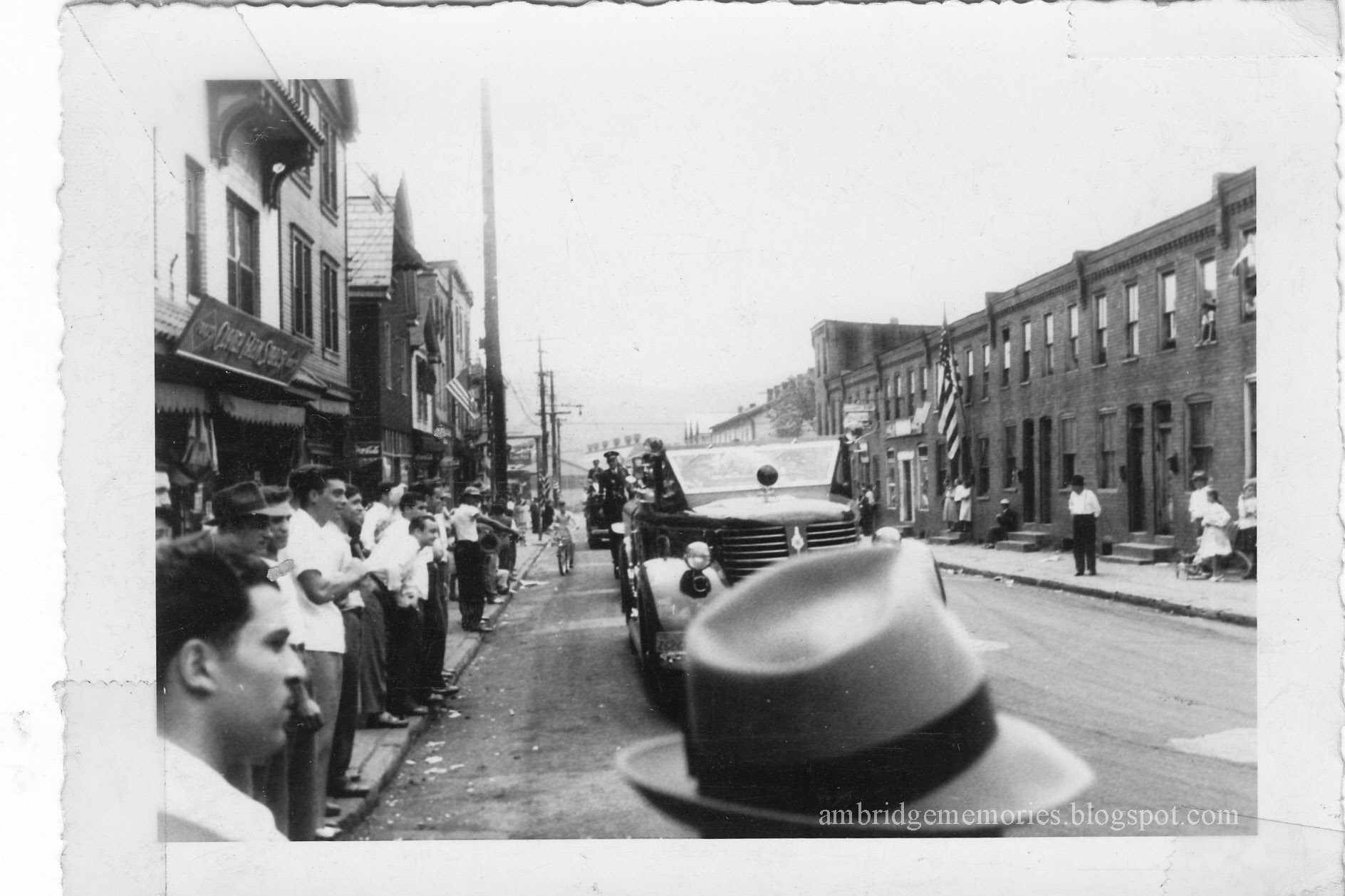
 
Firetruck
parade traveling along the 200 block of First St.
a row of Marshall Alley buildings on right
on left: Grosdeck's Clover Farm Store, 290-292 First St.


8th St. Toppers float
 making the turn from First St. onto Merchant St.
In background:
Canteen Luncheonette, 300 First St.,
Blossom Grill 296 First St.


Motorcyclist and police cars traveling east on 200 block of First St.
in background at end of street: American Bridge Co.


1916 model car
unidentified driver and passengers
right side: Karas Place, Balkan Restaurant, 291 First St.


Unidentified kilted bagpipers
right side: Karas Place, Balkan Restaurant, 291 First St.


Unidentified Navy flagbearers
200 block First St.
far background, end of street: American Bridge Co.


Conway Airport, Ben Mauro Co. Aviation Division entry
unidentified passenger
200 block First St.
on right: Karas Place, Balkan Restaurant, 291 First St.


Unidentified majorettes
buildings in background: 100, 102, 104, 106 Merchant St.


Taylor's Dairy truck with unidentified clown
200 block First St.
on right: Karas Place, Balkan Restaurant, 291 First St.


Ambridge B.P.O. Elks float
in background: Karas Place, Balkan Restaurant, 291 First St., 
to the right: end units of two rows of Marshall Alley buildings


Unidentified majorettes and drum major
unidentified location


CIO Local 1211 entry
making turn from 200 block First St. onto Merchant St.


Unidentified drum major and majorettes, unidentified spectators
unidentified location


Unidentified majorettes
in background: Karas Place, Balkan Restaurant, 291 First St.


Unidentified color guard and band
200 block First St.


Hot Tamales
representing American Bridge Co. and CIO Local 1270
200 block of First St.


Unidentified rider
Hot Tamales, American Bridge, CIO Local 1270 float
CIO Local 1270 car
on right:
Jimmy's Place, 294 First St.
Blossom Grill, 296 First St. 


Fraternal Order of Eagles 1365
200 block First St.
row of Marshall Alley homes on right


Pittsburgh Mercantile Co. float
on right:
Karas Place, Balkan Restaurant, 291 First St.


Unidentified rider
background: Jimmy's Place, 294 First St.


United Polish Societies entry making turn onto Merchant
On right: Blossom Grill, 296 First St.
buildings on left: on corner: 101 Merchant St.; behind, 303 and 305 First St. 


Unidentified float and revelers 
First and Merchant Sts.
buildings in background: on corner, 100 Merchant St.; behind, 303 and 305 First St.


Unidentified revelers
First and Merchant Sts.
buildings in background: on corner 100 Merchant St.; behind, 303 and 305 First St.
_____

* Not a typo. Patrick Escoto and his father spelled their last names differently.

Saturday, August 18, 2018

Ambridge streetcar #1, 1906

Ambridge's streetcar #1
(possibly January 1) 1906
courtesy John Dunn collection

Why were all these men and children, dressed for cold weather--and way in the back of the left side of the crowd, a horse--gathered in the 400 block of Merchant St. around a streetcar? I assume it must have been an important event. And where were the women? In the streetcar? Not invited? Too busy to come?

While local historian Bill Bowan left some notes on the back of the photo about the area where it was taken, he didn't include an explanation of the reason the group posed with the streetcar, which if you look closely, has a number on the front--"1."

I believe that the photo may show Ambridge's first streetcar on the day it began service. But I have no confirmation of that identification.

The French Point Street Railway Co. made its first run on January 1, 1906, over still unpaved Merchant St.  Going south, the two-car line's route was French Point to 4th St., then west to Maplewood where it turned south again until 1st St., turned east and looped back to Merchant St. for the trip north. (Daily Citizen Trade Area Directory, 1956)

To provide the power to run the system when it began, the operators, rather cleverly I think, temporarily used the boilers and engines still in the former Harmonist laundry building, with the addition of electrical generators and machinery. A permanent power system was planned for the spring of 1906. (Ambridge-Economy Citizen, Dec. 28, 1905)

Future plans for the French Point Street Railway Co. also included:
  • connecting the south end of the French Point line to the Pittsburgh Railways Co. line in Leetsdale, eventually connecting Ambridge with Pittsburgh, and  
  • connecting the north end of Ambridge's line to the Beaver Valley Traction Co. lines in Baden via the newly completed Duss Ave.--once the new steel viaduct over Legionville Hollow was finished. This connection would allow riders to travel between Ambridge and Beaver.

In 1934, the Beaver Valley Traction Co., then operating the streetcars in Ambridge, replaced them with buses. (Daily Citizen, March 31, 1939) The old streetcar tracks on Merchant were covered with blacktop in 1958 (Beaver Valley Times, July 29, 1958), but reappear from time to time during resurfacing.


The area of 5th and Merchant Sts.

The tall building you can see behind the streetcar is the razed Ambridge Savings and Trust Co. building on the northeast corner of Merchant and 5th Sts.

Here's what Bill Bowan's handwritten note on the back of the photo said:
About-1906--Ambridge Pa. Looking North toward 5th St. on Merchant.
Empty Lot on corner became "Regent" Theatre and Goldstein's Clothing Store downstairs.--2nd Flr. Andy Labenz has 12 Bowling Alleys--Duckpins, and Pool Tables. Regent Theatre became "Penn" Theatre. Witmeyers Drugs--became Freymark Drugs. M. Libermans Mens Furnishing Shop became Heberlines Jeweler-Optician and Musical Store--Wm. J. Bowan -73.
Between the occupation by the Regent and Penn Theatres, another theater was in the building eventually built on the southeast corner of 5th and Merchant--the Senate.

Freymark Drugs was at 513 Merchant, so perhaps the building with the ad painted on the side?

Sunday, December 10, 2017

200 block Merchant St., 1915: the mystery of Divine Redeemer's first school--plus a funeral

Vintage photos of Ambridge always excite me, especially if the scene is something I haven't seen before. But it's rare that my first view of a photo stuns me like the photo I'm posting about today did.

On March 31, 2016, this 1915 photo, showing a group of people and what appeared to be a horse-drawn hearse in front of Divine Redeemer Church's property on the west side of the 200 block of Merchant St., was posted on the Good Samaritan Parish Archives' Facebook page.  I had seen the photo before, in the 1956 Divine Redeemer Golden Anniversary book. It is not the photo that's the focus of this blog post, although it's the reason I was so awed by the photo that this post is about.

To better see the details of this photo, or the others in this post, a click or tap should enlarge them.

Divine Redeemer Church Property - 1915
Divine Redeemer Golden Anniversary 1906 - 1956 book

Maria Notarianni, who heads the committee that maintains the Ambridge Roman Catholic churches' archives at Good Samaritan Church, described the photo above on Facebook:
On April 2, 1907, Reverend Joseph A. Pospech was named Pastor of the Slovak Parish under the title of the Divine Redeemer Church in Ambridge. Land was purchased on the 200 block of Merchant St. that included a building that was suitable for a temporary church until the new one was built in 1918. The building can be seen in this 1915 photo where services were held in the basement. (The occasion may have been a funeral as there seems to be a horse-drawn hearse in front of the building.) 
The house in the photo was purchased in 1916 by Fr. Herkel to be used as the rectory.
In 1918 the new church was built to the right of the temporary church building and in 1927, a convent was built where the temporary church building was located. 
But that photo is less than the half if it. Literally, as I found out when I had the privilege of spending an hour in August 2016, with the late Karl Urda, grandson of prominent Ambridge builder and businessman Charles Kristufek, who died in 1943. During my visit, Mr. Urda shared with me several vintage Kristufek family photos, including the panoramic photo below that took my breath away when I saw it.

The photo in the Divine Redeemer Golden Anniversary book was only part of the right half of the panoramic photo!

Funeral, 200 block Merchant St., west side
1915
courtesy Karl Urda

Here's the left side of the panorama that wasn't in the Divine Redeemer Golden Anniversary book:

Left side of panorama
Divine Redeemer funeral
200 block of Merchant St., west side
1915
courtesy Karl Urda

The left side of the panorama shows horse-drawn carriages as far as the eye can see, I think confirming Maria's theory that the scene showed a funeral.

The building near the center of the left-side of the panorama is the First Ward School, built between 1908 and 1910. The school was closed in 1964 and razed soon afterwards.

The panorama also shows the building to the left of the freestanding bell tower, which would have been to the immediate left of where the Divine Redeemer convent later was built.

The story Mr. Urda had to tell about that building was also surprising. He told me that building was the first Divine Redeemer School, built by Charles Kristufek, who at the time was a member of Divine Redeemer, then given to the parish. Mr. Urda said that his grandfather was much criticized for building a school before a church was erected, but Charles Kristufek put a high priority on education, and thought that a school building was more important than where church services were held.

If that information is accurate, that means that the Divine Redeemer School in the old Davis Hotel, 300 Merchant St., which the church bought in 1920, was not Divine Redeemer's first school, as the modern recounting of Divine Redeemer's history says it was.

So far, I've been unable to find more information about the building, except that the 1911 and 1917 Sanborn Insurance maps of Ambridge identify the building as a dwelling, not a school.

In 1960 - 61, Divine Redeemer built a new school to replace the one in the Davis Hotel building. My memory of what was between the First Ward School and the Divine Redeemer convent before the new school was built, on property to the convent's left--or where the building that Mr. Urda said was the first school once stood--is very hazy. I seem to remember an old, derelict building there. We'd have to walk via a narrow walkway between that scary looking building and the convent to get to the old church hall behind the convent. That church hall was razed when the 1961 school was being built.

The building that was to the left of the convent before construction started on the new school apparently did not belong to Divine Redeemer, as one might expect if the building had been Divine Redeemer's first school. The Divine Redeemer School Solemn Blessing and Dedication Program, November 18, 1961, says that when plans for the new school were being finalized in 1960, "the Paul Kernich property, fronting on Merchant Street beside the Convent, was purchased," and the building on the property was razed by parish volunteers.

The razed building on the Kernich property would have stood between the Merchant St. entrance to the new school and Merchant St.

Merchant St. entrance to the former Divine Redeemer School
March 22, 2014
credit: Nancy Knisley

So, the history of the building that Mr. Urda identified as Divine Redeemer's first school, currently remains murky. Is the family story about that building being built as a school for Divine Redeemer true or merely a family legend? Did Divine Redeemer once own that building and later sell it? Did the Kruistufek family once own that property, but allowed the church to use it as a school, then later sold it? At this point, I can't say.

But perhaps, some day, I will be able to find more information about the building. And, maybe even find out whose funeral that might have been in 1915. If so, I'll update this post.
_____

Karl Urda died on March 9, 2017. I'm so grateful that he made time to talk to me and allow me to scan his vintage family photos.

Monday, December 4, 2017

Ambridge memorabilia: National Air Mail Week cacheted envelope, 1938


Ambridge National Air Mail Week postal cover
May 19, 1938

I've added postal cachets to my growing list of "random things I now know something about only because I've been researching Ambridge's history":

This envelope, postmarked May 19, 1938, in Ambridge, was part of a U.S. Postal Service week-long promotion of air mail. I think most of us now assume that mail going any distance travels by air. But not so in 1938, when mail primarily traveled by trucks, trains, and ships. Cross-country or overseas letters could take weeks to arrive at their destination.

The Postmaster General at the time, James Farley, declared May 15 - 21, 1938, "National Air Mail Week" (NAMW) to mark the 20th Anniversary of the first scheduled delivery of mail by plane. All local postmasters were encouraged to create a unique commemorative NAMW “cachet”-- that design on the left side of the envelope--to mark the event. And they were supposed to bring attention to the benefits of air mail. Citizens were urged to send at least one letter by air mail during the NAMW celebration.

May 19, the day of the postmark on the never-mailed envelope above, was the day chosen for special NAMW events. Among the events were one-time-only NAMW plane flights, with planes carrying mail between the many towns celebrating NAMW. Many of those towns didn't have airports, but landing strips for small planes were prepared on local streets and fields.

Ambridge's NAMW cachet, featuring Old Economy Village, was one of an estimated 10,000 that were used in towns across the country. I don't know if a plane landed in Ambridge on May 19, 1938, but I'm going to try to find out. I'll update this post if I find any more information.

Here's a closeup view of the Ambridge cachet:

Ambridge NAMW cachet

Tuesday, November 8, 2016

Morton Chevrolet & KDKA election results ad, 1948

In 1948, the technology that provided election results wasn't as up-to-the-minute as it is today. Voters relied on radios, or their daily papers, to find out the election's outcome.

According to the November 2, 1948, Beaver Valley Times, that evening's KDKA election results radio broadcast would be the 28th anniversary of the first public radio election returns broadcast in Beaver County. Even reporting the election returns on the radio was quite the process back in 1920:
The returns were broadcast by KDKA, Pittsburgh, in its initial regularly-scheduled service and were received by the Daily Times, forerunner of the Beaver County Times, in Beaver.

Reception of the returns was made possible by Walter Barnhart, head of the Barnhart radio and electric store in Beaver, who built and operated the receiving equipment and amplifier used by the newspaper. No loud speakers were available, but Mr. Barnhart devised an amplifier by using a large megaphone loaned by Beaver high school.
...
A large crowd listened to the broadcast at the office of the Daily Times on Third street.
Morton Chevrolet, KDKA election results ad
Daily Citizen
November 1, 1948

1948, the year of the ad above, was also the year of the upset election in which the polls had predicted Republican Thomas E. Dewey would win the presidential election; but the polls were wrong, and Harry S. Truman became president. Truman was famously pictured gleefully holding up the erroneous November 3, 1948, Chicago Daily Tribune, with the large banner headline "Dewey Defeats Truman," and reportedly said, "That ain't the way I heard it."

Even though Dewey won Pennsylvania's presidential vote, the Daily Times reported that Ambridge had voted 2 - 1 for Truman.

Thursday, September 1, 2016

In 1945, a unicorn came to Ambridge

During the first week of September 1945, a traveling exhibit of rare and odd animals came to Ambridge, and the unicorn surely had to be the rarest of all.

An ad for the show featured a beautiful, classic unicorn as depicted in folklore, with a horse-like head and a large horn on its forehead. Wow! And skeptics say they didn't exist. It looks pretty happy too. Of course "It's real. It's alive!!" Who would want to see a fake or dead unicorn?!

Animal Oddities Exhibit ad
Daily Times
September 3, 1945

Although whoever sketched the unicorn for the announcement below, featuring the rare creature, did an awful job! Why, the unicorn almost looks like an ox or bull with a single horn, nose-ring included.

Animal Oddities announcement
Daily Times
September 4, 1945

Still, rest assured, exhibit-goers would see the unicorn of myth. From the announcement:
Among the unique animals to be shown is the Unicorn, which dates back to the wanderings of the barbaric tribes before civilization. The single-horned animal, shown here, is greatly sought after for its wonderous powers of magic and medicinal values. The miraculous horn is always described as growing on the brow of a "beast so glorious, so virtuous, so beautiful that heaven granted the earth only one specimen at a time."

Now would an ox or bull fit that description? No!

Although there was only one unicorn on earth in September 1945, if you came to the field at 17th and Merchant Sts. in Ambridge, you could see it! Only 25¢ (plus tax) for adults; 10¢ (plus tax) for kids!

If the magical unicorn wasn't enough, there were 100 more "living curiosities" in the exhibit, including Belgian Bob, the world's largest living horse.  And Nebcurhah, "The 3000-year-old man from the Valley of the Kings in Egypt." No mention of he was still living or not.

Animal Oddities Exhibit ad
Daily Times
September 6, 1945

Lest you think that the ads might be making stuff up about the animals in the exhibit, here's  a photo of Lone Star, the world's largest living steer.

Lone Star
World's Largest Living Steer
Daily Times
September 5, 1945

The text under the photos said:
Beaver Countians will have the opportunity of viewing, "Lone Star" (pictured above) world's largest living steer, 9 feet tall and weighing around 3,000 pounds, showing with "Animal Oddities" exhibit, on transcontinental tour with the earth's strangest living oddities, now located on the showgrounds at 17th and Merchant streets, Ambridge.
   This unusual exhibit is on display through Sunday, September 9th in a large tent, and included in the oddities is the world's largest living horse measuring 19 1/2 hands, along with 100 other rare animals.
   Included in the exhibit are strange animals featured in "Believe It or Not", by Robert Ripley.
Surely, if Lone Star was that big, the unicorn was real!

Wednesday, July 6, 2016

Golden Jubilee: The Battle of Borough Park

Last summer, I started a series of posts about Ambridge's 1955 Golden Jubilee. I was just about done, with only the final day of the celebration to write about. And I left the last post I wrote, about the historical pageant "Frontiers of Freedom," with a cliffhanger:
The Golden Jubilee wasn't over yet. Monday, July 4, was "Armed Forces" Day, featuring a "Mock Battle" in Borough Park. Eighty members of the National Guard would shoot 7,000 to 10,000 rounds of blank ammo, and dynamite charges were to be placed to simulate mine explosions and cannon fire. What could go wrong with that?
And there I left readers hanging because I got distracted by another topic, "Oh, look, Davidson's once had two stores!" And then another, "I have the names of the boys at the Greek Coffee House!" And...now here it is a year later, and it's really about time to wrap up the Golden Jubilee series with the events on July 4. And just as the celebration began with a bang, it ended with one too.

Armed Forces Day, as with most of the Jubilee celebration, was packed with activities: an Armed Forces Exhibit; guided tours of Old Economy; the final judging of the Brothers of the Brush beards, the Sisters of the Swish costumes, and the talent hunt; the final performance of "Frontiers of Freedom," capped with fireworks. Oh, and that mock battle in Borough Park,* scheduled for 2 P.M., which the June 29, 1955, Beaver Valley Times anticipated would involve "plenty" of shooting and land mine explosions.

The July 5, 1955, Beaver Valley Times reported that about 1,000 spectators watched the battle involving Company B of the Infantry Battalion, Pennsylvania National Guard. The object of the battle was for the attacking force to cross the park's baseball field to take the hill on the opposite side, held by 10 men. At intervals during the battle, previously placed charges were set off. It must've been quite a show.

I never found any mention of which side of the battle was victorious.

Machine gunners
mock battle at Borough Park
July 4, 1955
Beaver Valley Times
July 5, 1955

Times caption:
DEFENDERS -- Machinegunners of the 110th Infantry Battalion, Pennsylvania National Guard, New Brighton, defend a hill in their mock battle in Ambridge Borough Park Monday. The demonstration was a part of Ambridge Golden Jubilee.
The article noted that "A Beaver County Civil Defense first aid team stood in readiness," along with fire trucks from Ambridge and Harmony Township. It pays to be prepared.
Sgt. Edward Harker, 12th Marine Division, Pittsburgh, put on a flame-thrower demonstration after the battle.
Sgt. Harker was "wounded" when the wind shifted, sending the flame back at him. He suffered first degree burns of his right hand and wrist and minor burns of his arm and face. 
Members of the Civil Defense first aid unit treated the sergeant.
After all that excitement, the fireworks that ended the Jubilee might have felt rather low-key and on the quiet side.

If you want to read the previous posts in the Golden Jubilee series, here are links:

The human pirohy

The Big Train Robbery

Brothers of the Brush, Sisters of the Swish

Let the celebration begin!

Old Fashioned Bargain Days

Old Fashioned Bargain Days ads

The "mammoth spectacle" parade

Golden Jubilee Program

"Frontiers of Freedom"

Ambridge trivia: Did you know...? #8

_____

* Now called Walter Panek Park

Tuesday, July 5, 2016

Ambridge trivia: Did you know...? #8 Wooden coins

For Ambridge's 1955 Golden Jubilee, merchants handed out not just wooden nickles, but also wooden dimes and quarters.

I've never seen one of the Golden Jubilee wooden dimes or quarters, have you?

Examining wooden coins
Ambridge Golden Jubilee
Beaver Valley Times
June 22, 1955

Times caption:
WOODEN NICKELS INITIATED -- W. L. Cain, president of Ambridge Economy Bank, and Kay Kokoski, "Miss Ambridge Golden Jubilee" who is a teller in the bank, examine wooden coins, official money of Ambridge Golden Jubilee. The money will be handed out by merchants in the form of change. It is redeemable in Ambridge, Economy and Mellon National Banks. It comes in three denominations, nickles, which are red; dimes, which are blue, and quarters, which are green.
A photo of a Golden Jubilee Wooden Nickel is in the July 17, 2015, post "Golden Jubilee: Old Fashioned Bargain Days."

Tuesday, June 7, 2016

Economy's Grand Historic Pageant, the Centennial Parade, June 7, 1924

Economy Centennial Celebration postcard, front
1924
Economy Centennial Celebration postcard, back
1924

The former village of Economy, established by the Harmony Society in 1824, later absorbed into the borough of Ambridge, celebrated its centennial from Friday, June 6 through Sunday, June 8, 1924. The weekend was full of ceremony and entertainment, but the Grand Historic Pageant--also known as a parade--probably was the most attended event.

According to the Centennial Program, the Saturday, June 7, parade was scheduled to begin at 2:30 P.M. on Park Rd., turn east on 1st Street, turn north on Merchant, march to French Point, then proceed to Ohioview Ave., 12th St., Church St, 11th St., Melrose, and finish on 10th St. Since many of the photos below were taken on Maplewood Ave. at 8th St., I'm not sure how accurate that description of the planned route turned out to be.

The June 9 Ambridge Citizen proclaimed the parade, "The greatest spectacle in the history of Beaver County."

The Citizen reported:
As the great procession held in connection with the Economy Centennial passed before the vast throngs that had gathered from far and wide records were being established that placed Ambridge at the very pinnacle in the county chronicles. For size, for originality, for picturesqueness, for beauty, for historical value, the Ambridge pageant and parade surpassed anything that had ever before been attempted in this valley. Over 2,500 persons and over 200 autos and floats formed a procession about three miles long, requiring 45 minutes to pass a given point.
...
The background for the paraders formed a great sight itself. The brightly decorated buildings, with every available window, nook and corner filled with people; many roofs filled with daring spectators, the line of parade on both sides massed with 40,000 people from various parts of the country; every accessible, vacant, lot, filled with automobiles parked during the procession; the Legion's avenue of flags and the American colors everywhere, the town was veritably a mass of color and humanity.

The Citizen said that after the parade had passed, "It required over an hour for the crowds to disperse from Merchant street [sic]."

The parade's tremendous success may have surprised former Harmony Society trustee John S. Duss. When the plans for the Centennial's events, including the ambitious ideas for the parade were discussed in December 1923, the Daily Times reported, "It is the opinion of Mr. Duss, however, that the time is too short to adequately stage such a pageant."

Only a few of the parade photos I've found identify the scene shown, so I tried to match the Citizen's and Centennial program's descriptions with the unidentified photos and to put the photos in order of their appearance in the parade. None of the original photographers for any of the photographs are identified.

The parade was organized into four divisions.

Division A had the Ambridge Police Force; three Legion color bearers (J. R. Armington, Walter Shephard, and Victor Pate); a car with Centennial President John T. Jessen and three women from "the Old Folks Home"; and a float of Uncle Sam and Columbia.

The Citizen said Ambridge Police "Chief P. J. Caul and his force of six" marched. So this may be them; the uniforms look like theirs, but I'd like to confirm that identification:

Ambridge police force?
Economy Centennial Parade
8th St. and Maplewood Ave.
June 7, 1924
courtesy Beaver County Genealogy and History Center

This must be, without a doubt, the "Uncle Sam and Columbia" float. The Citizen identified R. K. Smith as Uncle Sam and Miss Janet Bianchi as Columbia. The location where the photo was taken doesn't look familiar to me. Any ideas?

Uncle Sam and Columbia float
Economy Centennial Parade
June 7, 1924
courtesy Beaver County Genealogy and History Center

Division B represented the area's early history, 1784 - 1824. The Citizen described this division: "Every important event that history records for this section was shown and noted in order of their happenings."

The photo below must be from that division. The photo is very faded, but there's a man in a colonial uniform plus an Indian wearing a headdress on the float. The Centennial program lists the floats in this group. Could the float in front be "Conrad Wersser [sic] raising the British flag at Logstown in presence of the English trader Geo. Croghan and a group of Indians"? (Conrad Weiser was the colonial ambassador to the Indians.) Or perhaps, "George Washington in 1753 in conference with Sachems of the Six Nations, at Logstown"?

"Early history" floats
Economy Centennial Parade
June 7, 1924
courtesy Beaver County Genealogy and History Center

The Citizen mentioned one colonial rider on horseback: General Anthony Wayne portrayed by Dr. C. R. Bonzo. Maybe the below photo shows him.

General Anthony Wayne ?
Economy Centennial Parade
8th St. and Maplewood Ave.
June 7, 1924
courtesy Beaver County Genealogy and History Center

The parade's Division C was the Harmony Society era in Economy, featuring floats depicting daily Harmonist life.

Harmony Society haymakers float
Economy Centennial Parade
8th St. and Maplewood Ave.
June 7, 1924
courtesy Beaver County Genealogy and History Center

The 1826 Economite fire engine was borrowed from the Carnegie Museum for the occasion.

Economite fire engine
Economy Centennial Parade
June 7, 1924
courtesy Borough of Ambridge

Mrs. John S. Duss, one of the last trustees of the Harmony Society, and John Duss, Jr. rode in the Duss coach.

Coach carrying Mrs. John Duss and John Duss, Jr.
Economy Centennial Parade
June 7, 1924
courtesy Borough of Ambridge 

Division D was the "Modern Ambridge" section, with Ambridge officials followed by bands, floats, decorated trucks, and marchers from schools, organizations, industries, and businesses.

Several local fire departments participated in the parade, but only one had a name ending in "sdale" as shown on the truck in the photo below, Leetsdale.

Leetsdale Vol. FD firetruck and firefighters
Economy Centennial Parade
8th St. and Maplewood Ave.
June 7, 1924
courtesy Beaver County Genealogy and History Center

The next photo may be Ambridge's Hook and Ladder Co., No. 1. While this photo is unidentified, the fire truck looks very much like Hook and Ladder Co. No. 1's in a photo in the Centennial program.

Ambridge Hook and Ladder Co. No. 1 ?
Economy Centennial Parade
8th St. and Maplewood Ave.
June 7, 1924
courtesy Beaver County Genealogy and History Center

The Kemena Lumber Co., located at 10th and Merchant Sts. in 1924, built a tiny house on their float, "complete in every detail, even to the gardens and lawn in front of the porch on which sat little Virginia and Frank McCabe," said the Citizen.

Kemena Lumber Co. float
Economy Centennial Parade
8th St. and Maplewood Ave.
June 7, 1924
courtesy Beaver County Genealogy and History Center

According to the Citizen, the American Bridge Co. float "represented a railroad bridge span, complete in every detail."

American Bridge Company float
Economy Centennial Parade
June 7, 1924
courtesy Borough of Ambridge

I can't even guess at the identity of this band, one of a number of local bands that marched. Nor can I identify the street shown. Does the street look familiar to anyone?

Band (unidentified)
Economy Centennial Parade
June 7, 1924
courtesy Beaver County Genealogy and History Center

The Citizen described the Ambridge Woman's Club float as decorated with 5,000 Richmond roses and said the women riding on the float represented the club's activities: "Alberta Budd represented the Spirit of Woman's Club; Zilpha Miller, the nurse; Dorothy Kelley, an injured child; Mary Bittinger and Betty Fitzgerald, the library; and Mildred Schermerhorn, health. Mrs. Thos. D. Norris drove the float."

I'm still trying to identify the building behind the float. The brick street narrows down the location a bit to "not Merchant St.," and the trolley tracks should narrow it further. Perhaps Park Rd. or 1st St.?

Ambridge Woman's Club float
Economy Centennial Parade
June 7, 1924
courtesy Borough of Ambridge

The list of Ambridge organizations participating in the parade was extensive. The photo below shows the Patriotic Order Sons of America.

Patriotic Order Sons of America
Economy Centennial Parade
June 7, 1924
courtesy Beaver County Genealogy and History Center

The Citizen says the Loyal Order of Moose float: "decorated in lavender and white, represented Mooseheart and Moose Haven homes; the former by a number of children and the latter, an elderly couple at a desk." The scene was shot at the Moose Palace building, formerly at the northeast corner of 13th and Merchant Sts., destroyed by a fire in 1937.

Loyal Order of Moose float
Economy Centennial Parade
Moose Palace, 13th and Merchant Sts.
June 7, 1924
courtesy of Lorianne Stangl Burgess

According to the Citizen, 400 students of St. Stanislaus parochial school "marched in the formation of the American flag." The children in the flag's staff wore yellow hats; those in the stripes wore red and white hats; and those in the canton (the rectangle with the stars) wore blue and white hats. The photo below might show some of the students.

St. Stanislaus parochial school children?
Economy Centennial Parade
8th St. and Maplewood Ave.
June 7, 1924
courtesy Beaver County Genealogy and History Center 

I have no idea who this group of girls carrying U.S. flags represented.

Girls with U. S. flags
Economy Centennial Parade
8th St. and Maplewood Ave.
June 7, 1924
courtesy Beaver County Genealogy and History Center 

The Ambridge Savings and Trust Co. float "represented its Liberty Bell savings accounts, with Miss Liberty (Miss [name unreadable]) sitting by the Liberty Bell," the Citizen said.

Ambridge Savings and Trust float
Economy Centennial Parade
8th St. and Maplewood Ave.
June 7, 1924
courtesy Beaver County Genealogy and History Center 

The Citizen reported, "The Ukrainian Nationality of Ambridge had a large turnout."

Ukrainian Nationality of Ambridge marchers
Economy Centennial Parade
8th St. and Maplewood Ave.
June 7, 1924
courtesy Beaver County Genealogy and History Center 

The Citizen described the J. M. Breen's Furniture float as "a bower of ferns and palms" and playing the role of a newly married couple who furnished their home at Breen's were Virginia Goerman and William Goerman.

Breen's Furniture float
Economy Centennial Parade
June 7, 1924
courtesy Beaver County Genealogy and History Center

I wish I had photos of some of the other business participants' entries like the Briola Brothers ice plant's truck "loaded with large cakes of ice, in which had been frozen fish and fruit." Or the Ambridge-Economy Bottling Works truck which dispensed free pop.

Be on the lookout for memorabilia from the Economy Centennial parade. The Citizen noted, "Most of the business firms represented in the parade threw souvenirs of all descriptions all along the route of the parade."

Update: Sept. 29, 2016

More parade photos!

First, four photos from the Old Economy Village Archives:

Father Rapp's coach was borrowed from the Carnegie Museum for the occasion. It would have been at the beginning of the Harmony Society section of the parade. According to the Ambridge Citizen, 18 men in silk coats and high hats formed the guard of honor.

Father Rapp's coach
Economy Centennial Parade
June 7, 1924
Old Economy Village Archives


Float depicting Harmony Society Women spinning
Economy Centennial Parade
June 7, 1924
Old Economy Village Archives

The Citizen reported, "The old Economy milk wagon with the daily bulletin, announced the loss of a 'hen with red band on left leg.'"

Economy milk wagon with daily bulletin
Economy Centennial Parade
June 7, 1924
Old Economy Village Archives

Another photo of the Economy haymakers float:

Economy haymakers float
Economy Centennial Parade
June 7, 1924
Old Economy Village Archives

Two photos belonged to the late Eddie Dzubak, Sr. and are posted courtesy of his children, Lesabeth Trzcianka and Eddie Dzubak, Jr. :

The Knights of Columbus contingent had 65 (85? hard to read microfilm) marchers as well as a float showing the landing of Columbus.

Knights of Columbus
Ambridge Council No. 1780
Economy Centennial Parade
June 7, 1924
Eddie Dzubak, Sr. Collection

The Citizen reported that "St. Michael's Russian Society had 70 members in line."

Beneficial Russian Society of St. Michael of Ambridge
No. 121 of R.B.O.
Economy Centennial Parade
June 7, 1924
Eddie Dzubak, Sr. Collection

The final new photo, published in the August 25, 1954, Ambridge Daily Citizen, shows some of the crowd watching the Economy Centennial parade at 4th and Merchant Sts. and provides a view of some of the east side of the 400 block of Merchant. Look at the men hanging on the utility pole on the far left!:

Wagons and floats
Economy Centennial Parade
4th and Merchant Sts.
Daily Citizen
August 25, 1954

Daily Citizen caption:
Pictured above is one of the original United Dairy white horse and single wagons which participated in the Economite Centennial Parade during the summer of 1924. The picture was taken at 4th and Merchant Sts.
_____

Many of the photos above credited to the Beaver County Genealogy and History Center were taken at the intersection of Maplewood Ave. and 8th St. The brick house with front porch in the background is still there, now the Anglican Church in North America Provincial Office, 800 Maplewood. The porch is now enclosed. The large three-story building behind the house is the Ambridge Hotel, Merchant St., built in 1905, razed in 1964.

As big and grand as the Economy Grand Historic Pageant may have been, Ambridge's Golden Jubilee parade, described as a "mammoth spectacle", held in 1955, topped it in number of units and length.