Showing posts with label cars. Show all posts

Saturday, July 31, 2021

Ambridge parade on First St. 1955

Ambridge Golden Jubilee's Miss Greater Ambridge, Helen Witek
National Electric float
intersection First and Merchant Sts.
background: Karas Place, Balkan Restaurant, 291 First St.

Patrick Escoto* let me scan some photos that belonged to his late father, Phillip "Pippy" Escote.* Among the photos were some from a parade along what I recognized as Ambridge's First St. before the the neighborhood was razed, beginning with the Marshall Alley buildings in the mid-1950s, then more extensively in the early 1970s, when the entire area was cleared for redevelopment. 

The photos didn't give the date of the parade, or identify the parade participants or the spectators.

However, I am pretty certain that the photos were of Ambridge's Golden Jubilee parade on July 2, 1955, even though I haven't been able to find photos showing the same participants in the news photos of the parade that Ambridge's Daily Citizen called "a massive spectacle."

My best clue so far that these photos are of the Golden Jubilee parade is the Miss Greater Ambridge parade float above, on which Helen Witek, who was chosen for that honor as part of Ambridge's Golden Jubilee celebration, was riding with her court.

None of the different majorette or drum major uniforms in any of the photos match the ones worn at Ambridge High School in the mid-1950s according to photos in the 1954, '55, or '56 Bridger yearbooks. But there were many many marching units in the parade. Recognize anyone?

The very long parade was staged along the 100 and 200 blocks of First St., and then north on Park Rd. But the parade officially started at the intersection of First and Merchant Sts., which once began between the 200 and 300 blocks of First St. So the lucky residents of First St. got to see the parade before those watching elsewhere in Ambridge did.

If you can provide identifying information (people, float sponsors, businesses), or memories of the parade traveling up First St., please leave a comment.

Here are the rest of the Escoto parade photos in no particular order:

All photos in this post are courtesy of Patrick Escoto.
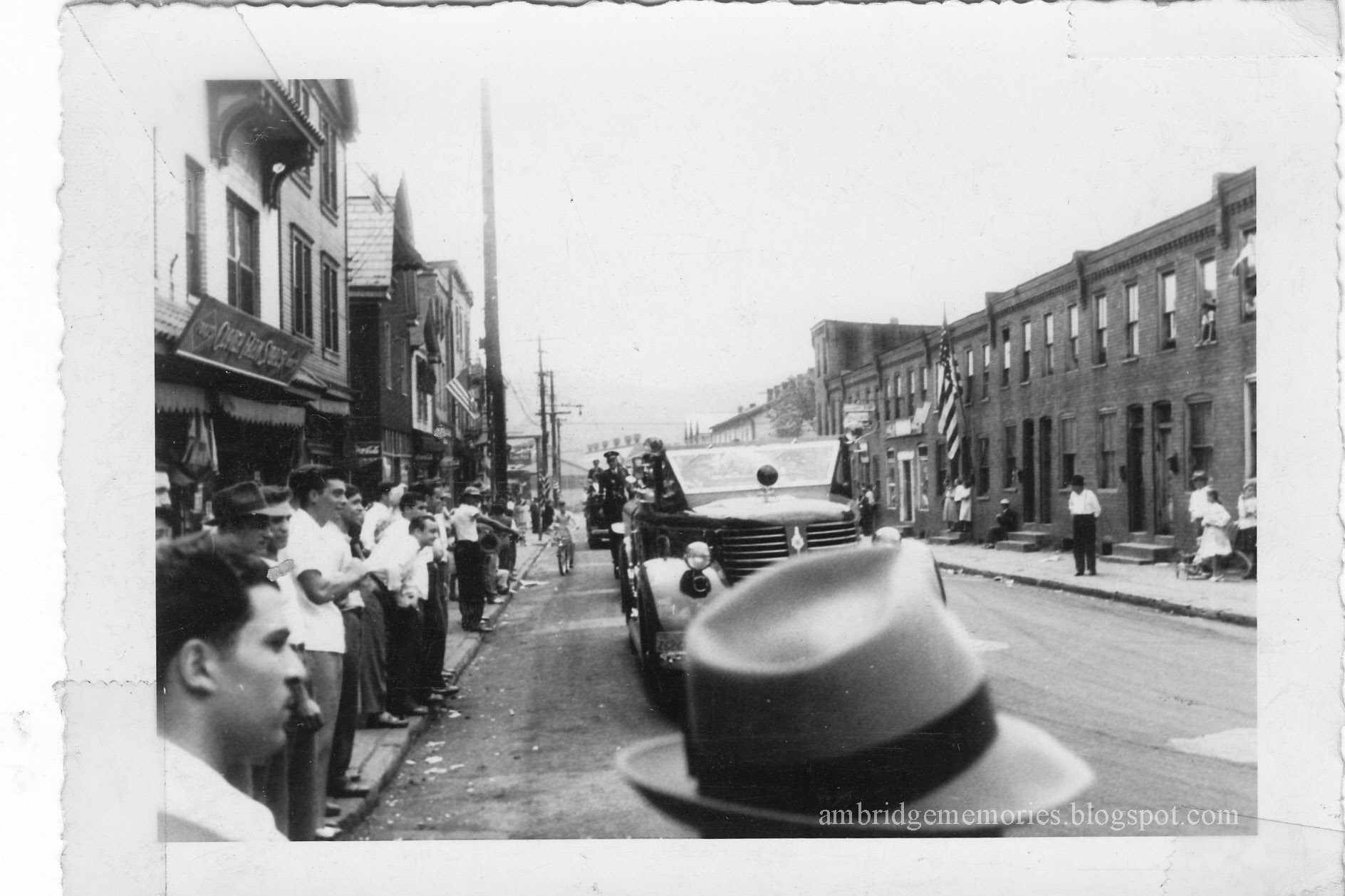
 
Firetruck
parade traveling along the 200 block of First St.
a row of Marshall Alley buildings on right
on left: Grosdeck's Clover Farm Store, 290-292 First St.


8th St. Toppers float
 making the turn from First St. onto Merchant St.
In background:
Canteen Luncheonette, 300 First St.,
Blossom Grill 296 First St.


Motorcyclist and police cars traveling east on 200 block of First St.
in background at end of street: American Bridge Co.


1916 model car
unidentified driver and passengers
right side: Karas Place, Balkan Restaurant, 291 First St.


Unidentified kilted bagpipers
right side: Karas Place, Balkan Restaurant, 291 First St.


Unidentified Navy flagbearers
200 block First St.
far background, end of street: American Bridge Co.


Conway Airport, Ben Mauro Co. Aviation Division entry
unidentified passenger
200 block First St.
on right: Karas Place, Balkan Restaurant, 291 First St.


Unidentified majorettes
buildings in background: 100, 102, 104, 106 Merchant St.


Taylor's Dairy truck with unidentified clown
200 block First St.
on right: Karas Place, Balkan Restaurant, 291 First St.


Ambridge B.P.O. Elks float
in background: Karas Place, Balkan Restaurant, 291 First St., 
to the right: end units of two rows of Marshall Alley buildings


Unidentified majorettes and drum major
unidentified location


CIO Local 1211 entry
making turn from 200 block First St. onto Merchant St.


Unidentified drum major and majorettes, unidentified spectators
unidentified location


Unidentified majorettes
in background: Karas Place, Balkan Restaurant, 291 First St.


Unidentified color guard and band
200 block First St.


Hot Tamales
representing American Bridge Co. and CIO Local 1270
200 block of First St.


Unidentified rider
Hot Tamales, American Bridge, CIO Local 1270 float
CIO Local 1270 car
on right:
Jimmy's Place, 294 First St.
Blossom Grill, 296 First St. 


Fraternal Order of Eagles 1365
200 block First St.
row of Marshall Alley homes on right


Pittsburgh Mercantile Co. float
on right:
Karas Place, Balkan Restaurant, 291 First St.


Unidentified rider
background: Jimmy's Place, 294 First St.


United Polish Societies entry making turn onto Merchant
On right: Blossom Grill, 296 First St.
buildings on left: on corner: 101 Merchant St.; behind, 303 and 305 First St. 


Unidentified float and revelers 
First and Merchant Sts.
buildings in background: on corner, 100 Merchant St.; behind, 303 and 305 First St.


Unidentified revelers
First and Merchant Sts.
buildings in background: on corner 100 Merchant St.; behind, 303 and 305 First St.
_____

* Not a typo. Patrick Escoto and his father spelled their last names differently.

Monday, October 21, 2019

Vintage cars, 6th St. and Duss Ave. circa late 1920s. And an intriguing corner in the corner

"2 Packards-1 Franklin East Corner 6th & Duss Ambridge"
circa late 1920s
Laughlin Memorial Library archives

Sometimes, when doing historical research, I find unexpected details that lead me in unexpected directions. And the photo above led to one of those times.

I don't know much about this particular photo other than the information that the late local historian Bill Bowan wrote at its bottom. "Early 20's - 2 Packards-1-Franklin East Cor 6th & Duss Ambridge." I don't know the identities of the people in the photo. I don't know why the three cars are parked where they were. And I don't know how Bowan came to own the photo.

And because I know so little, I thought I just would post the photo, say something about the photo's location, and that would be that.

"That" didn't turn out to be "that," but here's what I know about the location:

The houses in the photo's background look like 600 and 602 Beaver Rd. which are still there, so the photo was taken looking east. While 600 Beaver Rd. is on the 1923 Sanborn Insurance map, 602 is not. So I began to question the "Early 20's" date Bowan had written on the photo.

Maria Notarriani told me that the 602 Beaver Rd. house was built in 1926 according to Beaver County tax assessment records, so 10 years after the house at 600 Beaver was built:1916.

So the photo must have been taken later than the "early 1920's." Perhaps the late '20s?

Photos are often misdated--sometimes by a month or two, sometimes by many years. And I didn't believe the the date was critical to the history of the photo. So, blog post finished! But no.

Because while looking at the building on the left side of the photo, I had noticed that its Duss Ave. side slanted upward, and rather steeply too. While the left lower corner of the photo is both faded and out-of-focus, the incline of that corner building's ground floor is obvious. Hmm. Interesting. And me being me, I couldn't just ignore that.

Which leads me to ask: Does anyone have any information on the grading of the 600 block of Duss and/or the histories of the buildings on the east side of that block, especially the buildings closest to the Duss and 6th St. intersection?

Because at the time the vintage photo at the top of this post was taken, the 600 block of Duss Ave. sure wasn't as level as it is today:

600 block of Duss Ave. looking North
Google Street View
August 2011

And I've always wondered why the ground level of some of the buildings in the 600 block of  Duss, especially those closest to 6th St., looked odd, like they perhaps weren't built at the same time as the upper floors. Consider:

This is what the building on the corner of 6th and Duss, 600 Duss, currently looks like. Although it looks quite changed from the building on the left of the photo at the top of this post, tax records say it was built in 1920, so it must be the same building.

600 Duss Ave.
Google Street View
August 2011

The odd ground floors are especially evident in these buildings:

Left: Ross Auto Body, 606 Duss Ave.
Right: Filipino American Club of Ambridge (formerly Sons of Italy Lodge), 604 Duss Ave.*
Google Street View August 2016

Tax records also show that 603 Beaver Rd.,* the street address used by the Sons of Italy Lodge, was built in 1915. The 606 Duss building was built in 1920 according to tax records, although the 1923 Sanborn Insurance map only shows an empty lot on Duss at that site. (The map does show a building on Beaver Rd. that currently would abut, or connect to, the rear of 606 Duss.)

So the evidence seems to point to two possibilities: the buildings' current Duss Ave. ground floors were once below-ground basements; or newly constructed ground floors were added after that part of Duss was graded. Well, I guess there's a third possibility: the buildings' owners just wanted an unusual facade on the lower floor.

One other oddity about the 600 block of Duss that may be related to grading: while the houses on both sides of the street abut the sidewalk, those on the east (even-numbered) side have a raised porch with the entrance to the house about a floor above the sidewalk. While on the west (odd-numbered) side, the buildings' porches/entries are basically level with the sidewalk. That suggests to me that when the even-numbered homes were built, they were located on a hill; then later, the base of that hill was removed, and the bottoms of the porches were extended down to street level. But I'm not wedded to that theory.

I previously wrote about a vintage photo of 5th St. and Duss Ave. being graded, but I was unable to determine when that grading was done, except that the photo was taken between 1919 and 1928. I also don't know how much of Duss was graded then. So I don't know at this time whether the grading shown in that photo was related to any grading done in the 600 block.
_____

* When the building at 604 Duss was the Sons of Italy Lodge, it used the address 603 Beaver Rd., where there was a more formal entrance. The Filipino American Club, now located in the same building, gives its address as 603 Duss Ave., not 604, even though it's on the east, even-numbered side of Duss Ave.

I expect that one day someone is going to wonder why a building on the even-numbered side of Duss has an odd-numbered address. Just like I once wondered why the former Sokol at 424 Duss has an even-numbered address even though it's on the odd-numbered side of the street. Turns out the reason is that the original address of the Sokol building was 424 Melrose Ave. Later, in 1951, a large second floor social hall, entered on Duss, was added. 

Sunday, September 22, 2019

Ambridge's Hupmobile Garage

Ambridge Central Garage
Hupmobile Sales - Service
901 Glenwood Ave.
Daily Citizen
Aug. 25, 1954

Daily Citizen
caption:
THE "HUPMOBILE" GARAGE at 9th and Glenwood Ave., Ambridge. It is now L & S Auto Shop. Note the "Hupmobile" ready for action. 
The Daily Citizen didn't provide the date the Hupmobile Garage photo was taken, but Ambridge Central Garage was listed as a Hupmobile dealer in the April 7, 1929, Pittsburgh Press.

The Central Garage building is still standing. Until recently, it was the location of Kal's Body Shop. It looks like the building is currently unoccupied and for sale.

901 Glenwood Ave.
March 27, 2014
credit: Nancy Knisley

Tuesday, September 3, 2019

T. C. Pearce, Funeral Director, 1929

T. C. Pearce, Funeral Director
1200 Merchant St.
ad
Daily Citizen
August 10, 1929

Everything I know about T. C. Pearce, Funeral Director, is in this 1929 ad. If you know anything about Pearce or his business, please leave a comment.

1200 Merchant St. is still standing. According to Beaver County property records, the building was built in 1914. For many years it was the location of an insurance agency. I don't know who occupies the building now.

1200 Merchant St.
Aug. 19, 2017
credit: Nancy Knisley

Thursday, June 22, 2017

Luce Hardware & Supply, Metz 22 ad, 1912

I really like vintage newspaper ads and am especially delighted when I find something unexpected--like Ambridge's Luce Hardware and Supply Co.'s 1912 ad for a Metz 22 car. Imagine going to your local Do It Best for some picture hooks, potting soil, and a new car.

Luce Hardware & Supply Co. ad for the Metz 22
Daily Times
March 28, 1912

The advertised 28 - 32 MPG isn't bad, but that "100 miles on a pint of lubricating oil" is a bit of a negative. On the plus side, the Metz 22's guaranteed hill-climbing performance would be a real asset in Ambridge.

As far as I know, Luce Hardware & Supply Co. opened in 1905. I don't know when it closed. I also don't have a street address.

Wednesday, May 18, 2016

Miss America visits Ambridge, 1927

In 1927, Miss America visited Ambridge. In the photo below, taken at the Mackintosh-Craven Garage, Miss America is on the right. Her companion was Miss Ambridge, Stella Fallieras Bellas. The Maple Restaurant's Tom Pappas told me that Stella Bellas, his great-aunt, was the first Miss Ambridge.

Stella Fallieras Bellas and Miss America
in front of Mackintosh-Craven Garage
300 block of Merchant St.
 April 1927
Laughlin Memorial Library archives

The August 15, 1983, Beaver County Times had a "Looking Back" article about this photo. The article said that during a 1927 nationwide tour, Miss America stopped in Ambridge for the I.O.O.F. (Odd Fellows) follies and a merchants' promotion.

Although the Times article said the Miss America in the photo was either 1926's Norma Smallwood, Miss Tulsa, or 1927's Lois Delander (misspelled Delaner in the article), I believe it must be Miss Smallwood, since the Miss America Pageant was held in September, so the 1927 Miss America wouldn't have been crowned yet.

The Times article said that the photo was taken during the summer of 1927. However, another photo of the two women, obviously taken during the same visit, is marked April 1927:

Miss America and Stella Fallieras Bellas
Ambridge Country Club?
April 19?, 1927
Laughlin Memorial Library archives

I think the women's clothing is more appropriate for April than the summer, so I'm inclined to think the April date is accurate.

According to the Times article, the garage provided the Buick in the photo for Miss America to use during her visit.

Here's a better view of the car parked at the Ambridge Country Club. The sign in the window says "Miss America, I.O.O.F. Follies."

Miss America and Stella Fallieras Bellas (in car)
Ambridge County Club
April 1927
Laughlin Memorial Library archives

The garage building is still standing in Ambridge, but much altered. Many may remember it as the former Taylor's Dairy building. Currently, the building is the location of Creekside Springs bottled water company.

Taylor's Dairy
Intersection of Duss Ave. and Merchant St.
Beaver Valley Times
February 13, 1954

Sunday, December 20, 2015

Christmas lights, Merchant St. 1960

This is the 500 block of Merchant Street at night in December, 1960, looking north towards 6th St.: a canopy of big, colorful Christmas lights, lighted wreaths with bells, brightly lit stores open for evening shopping, and parking spaces crowded with shoppers' cars.

Christmas lights
500 block of Merchant St.
Beaver County Times
December 8, 1960

Times caption:
AMBRIDGE AT NIGHT -- The Christmas spirit prevades (sic) downtown Ambridge this holiday season with the colorful lights spreading a warm glow over the community's business section.

On the left hand side of the photo, you can see the lighted sign for Fashion Hosiery, 551 Merchant. Beyond that, the store with the huge lighted window was G. C. Murphy, 561-565 Merchant. Further north, there's the S & S Shoes sign, 599 Merchant.

On the right, the sign with "JE" was Krauss Jewelers, 546 Merchant.

Tuesday, May 19, 2015

Auburn, Hudson, Essex, Marmon, Graham Brothers Trucks: ads

These ads for long-gone businesses selling long-gone brands of cars and trucks came from a photocopy of pages from a 1925 Ambridge City Directory in the Laughlin Memorial Library's archives:


Auburn Automobiles were produced from 1900-1936.


Hudsons were produced from 1909-1954. Towards the end of their brand-life, they were part of AMC.

Essex cars were produced from 1918-1932, from '22-'32 by Hudson.


Studebakers were produced from 1902-1966.

Marmon Cars, which introduced rear-view mirrors as standard equipment, were produced from 1902-1933.

Mack Trucks which began in 1907, are, of course, still made.


Dodge Brothers Cars were produced from 1915-1935, towards the end by Chrysler. Eventually "Brothers" was dropped from the name, and Chrysler still produces Dodges.

Graham Brothers Trucks, once part of Dodge Brothers, were produced from 1919-1929 when they became Dodge trucks.

Sunday, May 4, 2014

Merchant Street: 500 block, late 1960s?

500 block of Merchant Street, Ambridge
late 1960s?
photo courtesy of Betty Lazorisak, used with permission

The photo above shows the 500 block of Merchant Street looking north. The exact year of the photo is unknown, but the Mustang parked in front of Paul's Bakery puts it no earlier than the mid-1960s. The Christmas decorations on the light poles means the photo was taken before or just after Christmas.

The parking spaces are mostly filled, but there are only a few pedestrians in the photo, which seems odd for Ambridge at that time.

I couldn't see all of the businesses' signs in the photo, so I haven't been able to identify them all, but I see:

On the left, which is the west, odd numbered side of Merchant:

Paul's Bakery, 511 Merchant Street
Ambridge Army & Navy Store, 517 Merchant Street
Altmeyer's, 519-523 Merchant Street
Anderson's Candy, 529 Merchant Street
Georgann's Tots N' Teens, 537 Merchant Street
Fashion Hosiery, 551 Merchant Street
G.C. Murphy, 561-565 Merchant Streets

On the right, which is the east, even numbered side of Merchant:

Ambridge Savings and Loan, 506 Merchant Street
Davidson's, 510 Merchant Street
Town and Country Bar, 540 Merchant Street

For my ever-growing list of pre-1970 Ambridge businesses check my List of Lists.

Saturday, March 8, 2014

Bowling dux at Ambridge Alleys


Stettler Motor Company building,
entrance to second floor Ambridge Alleys at far end,
Bridger yearbook, 1968

There were other towns that had a bowling alley. There were other towns that had a Cadillac dealership. There may have been other towns that had both a bowling alley and a Cadillac dealership. But I'd be surprised to learn that any town other than Ambridge had a bowling alley above a Cadillac dealership.

The Cadillac dealership was Stettler Motors at 916 Merchant Street; the alleys were Ambridge Alleys at 914 Merchant Street, owned in the '50s and '60s by Duke Larnish and George Maletic. 

When I was young, my grandparents would sometimes take me bowling at Ambridge Alleys. I only remember duckpins*--"dux" in the sports pages--although at some point, tenpin lanes were added; however, we always bowled duckpins.

To bowl, you entered a door on the south end of the Stettler Motors building (in the above photo, the door isn't visible, but it's at the far end of the building under the small, dark sign), and then climbed stairs to the building's second floor.

From the moment you entered the door, you could hear the loud crack of wooden pins being hit by bowling balls, then clattering as the pins hit the wooden floor.

And, from the moment you entered the door, you could smell the smoke of many cigarettes. When you got upstairs, you could smell ashes from the many ash trays too. In the '50s and '60's, so many people smoked just about everywhere except, possibly, in church during services. 
 

At the top of the stairs was a counter where you paid for your games and the alley rented bowling shoes and sold snacks and smokes. My grandparents would buy me a bottle of pop. My favorites to buy there were Squirt and "chocolate pop," otherwise known as Yoo-hoo chocolate drink, but never called that by anyone I knew.

In those days, lanes didn't have automatic scoring. I was good at math, learned how to keep score, and enjoyed doing it. [Update: April 13, 2014: But keeping score at Ambridge Alleys was easier than at most duckpin lanes because at Ambridge, duckpin bowlers only bowled two balls per frame, just like tenpins.**]


Bowling duckpins at Ambridge Alleys,
Bridger yearbook, 1953

Ambridge Alleys didn't have automatic pin-setting machines either. Instead, they had pinboys, boys as young as pre-teens, working for five or 10 cents a game (or per hour, depending on who is relating the story of their pinboy stint) who set up the pins and sent bowled balls back to bowlers.

While waiting for a bowler to roll the ball, the pinboy scrunched up on a ledge above and to the side of the pit area behind the pins. After the ball hit the duckpins, the pinboy would jump into the pit and step on a pedal which would lift a pin into the bottoms of any still-standing duckpins to hold them in place. He'd put the ball onto the ball return track so it would roll back to the bowler and cleared off any duckpins that had been knocked-down. Then the pinboy would release the pedal and jump back onto his seat.

Once the frame was over, the pinboy would then setup all ten pins for the next bowler.

Being a pinboy could be hazardous what with flying pins--which is why the scrunching was necessary--and balls that came rolling down the alley before the pinboy had returned to his perch, sometimes accidentally because the bowler was inept or inattentive, and sometimes not accidentally by a bowler who thought hitting the pinboy with a ball and pins would be amusing.

I don't know when the Ambridge Alleys closed. I believe it was still open in the late '60s when I went away to college. If you know, please leave a comment.

The Stettler Motors building is still standing. The lower floors have been subdivided and occupied by businesses. Here's what the building looked like last year. The door to enter the stairway to the bowling alley would have been at the right side of the photo.


Former Stettler Motors building,
914-916 Merchant Street, Ambridge
June 23, 2013
_____

* In case you're not familiar with duckpin bowling, it's similar to tenpin bowling, but with lighter balls that are smaller and have no finger-holes, and squat pins that are shorter and lighter than in tenpins. You'd think that duckpin's shorter, lighter pins would be easier to knock down than the bigger, heavier tenpins, but in fact, it's harder. To compensate for the greater difficulty, the scoring in duckpins allows three balls per frame, but even with the additional ball, the final scores in games are typically lower than in tenpins.

Duckpins were/are bowled in only a few areas of the country, Pennsylvania being one of them. By coincidence, the Baltimore area where I've lived for over 40 years also has duckpin alleys, although fewer of them now than there were when I first moved to the area in 1971.


** My mother, an avid bowler who still bowls at age 87, confirmed that duckpin bowlers only bowled two balls per frame at the Ambridge Alleys. She said that the two ball per frame was also the rule for duckpins at Beaver Valley Bowl in Rochester. 

Saturday, October 5, 2013

When American "compact" cars weren't so compact: Valley Dodge ad October, 1963

Here's a Valley Dodge ad from October 7, 1963, touting the "compact" Dart. Of course, the ad says the '64 Dart is "a fresh new compact in the large economy size." Because what could be better than a compact in a large economy size? I guess in comparison with other cars being sold at the time, it was compact.


Valley Dodge ad for "Compact Dodge Dart," Beaver County Times, October 7, 1963

Compare the Dart with the size of the Oldsmobiles in the Stettler Motor ad in the same issue of the Times.

Stettler Motor Co. ad for '64 Olds models, Beaver County Times, October 7, 1963
_____

Valley Dodge, Inc. was located at 10th and Merchant Street, Ambridge.
Stettler Motor Co. Inc. was located at 916 Merchant Street, Ambridge.