Showing posts with label mills/plants. Show all posts

Saturday, December 17, 2022

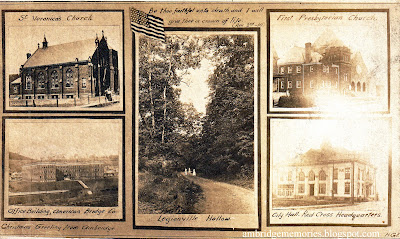
Vintage Ambridge Christmas postcard, circa 1918

"Christmas Greeting From Ambridge"
unposted vintage postcard
circa 1918
personal collection

In the left bottom corner of this card it says, "Christmas Greeting from Ambridge."

Shown on the card with photos' captions:

Left, top: St. Veronica's Church; bottom: Office Building American Bridge Co.

Right, top: First Presbyterian Church; bottom: City Hall, Red Cross Headquarters

Center: Legionville Hollow

Because the other four photos show notable Ambridge buildings, the choice of a scene showing three women strolling in a wooded Legionville Hollow lane as the larger center photo seems to me like an unusual choice. Maybe the scene held some special importance. Or maybe it was simply pretty. Or maybe it just fit better in the vertical space.

The American flag and bible verse at the top seem surprising for a Christmas card: "Be thou faithful unto death, and I will give thee a crown of life." (Rev. 2nd - 10). So merry. But I don't claim any expertise in vintage Christmas postcards, so maybe those are typical for the time.

This divided back postcard, now faded on the right side, was unmailed and had nothing written on the back. I based the "circa 1918" date, in part, on the photo of the First Presbyterian Church showing the church's "auditorium" that was dedicated in December 1917, after it was added to the right side of the earlier "chapel."

The flag, bible verse, and the "City Hall" (Ambridge's first Municipal Building) being described as the Red Cross Headquarters added to my thinking that this postcard might date from one of the U.S.'s WWI years (1917 - 1918), but I can't say with certainty. As do the dresses worn by the women in the Legionville Hollow photo.

Friday, December 17, 2021

The new block of 4th Street: Park Road to Ohio River Blvd., 1945 - '46

 
Intersection of Park Rd. and 4th St.
April 10, 1946
Laughlin Memorial Library archives

The photo above shows the practically brand-new intersection of Park Rd. and 4th St. The photo must have been taken from the American Bridge Office building which stood southwest of the new intersection.

John Domansky IDed the small building on the southwest corner of the intersection as belonging to the gas company. But so far, I don't have any confirming information.

Here are more views of the new brick-paved intersection:

Intersection of Park Rd. and 4th St.
north side of American Bridge Office shown on upper left
American Bridge Co. plant in background, right
April 10, 1946
Laughlin Memorial Library archives


Intersection of Park Rd. and 4th St.
looking west toward American Bridge Co. plant
American Bridge Office building on left
April 10, 1946
Laughlin Memorial Library archives


Intersection of Park Rd. and 4th St.
American Bridge Park on right
American Bridge Co. plant in background
April 4, 1946
Laughlin Memorial Library archives


Intersection of Park Rd. and 4th St.
looking toward 400 block of Park Rd.
April 10, 1946
Laughlin Memorial Library archives

That house on the corner of Park Rd. and 4th St. is still there, as is the darker house on Park Rd. above it, only now there's another house between them. 

During the spring and summer of 1945, that new block of 4th St. had been constructed to connect Park Rd. to the new extension of Ohio River Blvd. from the Allegheny County line to Ambridge's 8th St.

Ohio River Blvd. and 4th St.
construction
looking east from Ohio River Blvd.
American Bridge Office building on right
October 18, 1945
Laughlin Memorial Library archives


Ohio River Blvd. and 4th St. 
construction on 4th St.
American Bridge Co. plant in background
October 18, 1945
Laughlin Memorial Library archives


Construction of 4th St. between Park Rd. and Ohio River Blvd.
north side of American Bridge Office bldg.
October 18, 1945
Laughlin Memorial Library archives


Intersection of Park Rd. and 4th St.
looking west toward American Bridge plant
October 18, 1945
Laughlin Memorial Library archives

I believe that the sign to the right of the parked car says:
"Entrance at Merchant St. to American Bridge Co. and Penna. R. R. Station"

But extending 4th St. from Park Rd. to the boulevard had a legal complication: the land needed for the extension was owned by the American Bridge Co. The extension would go right through the American Bridge Park.

The legal issues involved in extending 4th St. through American Bridge's private property was nicely resolved in a "Deed of Dedication" which was memorialized as Ambridge Borough's Ordinance No. 562. Here's the beginning of the lengthy handwritten ordinance which included the signed deed:

An ordinance approving and accepting a Deed of Dedication from the American Bridge Company for the purpose of dedicating to public use that portion of Fourth Street, extended, in the said Borough of Ambridge, between Park Road and the new Pennsylvania State Highway.
In the deed, the American Bridge Co. agreed to give Ambridge Borough the legal right to the portion of 4th St. between Park Rd. and the new extension of Ohio River Blvd. For that right, Ambridge paid American Bridge Co. $1.00.
_____

Thanks to the Borough of Ambridge's Marilyn Sheleheda for scanning Ordinance No. 562 for me. The ordinance was not only not available online, but bound in a large book with other old handwritten ordinances. Scanning that couldn't have been easy.

Tuesday, December 14, 2021

Marketing the new town of Ambridge: Part 1: Porter Locomotive is coming! Porter Locomotive is coming! But did it?


Real Estate Trust Co. ad for Economy-Ambridge
"The H. K. Porter Company"
"Locomotive Shops to Employ 2,000 to 3,000 Men"
Pittsburg Press,
April 18, 1906

In 1903, the American Bridge Company started building the world's largest structural steel fabricating plant along the east side of the Ohio River. The building site was on land that had once belonged to the Harmony Society, which by then, had faded away, becoming history.

In the former Harmonist village of Economy, north of the new plant, a small number of non-Harmonist businesses and employees of the Society remained. But beyond the village, there was mostly undeveloped land: fields, orchards, vineyards, and pastures, occasionally punctuated by coke ovens and oil and gas wells.

Now think of what the American Bridge Co. had to do to start a thriving industrial town from basically scratch.

Sure, the company might have no problem attracting the massive labor force needed to build, then work in, their new plant. But think of everything those workers would need. Homes, food, supplies, transportation, banks, postal service, schools, churches. And what about infrastructure? Who would build streets, sidewalks, sewers, a water system? How do you attract professionals needed to care for the sick or bury the dead?

American Bridge did pretty much what's still done today. It hired a real estate company. And that company advertised.

The Real Estate Trust Co. of Pittsburgh, which had a branch office at the corner of Park Rd. and 5th St. in Ambridge, was given the task of selling the new town of Ambridge to potential businesses, investors, and residents. Early on, the company published a multi-page sales brochure, "Ambridge, Reasons for Her Coming Greatness," with descriptions and photos of the very early stages of the building of the American Bridge plant and Ambridge's infrastructure.

In May 1904, the real estate company placed two full-page ads in the Pittsburg* Press, touting the marvels of the new "manufacturing city" of Economy. The "Ambridge" name hadn't caught on yet.

The first ad, full of hyperbole and fantastic predictions, offered a free train excursion to see "the greatest industrial and city building progress in modern times." I highly recommend reading the ad; it's not only entertaining, but offers a jaw-dropping view of the early plans for Ambridge's development. (The ad's easiest to read if you visit the digital Pittsburg Press from May 3, 1904.)

Ad for "The Marvel City"
Pittsburg Press
May 23, 1904

The following day, the Press featured another full-page ad.

Ad for "The Marvel City"
Pittsburg Press
May 24, 1904

This second ad still contained some of the same amazing predictions about the future Ambridge as the previous day's ad did. But I think the seconds ad's most astonishing selling point was that it featured former Harmony Society trustee, "world's famous bandmaster," John Duss, saying his "greatest achievement" was selling "miles of level plateau to capitalists." (Click here to read the ad in the digital Pittsburg Press.)

In the spring of 1906, the same real estate company started placing a series of smaller ads in the Pittsburg PressPittsburgh Post, and Pittsburgh Gazette, this time focusing not on what Ambridge was going to become, but rather on what Ambridge already was.

The exception to these ads featuring Ambridge's already-existing amenities, buildings, and infrastructure were the earliest five that I found. Those five ads announced that the famous Porter Locomotive Co., which made small industrial locomotives used in places like mills, lumberyards, and mines, had plans for a huge new plant in Ambridge.

These Porter Locomotive ads were the only ones I've found in the series that were about an industry that was yet to come to Ambridge. And the only ads to feature the same reason Ambridge was wonderful more than once. Later, Porter Locomotive's coming to Ambridge was mentioned in several subsequent ads which I plan to feature in separate posts.


Real Estate Trust Co. ad for Economy-Ambridge
"Porter Locomotives Will Haul Money into Economy-Ambridge"
Pittsburgh Post,
April 20, 1906

Real Estate Trust Co. ad for Economy-Ambridge
"Porter Locomotive Shops"
"Double The Capacity of The Company's Present Shops"
Pittsburg Press,
April 22, 1906


Real Estate Trust Co. ad for Economy-Ambridge
"A Wonderful Engine"
"Economy = Ambridge"
Pittsburgh Post
April 24, 1906


Real Estate Trust Co. ad for Economy-Ambridge
"Realty Values in Economy-Ambridge Forge Ahead"
"one of the largest locomotive works in the world will commence operations"
Pittsburgh Post
April 26, 1906


Did Porter Locomotive ever come to Ambridge?

Over many months I've looked for information about the Porter Locomotive plant in Ambridge, so highly anticipated in 1906 and '07.

To be sure, Porter Locomotive's plans to move its existing Pittsburgh plant to a new plant in Ambridge wasn't just some advertising hoopla dreamed up by the Real Estate Trust Company to sell property. Not only was there information about the planned move in several newspapers, but also, thanks to Sarah Buffington, Old Economy Village's curator, I now have a copy of a 1906 deed showing that the H. K. Porter Co. bought property, not exactly in Ambridge, but rather a bit north, in Harmony Township's Legionville.   

And yes, in 1959, the H. K. Porter Corp. purchased Ambridge's National Electric plant. But by then Porter was no longer making locomotives, and National Electric, which produced electrical products, wasn't located on the property that Porter Locomotive bought in Legionville in 1906.

It looks to me as if Porter Locomotive's Pittsburgh plant remained opened. And that Porter Locomotive may have opened additional plants in locations other than Ambridge. 

I found no information about Porter Locomotive ever building a plant, hiring workers, or producing locomotives in Legionville or Ambridge. Did any of that ever happen?

I've seen Porter Locomotive listed among Ambridge's industries in several places, but none provide more information than the name, and perhaps, mention that it was north of Ambridge. Although I checked with a couple of the writers who had said Porter Locomotive was in Ambridge, they couldn't offer me more information.

So, did Porter Locomotives ever build a plant and manufacture locomotives in or near Ambridge? I don't have the definitive answer to that yet. But right now, I'm inclined to say "no."

I do know that in 1917, Porter sold at least some of the Legionville property to the Firth Sterling Steel Co., and that Firth Sterling later sold the property to several buyers, but that's about it. One of the buyers was Spang Chalfant Co. which according to a March 21, 1939, Daily Citizen article, bought 55 acres on the flat area between the railroad and the Ohio River, previously an "old dairy farm."

There may be people who can tell me about Legionville's history during 1906 - 1917, and I know there are people who know a lot about the history of the Porter Locomotive Co. If anyone can help with additional information about what happened with the plan to move Pittsburgh's Porter Locomotive plant to Legionville, I'd be grateful.
_____

* For a time, the Pittsburgh Press spelled its name "Pittsburg Press," the no "h" spelling dictated by the United States Board on Geographic Names. Other Pittsburgh papers kept the "h". Eventually, the Pittsburgh Press added the "h" back.

Sunday, June 27, 2021

Ambridge's American Bridge Co. constructing a towboat, circa 1912

"Fabricating steel hull for towboat
at Ambridge plant of American Bridge Company"
Industrial World 
July 8, 1912

I suspect that when many people remember the work done at Ambridge's American Bridge Co. plant, they think of structural steel fabricated for projects such as bridges, skyscrapers, or sports stadiums. But the Ambridge plant also built boats.

Not big boats. The Ohio River isn't deep enough for a shipyard that could build large ships. However, the Ambridge plant had a Barge Yard which built hundreds of barges, mostly freight barges, but also more specialized ones for dredges, derricks, or tanks that carried liquids like oil. 

The plant also occasionally built towboats, or at least the hulls for them, with the boats being finished elsewhere by their owners. 

Towboats are the boats that push barges. So, towboats don't "tow" a barge by pulling it the way a tow truck might pull a car; they push. (What can I say? English is weird.) In contrast, tugboats do pull ships. So, as I learned only recently, the boats you see pushing barges in the Ohio River are towboat, not tugboats. 

I don't know what towboat the photo above shows being built or who ordered it. Industrial World's July 8, 1912 issue doesn't provide that information anywhere that I could find.  And, as of now, I haven't found information elsewhere about a towboat being built in Ambridge in 1912. Perhaps the photo was taken earlier than 1912.

_____

During WWII, American Bridge's Navy Yard, built across Big Sewickley Creek from the plant, also built ships: 123 LSTs (Landing Ship, Tank).

And, during WWI, Ambridge's American Bridge plant fabricated the hulls for large ships that were then sent to shipyards capable of finishing the ships' construction. One of those ships was the freighter U.S.S. Ambridge

The same photo as the one above was also published in Coal and Coke Operator, July 25, 1912.

Wednesday, March 31, 2021

Great St. Patrick's Day Flood, 1936: Ambridge stories


Unidentified boy looking at train on flooded railroad tracks,
east side of American Bridge Co., at the Ambridge Station 
St. Patrick's Day Flood, 1936
postcard
personal collection


The cause of the 1936 St. Patrick's Day floodthe biggest natural disaster in the history of the Pittsburgh regionhas been blamed on weeks of abnormal weather. First a prolonged cold spell allowed an unusual amount of snow and ice to accumulate. Then, just before St. Patrick's day, a sudden rise in temperature caused a rapid melt. And if those weren't problematic enough, an hours-long downpour added to the amount of water that had already been rising out of local streams and along the banks of Pittsburgh's rivers. Previously unimaginable destruction and death followed in Pittsburgh and many other river communities. 

During the overnight hours of March 17, the Ohio River began to rise in Ambridge. Although located along the river, Ambridge was relatively lucky thanks to its natural topography and to the American Bridge Company's occupation of most of the riverfront. American Bridge, though, wasn't so lucky.

The "crackerbox" tenements that had once stood on the river bank between 9th and 10th street, and flooded in 1907, were gone by 1936. Reportedly, only some of the Ambridge houses on Bank St. along Big Sewickley Creek were flooded. (But neighboring Fair Oaks, on the opposite, lower bank of the creek, wasn't as fortunate. See the photo below.) The rest of Ambridgehomes, businesses, and, with the exception of American Bridge, industrieswere high enough above the flood water that they were spared. 

Flooding in Fair Oaks along Big Sewickley Creek, 
opposite Ambridge
photo was taken from the upper part of Ambridge's Glenwood Dr.,
houses in the foreground are on Valley Rd.
March 1936
courtesy Ambridge Borough


Importantly, no Ambridge resident was reported as drowning in the deep, swift, muddy, and debris-filled floodwater. 

However, Ambridge experienced the same disruption of transportation, news, electricity, gas, phone, and telegraph service as other communities, not only along the river, but beyond.

Duquesne Light Co. substation
across Big Sewickley Creek from Ambridge,
Beaver St., Fair Oaks
March 1936 flood
courtesy Ambridge Borough

Roads were blocked by water, mud, or rockslides, making travel in or out of Ambridge pretty much impossible. Trucks that usually delivered food and other vital supplies could not make the trip into Ambridge. Rail service was suspended; a train was stranded on flooded tracks at the Ambridge station. 

Electric service was iffy and eventually limited to Ambridge's water plant, dairies, bakeries, and the phone company. Streets were unlit; buildings were lit by candles, flashlights, lanterns, and fireplaces for several days. Burgess P. J. Caul issued a special notice on March 20: 

Gas service in Ambridge from 8th St. south was shut off for several days as a safety precaution. As a result, many homes and businesses were unheated and stoves inoperable. 

Ambridge schools were closed until March 23 because they had no lights and heat.

Phone service was limited to emergency calls to the police and fire departments, doctors, drug stores, industrial plants, news offices, and other places that might need to be contacted if there was an emergency.

A big worry was that the Ambridge Water Works, with its location near the river, and already surrounded by water, might flood. Users were urged to conserve water. Ambridge's industrial plants were closed in the hopes that would ensure enough water for residential use. Fortunately, the Water Works survived the flood without contamination from the Ohio.

The only plant in Ambridge that remained open in the immediate aftermath of the flood was National Electric Co., so it could make critically needed replacement electrical equipment for damaged public utilities. But the company had to rely on its own power and water supplies. Electricity wasn't available from Duquesne Light Co. or water from the borough. 

Mail could not be delivered for two days. Outgoing mail couldn't leave Ambridge either.

The Ohio River finally crested in the Ambridge area at noon, March 18, measuring 44.3 feet at Lock No. 4 in Legionville in Harmony Township, more than 18 feet above flood stage. The flood water continued downstream, making its way towards other river towns in Beaver County, West Virginia, and Ohio. 


The flood at American Bridge Company

American Bridge Co.
Ohio River flood
March 18, 1936
postcard
personal collection

Ambridge's American Bridge, the largest structural steel fabricating plant in the world, seems to have been caught off guard by the amount of water the Ohio was rushing towards it that fateful St. Patrick's Day.

Men working at American Bridge the night of March 17 tried to save some of the plant's important property as the river began to push its way in, but the water came in so fast, and rose so high, the men had to abandon the plant at 3 AM. Plant electricians continued to work in the plant's powerhouse until 8 AM when they had to be rescued by boat. Power to the plant was finally shut off. The water continued to rise. 

On the morning of March 18, men who reported for work were sent home. American Bridge's barge yard and main shops were reportedly covered by two feet of water, a foot higher than during the disastrous 1907 flood. As a result, the plant couldn't operate and so was shut down. The local plant manager said all they could do was wait until the water receded to assess the damage. However, the damage was expected to be more than the "thousands of dollars" incurred during the '07 flood. That expectation turned out to be true, but did not do justice to the final cost of returning American Bridge to operating condition as the water continued to rise to a record eight feet.

On March 19, American Bridge officials said that the plant was still under four or five feet of water, after dropping about three feet from its high mark at 8 PM the day before. Repairs in the plant couldn't begin until the water receded. (Daily Citizen, March 20, 1936)

By March 20, water at American Bridge had receded "to the top of the lower level of the boat yard ways." Cleanup by several hundred employees began that morning. The "reclamation" and "re-conditioning" started in offices, shops, and yards where mud and debris had to be removed. Replacement of records and files destroyed by the flood began. Motors were taken to Ambridge's National Electric Co. plant to be cleaned and dried.

Once the power was turned back on, more workers would be added to complete the cleanup which would require "weeks" to finish. 

Cleanup continuing through April 6, when the all departments finally reopened. However, only the barge yard and a limited number of other departments were back to full operation. Other departments still were unable to fully open because the power plant, while working again, couldn't yet provide enough power. (Daily Times, April 8, 1936)


The Daily Citizen publishes despite obstacles

Getting news in 1936 wasn't always quick and easy in ordinary times, but for a while during and after the flood, finding out what was happening was much more difficult than usual. 

Most people relied on local newspapers and, maybe a radio if they, or a neighbor, were lucky enough to own one during the depression years. 

But without electricity, radio stations couldn't broadcast. Pittsburgh's powerhouse station KDKA could only broadcast intermittent alerts and emergency information. And without electricity, Ambridge residents couldn't hear radio news anyway. Battery operated radios weren't common then, and the batteries required electrical recharging. 

Ambridge's Daily Citizen found gathering and printing the news to be quite a challenge, but they, with the generous help of newspapers from neighboring towns, made a valiant effort.

The morning United Press news report usually delivered to Ambridge's train depot didn't come on March 18. UP's Pittsburgh office was flooded, so the Citizen had to get most of its stories via long distance calls from Cleveland, Ohio. When UP finally was able to contact the Citizen "by special wire," the reporter had to read the information by flashlight. 

With its gas service cut off, the Citizen couldn't operate the gas-heated linotype machines used for most of its printing. But the Sewickley Herald offered the use of their linotypes, enabling the Citizen to print "a limited amount of copy." The Citizen noted the published paper's unusual appearance, since it was set with the different typefaces used by both newspapers. Beaver's Daily Times also helped by sending "five galleys of their early copy."

Yet another problem arrived two days later when the Citizen's printing plant lost electric power, stopping its ability to print. But the Citizen was able to publish a four page edition, thanks to the Beaver Falls News-Tribune, which allowed the Citizen to use its equipment.

But that wasn't the end of the problems created by the flood. Four days into the flood, all of Beaver County lost electric power, and none of the papers in Beaver County could print. But the Citizen's staff still was determined to print a paper. Here's how they accomplished that with ingenuity, some unusual help from two people in Ambridge, an Ambridge industrial plant which had its own electrical supply, an extraordinary effort by the paper's staff, and finally, the help of a newspaper in neighboring Butler County:
A small motor was dismantled from a washing machine, loaned by [Ambridge business owner] C. F. Milleman, and attached to one of linotype machines.

At 2 o'clock this morning, employees practically dismantled the mangle and sewing machine of Mrs. Anna Ross, 184 Sixth Street, in order to procure the pully and gadgets found necessary for the completion of the primitive but nevertheless effective contrivance. Operators worked all night preparing for today's issue by the light provided by two kerosene lamps, a lantern and flashlights. The entire force was kept busy this morning setting much of the copy by hand. The Citizen's portable saw was moved to the plant of the National Electric Company where their power was used in order to trim all advertising cuts.

Forms and type were then transported by [automobile] to Butler, where the paper was printed on the Butler Eagle press. 

The Ambridge marauders and one man's excuse

A number of out-of-town papers wrote about a mob from Ambridge that had gone to neighboring Leetsdale, a community that had suffered a great deal of flood damage, in order to loot. Leetsdale residents objected. A riot ensued. Leetsdale's police chief had to call the National Guard to help.

Here's the Pittsburgh Post-Gazette's March 21 account of the story:


I haven't yet found Ambridge's version of the whole Leetsdale looting story in the Daily Citizen, although according to the March 24 issue, one of the arrested Ambridge men offered an explanation of his actions to a judge:
Joe Gilbert, Bank street, Ambridge, was held under $2,500 bond at a hearing before Judge Ralph Smith, in Allegheny court yesterday on a charge of larceny, and he was committed to the Allegheny county jail.

Gilbert was one of the men arrested by the Leetsdale police for looting in the flooded area. According to Gilbert's story, he had no intention of stealing, but had come across a garage lodged against a tree in the garden flats 300 yards away from any house, and that looking in, he saw a raincoat and a jack, which he thought he was entitled to, since he had found them. Judge Smith, however, thought otherwise
.
The March 23 Citizen did say in an article about Leetsdale's flood damage and cleanup that eight of the nine Ambridge men who had been arrested were sent home "with a warning not to be caught back in Leetsdale again" and added:
Twenty-two Leetsdale residents, mostly members of the fire department, were deputized as special police by the [Leetsdale] Burgess and were armed with sawed off shot guns with orders to shoot in the legs anyone caught below the railroad tracks after dark. 

The missing Ambridge boy

Another Ambridge story that made a lot of out-of-town papers was about a missing 16 year-old boy who hadn't come home after visiting his grandmother in South Heights, across the Ohio, a few days after the flood had arrived in Ambridge. Naturally, his parents were frantic and search parties sent out, but they failed to find the boy. However, the story ended with a weird twist. Here's what the Daily Citizen wrote in its Monday, March 23 issue:
After three days of frantic searching for Elmer Bauder, 16-year old son of John Bauder, 554 Maplewood avenue, missing since Friday [March 20], word was received this morning that he was all-right and he had started on a trip.

Friday morning, young Bauder invited Frank McGeorge to go to South Heights to his grandmother's to get a warm dinner. When told that he would be over there for two or three hours, McGeorge declined saying that he had to be home in an hour. He asked Bauder if the "gang" would see him that night and was given the assurance that they would.

He went to the home of his grandmother, Mrs. Elmer Laughner, where he did have dinner. He was given $3 to buy galoshes and went to Beck's store for this purpose. They did not have the kind he wanted and he said he would wait until he returned to Ambridge. At 1:30 o'clock he walked out of the store and that was the last that was known of his whereabouts.

Police were notified and searches of parties of three and four have combed Ambridge and the South Heights districts. Yesterday, the state police sent out a teletype of his description. He disappearance also had been broadcast over the radio.

This morning, John Bauder, received a postal card, postmarked midnight Friday from the Oakland Branch of the Pittsburgh postoffice. It read:

"Dad, don't worry. I'm alright. I'm going someplace. I'll be back home shortly. Tell Grandmother Laughner I'm away on a trip with the DeMolays" signed, "Red."

The reference to the trip with the DeMolays was made because of the illness of Mrs. Laughner and he evidently did not want his grandmother to worry about him.

It is thought that the youth got a ride to Pittsburgh on a delivery truck and, having $8 in his pocket, decided to go to Johnstown to view the results of the flood. Another conjecture is that he is heading south with the intention of visiting Lawrence Shomo, who is attending Atlanta Military Academy at Port Defiance, Virginia, and then continuing to St. Petersburgh to visit his uncle, who owns a drug store there.

There had been no trouble between the boy and his relatives so it evidently had not been premeditated as he was not dressed up when he left home Friday.
I was told that Elmer eventually returned home, but as of yet, I don't know when. Or what his parents had to say to him when he did.


The floating garage
The floating garage crashing against a pier of the Ambridge-Aliquippa bridge let go an automobile which quickly sank while another [automobile] was lodged safely in the remaining part of the building as it moved down steam. (Daily Citizen, March 20, 1936)
_____

The information in this article came from reporting in Ambridge's Daily Citizen newspaper unless another source is named.
Thursday, March 18, 2021

Coffee Pot Inn, Duss Ave., 1929

Coffee Pot Inn
Duss Ave., Near New Byers Plant
ad
Daily Citizen 
August 10, 1929
 

Ever since I first saw this ad for the Coffee Pot Inn ("Hot Bar-B-Q Open All Year") when Maria Notarianni shared a scan of it with me several years ago, I've wondered exactly where on "Duss Ave., Near New Byers Plant" it was.

And then recently, while looking for something else entirely, I found the answer in The Pittsburgh Catholic, Sept. 22, 1932, issue, in an ad for a different Ambridge inn: the Golden Moon Inn, "Formerly Coffee Pot Inn."

The Golden Moon Inn ad advertised "Delicious BAR B Q--10¢. No Cover Charge; Dine and Dance; Private Parties and Banquets a Specialty."

Golden Moon Inn
"Formerly Coffee Pot Inn"
3000 Duss Ave.
ad
Pittsburgh Catholic
September 22, 1932

The address in the Golden Moon ad, 3000 Duss Ave., no longer exists. But if it still did, it would be as far north on Duss as possible without crossing the Legionville Bridge into Baden.

But perhaps the Coffee Pot Inn and the Golden Moon Inn weren't actually located that far north on Duss. I have a later address for the Golden Moon Inn, 2916 Duss Ave., which would have put it more or less across the street from where the Byers plant's office was. So either the Golden Moon had moved further south on Duss, or the buildings on that part of Duss were renumbered at some point so 3000 Duss became 2916 Duss. Does anyone know?

I've also wondered what that cute little building on the Coffee Pot Inn's right side was. Phone booth?  

Sunday, December 29, 2019

Ambridge's Harmony Hotel. And the other Ambridge Harmony Hotel

"Harmony Hotel"
Manuscript Group 354: Old Economy Village Collection
Photo Number 635b
courtesy of Pennsylvania Historical and Museum Commission
Old Economy Village
used with permission

Just a short distance northwest of the well-known and highly regarded Economy Hotel,* once located on the southwest corner of what is now 14th and Merchant Sts., there was a smaller, less impressive hotel. The Harmony Hotel, sometimes belittled as the "Tramp Hotel" or the "Hotel of the Unfortunates," hasn't been in business for many years, although its building still stands at 277 Fourteenth St.

Why those disparaging nicknames? According to Sarah Buffington, Old Economy Village curator:
"The guests at the Economy Hotel were told to arrive promptly at 4:30 for supper, so as not to keep others waiting. The staff was fed after the hotel guests, and then the 'tramps' were fed afterward. These homeless people were allowed to stay for one night, but were then told to move along. The Harmony Society kept track of them so that they wouldn’t overstay their welcome."
The date of the photo above is uncertain, but it probably dates from the late 1800s, before there was an Ambridge, or early 1900s. The building dates from much earlier, back to the establishment of Economy, and wasn't originally used as a hotel. Although it doesn't look like the typical, brick Harmonist house, it was the early home of Frederick Rapp, adopted son of George (Father) Rapp. Frederick Rapp later moved to a brick house that is on the grounds of Old Economy Village.

The three people in the photo are unidentified. but according to Buffington, the woman and girl may be Carrie Staples, a widow, and her daughter Katherine. Staples was a boardinghouse keeper there at the time of the 1910 census. 

The photo below shows a recent Google Street View of the former Harmony Hotel building:

277 Fourteenth St.
Google Street View
October 2013

What is not visible from Fourteenth St. is a large addition--that appears to me to be at least as large, or maybe larger, than the original house--built on the back of the building, probably around the time it became the Harmony Hotel. Buffington said the addition "is very much set up like an old hotel." You can see the addition from Boyleston St. Here's a satellite view of 277 Fourteenth St.:


277 Fourteenth St.
Google Satellite View

The other Harmony Hotel in Ambridge

To confuse Ambridge history more than it often is, there was another Harmony Hotel, across town from the one on 14th St. This Harmony Hotel, at 300 Merchant St., was built and operated later than the hotel on 14th St., but was also viewed as disreputable, especially by the American Bridge Co.

This Harmony Hotel was the bane of the American Bridge Co. for years. The company didn't want its employees drinking, and so devised deed restrictions that said that the area within the original boundaries of Ambridge was supposed to be "dry"--alcohol free--for 50 years. However, the Harmony Hotel, mere blocks from the company's plant and office, sold liquor. Legally. That was possible because the Harmony Hotel wasn't in Ambridge; it was in Harmony Township, at that time, just a walk across Merchant St. from Ambridge. Which I'm guessing made its site a very attractive spot for a bar...er...hotel.

The building shows up on the 1911 Sanborn Insurance map as the location of the planned "Hotel May," named for its builder. Sometime between then and 1915, the name was changed to Harmony Hotel. The battle between its owner and American Bridge Co. over the hotel's liquor license appears to have begun early. Here's part of the remarks made by F. T. Cadmus, the plant superintendent, from the Daily Times, October 22, 1915:


The liquor license battle continued in 1916 when the hotel was owned by George T. Davis. In an article in the Pittsburgh Post-Gazette, March 14, 1916, Davis' attorney claimed that the American Bridge superintendent, Cadmus, had warned employees of the company that they would be fired if they were seen in the barroom of the Harmony Hotel.

So American Bridge must have been pleased by this announcement in the January 2, 1917, Daily Times:


A "temperance hotel" may not have proved to be as popular as the barroom at the Harmony Hotel may have once been, because in 1920, Divine Redeemer Church, across Merchant from the hotel building, bought it and converted it into a parochial grade school. After the church built a new school in 1961, the building was sold to the Karnavas Vending Co.

Karnavas Vending Co.
former Harmony Hotel
former Divine Redeemer School
300 Merchant St.
Google Street View, Oct. 2017
_____

*Later renamed the Old Economy Hotel in the late 1800s.

Saturday, March 23, 2019

The U.S.S. Ambridge

"Mrs. L.D. Reilly, Sponsor U.S.S. 'Ambridge'"
christening ceremony
Federal Shipbuilding Co.
Kearney N.J.
May 24, 1919
courtesy Beaver County Industrial Museum

The stately ship above is the U.S.S. Ambridge at her launch on May 24, 1919. And, yes, she was named for Ambridge PA, where much of the ship was made by the plant that gave Ambridge its name, the American Bridge Co., once the largest structural steel fabricating plant in the world.

During WWI, demand for ships was greater than available shipyards. Ships could not be built as fast as they were needed, even before the U.S. entered the war in 1917.

In 1915, naval architect Chas. P. M. Jack, had a rather brilliant idea. While the Ohio River at Ambridge was too shallow for a shipyard that could construct large ocean-going ships, the American Bridge Co.'s plant there had churned out hundreds of barges over the years. Could the plant construct at least the hull for an ocean-going ship, which could be then be sent to a shipyard where the work would be completed?

Previous similar attempts elsewhere had been failures, but none of the companies that had tried and failed had American Bridge's expertise in fabricating not only barges, but also large structural steel projects. So American Bridge was given the contract to build one hull. Not the entire hull, but 60 percent of one. That hull was shipped to a shipyard in Chester PA, where builders found American Bridge's hull fit the other parts of the ship perfectly.

So the Ambridge plant was given a contract for 12 more hulls to be constructed in 1915 and '16--eight oil tankers and five freighters, all finished by the Chester Shipbuilding Co. Later, American Bridge added new equipment, was awarded more contracts, increased its production, and was able to fabricate enough hulls for as many as four 9,000-ton ships a month. (Daily Times, May 17, 1919)

Eventually, American Bridge and other fabricating plants could produce enough ship parts that the U.S. Shipping Board's Emergency Fleet Corp. built new shipyards to keep pace with the capacity of the plants to supply them. One of the new shipyards was U.S. Steel's Federal Shipbuilding Co. in Kearney N.J.

The U.S. had entered the war by the time American Bridge built Hull #15, Order No. 218259, which was shipped to Kearney, where she was completed and christened "Ambridge," on May 24, 1919, six months after the war had ended. The name was chosen to honor the work done by Ambridge's American Bridge Co. An article on the ship's christening said that the plant had built much more than the hull. "The ship was practically all fabricated in Ambridge, but was shipped to Kearney where a few parts were added and the parts assembled." (Daily Times, May 26, 1919)

The Ambridge was christened by Mrs. L.D. Reilly, wife of the manager of Ambridge's American Bridge plant. She's the woman in the photo below holding the Ambridge pennant, front row, second from left. Her husband also attended, as well as R. G. Manning, the plant's chief engineer, and A. J. Carpenter, shop superintendent, none of whom are identified in the photo. Perhaps Mr. Reilly is the man holding an Ambridge pennant on the far right, front row.

"Launching Party, U.S.S. "Belfort" and "Ambridge"
May 24, 1919
Federal Shipbuilding Company
Kearney N.J.
courtesy Laughlin Memorial Library Archives

The Ambridge was not a military ship, but rather a commercial freighter. The Daily Times article about the christening gave the ship's dimensions as 400 feet long, 55 feet wide, and 35 feet deep, with a speed of 14 knots, and capable of carrying approximately 9,000 tons.

The U.S.S. Ambridge wasn't as imposing when she was at sea as she looked at her launch

"The U.S.S. Ambridge"
The Federal Shipbuilder
Aug. 1919 - Jan. 1922

American Bridge's work was admired enough that the issue of The Federal Shipbuilder with the above photo also included a poem, "General Philip Kearny Asks" by Fred T. Llewellyn, that included these lines:
From Gary come the boiler shells,
Farrell the sheet-bar tonnage makes,
And Ambridge with her quota swells
The multiple array of strakes,
During her career, the Ambridge carried cargo as varied as Dutch flower bulbs and $2,000,000 in gold bullion destined for a U.S. bank, sailing primarily to and from European ports, but also South Africa and Central America.

I don't know how common smuggling via commercial freighters was during the period when the Ambridge was sailing, but she was caught with contraband at least twice.

In February 1927, customs authorities found 4,200 bottles of champagne, valued at $50,000, hidden in a coal bunker on the Ambridge, as well as 13 cases of narcotics. (New York Times, Feb. 17, 1927).

Then in June 1930, customs officials found smuggled champagne again, this time 3,168 bottles valued at $31,680. (New York Times, June 3, 1930)

The Ambridge was scrapped in 1935.

Monday, September 3, 2018

After the 1933 Spang-Chalfant strike violence, the immediate aftermath

This blog post is a continuation of the story of the October 5, 1933, Spang-Chalfant anti-strike violence in Ambridge PA. If you haven't yet read about it, I recommend you read my blog post telling the story, illustrated by a number of photos and a newsreel: "Ambridge 1933 anti-union strike violence at Spang-Chalfant." If you have already read it, consider re-reading it. It's a shocking and sad story appropriate for Labor Day.

Strikebreakers on patrol after ending the strike at Spang-Chalfant
AP photo
October 6, 1933

Here's the Associated Press description on the back of the above photo:
Guard Steel Property: Deputies Sheriff are shown patrolling the railroad lines beside an Ambridge, PA., steel plant, around which there has been sporadic warfare between pickets and officers for several days. Tear gas and rifle fire have been resorted to by officers to halt the activity of pickets. 
Since I first started researching the story of that strike, I have been struck by how the workers who were trying to unionize were not only beaten, shot, and teargassed by deputized strikebreakers, but also I've frequently been taken aback by the number of local officials who led, condoned, or were complicit in the violence against the strikers, including the Beaver County Sheriff Charles J. O'Loughlin, County Detective Robert Branyan, Ambridge Burgess P. J. Caul, and county District Attorney, A. B. de Castrique, as well as local police.

But the mistreatment of the workers, or those suspected of being union sympathizers, didn't stop when the strike did.

A 1995 article in the Buffalo Law Review * describes some of post-strike incidents:
The next day, three carloads of police patrolled the streets breaking up groups of three or more at gun point, even on the steps of their homes. Many were routinely searched. Police raided the offices of the strikers to arrest several leaders of the strike, carrying off records and cash, without warrants. Leaders spent days in jail until released on habeas corpus. More than twenty men were fired at Spang-Chalfant. 
"Injured men were also interrogated about their work before treatment."

"Police violently interfered with people going to the funeral of the man killed [Adam Petrasuski], and two women, Edith Brisker and May Ecker, were arrested when they tried to speak to the crowd."

The Law Review article also tells the story of how a community member not involved in the strike was not only shot by the deputies, but also mistreated by the very people who should have cared for him:
Abuse was not limited to pickets, a bread delivery man showed the extent of municipal control.
 I was near Twenty-fourth Street. There were no pickets or strikers there. A bunch of deputies, not among those who came in from the outside but from those who were inside shot at me. They were stationed on the railroad tracks. I did not know what for. I had no stick or anything. I was just watching from a distance what was happening when the fellows from the railroad tracks shot at me hitting me in the back. . . . 
 When I first came to the hospital I had to hang around in the waiting room. I was very sick, so I found a bench and lay down. Pretty soon someone came to me, I don't know whether he was a doctor or who, I was too sick to look up. He asked me "where you work?" I was too sick to reply. 
 The same evening Dr. F.C. Forcey who is on the staff of the Sewickley Valley hospital and who is also the company physician of the Spang-Chalfant Company said to me "You are a red." I said "sure, can't you see all the blood from my wounds." Then he said "You ought to be shot." 
 Then Dr. Boruku, the second day when he went to take the bandage off the wounds, asked me whether I cry. I said no. Then he tore the bandage off my arms, tearing the hair with it. "You must be tough," he said. Then when he started taking the bandage off my head he said "We're going to have fun now." He tried to tear it off. It hurt terribly, tears were rolling down my eyes, but I said nothing. He could not tear the head bandage off, so he took the scissors and cut my hair.
After I collect more information, I hope to write more about what happened in Ambridge in the aftermath of the 1933 strike. Until then, on this Labor Day, think about how people literally fought and died for the employment rights and benefits many U. S. workers have today.
_____

* Casebeer, Kenneth (Winter, 1995) "Aliquippa: The Company Town and Contested Power in the Construction of Law," 43 Buffalo L. Rev. 617

Monday, April 9, 2018

Ambridge view from a hill, 1905

I remember seeing the postcard below before I became so interested in Ambridge history and wondering back then if the photo was really of Ambridge. It's hard to identify old buildings from the sides, backs, and roofs, especially when the photo isn't sharp. Nothing looked familiar to me. And I couldn't see any of the familiar landmarks that would tell me "this can only be Ambridge," like the Old Economy church tower or the American Bridge office building. Is it possible the town might have been misidentified?

I know I wasn't the only person wondering about the identity of the town in the photo, because I've been asked "Is this really Ambridge?" several times. But I can now say with confidence, yes, it is Ambridge, because I have learned enough in the past several years to identify a few of the buildings. And a postcard message from 1905 helps too.

I've numbered the buildings I have IDed on the postcard. To see a larger view, click on the card:

Ambridge looking northwest from hill
circa 1905

While I've numbered the buildings from left to right, I'm going to start with #4 on the far right side, because, several years ago, that's the first building I thought I could identify.

#4. First St. Veronica Church, 8th St. and Glenwood Ave. Since razed.

St. Veronica Church
postcard
circa 1906

The next building I identified was #2, near the center:

#2. The long building with five single windows on the top floor, then groups of windows on the floor below, looks to me like the Ambridge Savings and Trust Co. building, once on the northeast corner of 5th and Merchant Sts., now also gone. The roof line is right.

Ambridge Savings and Trust buildings
5th and Merchant Sts.
circa 1920s
Louis Vukovcan collection
courtesy Jackie Vukovcan

#1. Based on the distinctive roof line with a cube on each end, I believe that #1 might be 439 Merchant St.  Vintage colored postcards show that building as red brick, with second and third floor balconies. It's the third building on the left side of the postcard below. That building still stands, but it's now painted white and its balconies are gone.

400 block of Merchant looking north
1909
postcard


439 Merchant St.
October 3, 2014
credit: Nancy Knisley

3. The identical, closely spaced row of roofs are probably the houses on Melrose Ave. They're still there more than a century later.

"Melrose Avenue Looking West, Ambridge, Pa."
500 block of Melrose looking north
postcard
postmarked September 28, 1911

The message on a mailed copy of the postcard below clinched the identification for me, plus provided some interesting facts about early Ambridge I hadn't heard before--including why the postcard scene might be as hazy as it is.

"View of Ambridge, PA"
postcard
postmarked 1905 

The message on the card says:
My dear Uncle, You can't see the Bridge works in this picture--just a little smoke. We are 25 minutes ride from Pittsburg. Have been here over four months and haven't seen a bright morning yet. Pittsburg smoke covers us up. Like the work but don't like the country. Am going to move pretty soon. Am working on sky scrapers now. 8 hr days with Sat. P.M. off. Wages are good too Living expenses are correspondingly high. Sincerely Rex. (I think its signed Rex, but maybe Ray?)

Here's a scan of the reverse of the mailed postcard immediately above:

reverse of mailed postcard
Nov. 7, 1905

It looks to me as if the card's photo might have been taken from a hill near 3rd St. Any thoughts on the hill's location?
_____

Thank you, Tom Martin, for the unmailed postcard at the top of this post.