Showing posts with label people. Show all posts

Wednesday, July 6, 2022

Five young men, 5th and Merchant Sts., 1947


3rd from left, Pete Lusty
2nd from left, John Smetanka
other young men unknown
1947
courtesy Dave Lusty

Dave Lusty, AHS '72, sent me this photo of his father, Pete Lusty, and four of his buddies, posing on the west side of Merchant St. near 5th St. in 1947. Pete Lusty would have been 20 years old at the time.

John Smetanka is the only of the four other young men that Dave could identify. If you know who any of the other three are, please leave a comment or contact me.

Note the streetcar tracks on Merchant St. Street cars through Ambridge were replaced by buses in 1934, but the tracks on Merchant St. weren't covered until 1958.

On the east side of Merchant, you can see the Penn Theatre's marquee. To the theater's right: The Penn Grill restaurant and Denmark's shoe store,

The building with the clock is the Economy Bank of Ambridge which was across 5th St. at 500 Merchant.

The Penn Theatre closed in the early 1950s, and the Melody Ballroom opened in the theater's former location in September 1953. The ballroom, Penn Grill, and Denmark's were all badly damaged in a big July 1954 fire. Another massive fire damaged the businesses that occupied the former theater in February 1963: the Bride and Deb Shop on the corner, Penn Grill, and Hankins Shoe Store. 

The former Penn Theatre building was razed after the 1963 fire, replaced by a parking lot. More recently, that corner was the location of the now-closed PNC Bank in 1984

The Economy Bank building was razed in 1984. WesBanco's drive though is now located where the bank once stood. 

Friday, June 3, 2022

Mikush Home Appliance Center, Ambridge's last appliance store


Mikush Home Appliance Center
811 Merchant St.
August 11, 2021
credit: P.J. Shotter

Once, in the 1950s - 1960s, the Mikush Appliance store was one of a number of stores on Ambridge's Merchant St. where a shopper could buy major appliances like washers and dryers, stoves, refrigerators, and dishwashers. Some others were Kubek's, Capital, Timney's, and Kelly & Cohen. Ambridge's Sears also did a big business selling appliances. Plus some furniture stores--including Ambridge, Economy, Modern, Goorin & Harris, and Darcel's--also sold them. 

But starting in the 1950s, all of Ambridge's stores were hit hard by a series of blows: the opening of Northern Lights Shopping Center in Baden; the extension of Ohio River Blvd. from Ambridge's 8th St. to Baden, eliminating the need to drive through downtown Ambridge; and then the biggest blow of all: the collapse of the U.S. steel industry and closing of the area's plants and mills in the 1980s. The growth of big box stores in the area didn't help.

So one by one the places that sold appliances in Ambridge closed, until only one remains: Mikush Appliance. 

I believe that Mikush Appliance is now the second oldest retail store in Ambridge, with only Stangl's Bakery being older. Perhaps their longevity is related to the fact that the two stores have been family owned and operated since the businesses began.

Mikush Appliance's story
Andrew Mikush Sr.
courtesy Bob Mikush

In 1929, a Yugoslavian immigrant with a third-grade education, Andrew G. Mikush Sr. [Andrew Sr. elsewhere in this blog post], began going door-to-door selling merchandise that now seems rather unusual: appliances.

But in the days before many families owned cars, selling appliances door-to-door must have been a savvy business idea for Andrew Sr.'s employer, Milleman's, a long-time Ambridge store that sold pianos and appliances.

Andrew Sr., who had worked as a delivery man for Milleman's, turned out to be a quite successful salesman. According to his grandson, Bob Mikush, people trusted his grandfather to understand their needs, undoubtedly helped by his self-taught ability to speak the languages of many of Ambridge's immigrants including Greek, Italian, Polish, and several other Slavic languages. 

Andrew Sr. had a talent for repairing appliances too and developed a reputation not only as an honest seller, but also a skilled appliance repairman, an important skill during the depression years when many people couldn't afford to buy a new appliance when the one they owned stopped working.

In 1932, with Mr. Milleman's support, Andrew Sr. was able to open a business at 926 Duss Ave. (which many might remember as the location of J. Strock Memorials for many years). There he sold and repaired a variety of new and used appliances and their parts: washers, ironers, stoves, vacuums. And, according to his business card, he also sold radios and pianos.  

Thanks to his impressive success, Andrew Sr. was given the Maytag appliance franchise in Ambridge, making the business one of Maytag's earliest dealers. 

Andrew Mikush Sr.'s business card
926 Duss Ave.
courtesy: Bob Mikush

Andrew Sr. wanted to move his business from Duss Ave, to Merchant St., but despite the Great Depression, Merchant St. was busy, and there wasn't any available space he could lease.

Still, Andrew Sr.'s business didn't remain on Duss Ave. for long. By the late 1930s, Andrew Sr. had moved his business to 601 Melrose Ave., a block east of Merchant. While the primary reason the business thrived was probably Andrew Sr.'s reputation for personal customer service, he also seems to have had a knack for promoting special bonuses for buyers. 

Andrew Mikush
classified ad
Daily Citizen
December 3, 1937

Andrew Mikush Sr.
behind counter of store at
601 Melrose Ave.
courtesy Bob Mikush


Andrew Mikush
"All Makes of Electrical Appliances"
601 Melrose Ave.
ad
"Minstrel Varieties" program
Ushers Club of St. Veronica's Church
April 1949
courtesy Good Samaritan Parish Archives

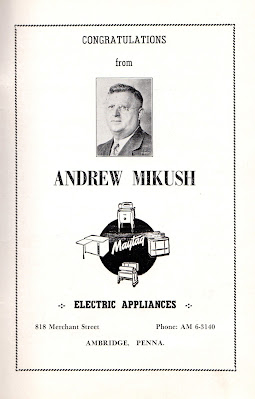
Although I don't know yet exactly when Mikush Appliances was finally able to move into a store on Merchant St., based on the ads above and below, the move to 818 Merchant St. was apparently sometime between April 1949 and December 1950. (I'll update this article if I find a more exact date.)

Andrew Mikush
Electric Appliances
818 Merchant St.
ad
Holy Trinity Dedication program
December 17, 1950


Andrew Mikush Sr. posing behind business' float
for the Ambridge Golden Jubilee parade
on float, grandchildren Roberta Mikush (now Sciulli)
and Andrew "Whitey" Mikush
in front of 818 Merchant St. store
July 1955
courtesy Borough of Ambridge


Andrew Mikush Sr. in front of Mikush Maytag Appliances
818 Merchant St.
Daily Citizen Trade Area Directory
1956


Andrew Mikush Appliance ad
Daily Citizen Trade Area Directory
1956

In 1962, Andrew Sr. retired and handed the store over to his son, Andrew R. Mikush Jr.

Andrew Mikush Jr.
ad
Bridger yearbook, 1971

A January 31, 1969, Beaver County Times article about Mikush Appliance's history and award-winning service, mentioned that the business soon would be moving to a larger building, purchased the previous year. The new location, at 811 Merchant St., previously Jay's Floor Covering store, would undergo extensive remodeling before a grand opening. Mikush Appliances has done business there ever since.
 
Mikush family in appliance store
811 Merchant St.
credit: Beaver County Times, March 23, 1997

Caption under photo above:
The Mikush family has been in business in Ambridge since the 1930s. From left are Whitey Mikush, Bob Mikush, Andrew Mikush and Bryan Mikush.
Andrew Jr. retired in 2001. His grandson, Bryan, now owns and operates the business.

Over the years, Mikush Appliances was recognized on several occasions by Maytag for their outstanding sales and service including the Maytag Red Carpet Service Excellence Award and the Outstanding Maytag Dealer Award. Bob Mikush also was invited to speak at the National Home Appliance Center Convention--twice. Even TV's lonely Maytag Repairman visited.
 
The lonely Maytag Repairman (actor Gordon Jump) visits Mikush Appliances
On left: WMBA announcer Dave Justice
On right: Andrew Mikush, Jr. and Al Serak
June 14, 1996
courtesy Bob Mikush

Recently, there's been a twist to the Mikush Appliances story: Despite the signs on the business that still say "Maytag," the store stopped selling Maytag appliances a few years ago. Bob Mikush said that after Maytag was sold to Whirlpool in 2005, the quality of appliances sold under the Maytag name just wasn't up to Mikush Appliances' standards that customers expected. 

Yet, amazingly, despite the competition from today's big box stores and the development of new shopping areas like Cranberry and Robinson Township, the store still sells appliances, although the models on display aren't as numerous as they once were. Most of its business is now in repairs and selling parts. But personal customer service is still its focus.


Some other things that make Mikush Home Appliance Center special:

- The business truly has been a family business for four generations. In addition to the founder Andrew Sr., Mikush family members who have been involved in the business include: Andrew Sr.'s sons, Andrew Jr. and Steve; grandsons Andrew (Whitey) and Bob and granddaughter Roberta; and great-grandson Bryan.

Roberta Mikush Sculli provided this memory:

My mom maintained the flower container outside the store, vacuumed and kept the store clean. When we were located across the street, I remember my grandmother coming to serve lunch. It was a full lunch like they ate in Europe. They ate their main meal at lunch.  My grandfather locked the front door and we all ate together.

- Bob Mikush will repair lamps at the store.

Bob Mikush with lamps needing repair
November 25, 2015
courtesy Ambridge Area Chamber of Commerce


- The store has decades of both Maytag and Ambridge memorabilia on display.

- Bob Mikush is a wonderful source of information about Ambridge's history.

- The business has been a frequent supporter of many Ambridge events, schools, and organizations.

Saturday, July 31, 2021

Ambridge parade on First St. 1955

Ambridge Golden Jubilee's Miss Greater Ambridge, Helen Witek
National Electric float
intersection First and Merchant Sts.
background: Karas Place, Balkan Restaurant, 291 First St.

Patrick Escoto* let me scan some photos that belonged to his late father, Phillip "Pippy" Escote.* Among the photos were some from a parade along what I recognized as Ambridge's First St. before the the neighborhood was razed, beginning with the Marshall Alley buildings in the mid-1950s, then more extensively in the early 1970s, when the entire area was cleared for redevelopment. 

The photos didn't give the date of the parade, or identify the parade participants or the spectators.

However, I am pretty certain that the photos were of Ambridge's Golden Jubilee parade on July 2, 1955, even though I haven't been able to find photos showing the same participants in the news photos of the parade that Ambridge's Daily Citizen called "a massive spectacle."

My best clue so far that these photos are of the Golden Jubilee parade is the Miss Greater Ambridge parade float above, on which Helen Witek, who was chosen for that honor as part of Ambridge's Golden Jubilee celebration, was riding with her court.

None of the different majorette or drum major uniforms in any of the photos match the ones worn at Ambridge High School in the mid-1950s according to photos in the 1954, '55, or '56 Bridger yearbooks. But there were many many marching units in the parade. Recognize anyone?

The very long parade was staged along the 100 and 200 blocks of First St., and then north on Park Rd. But the parade officially started at the intersection of First and Merchant Sts., which once began between the 200 and 300 blocks of First St. So the lucky residents of First St. got to see the parade before those watching elsewhere in Ambridge did.

If you can provide identifying information (people, float sponsors, businesses), or memories of the parade traveling up First St., please leave a comment.

Here are the rest of the Escoto parade photos in no particular order:

All photos in this post are courtesy of Patrick Escoto.
 
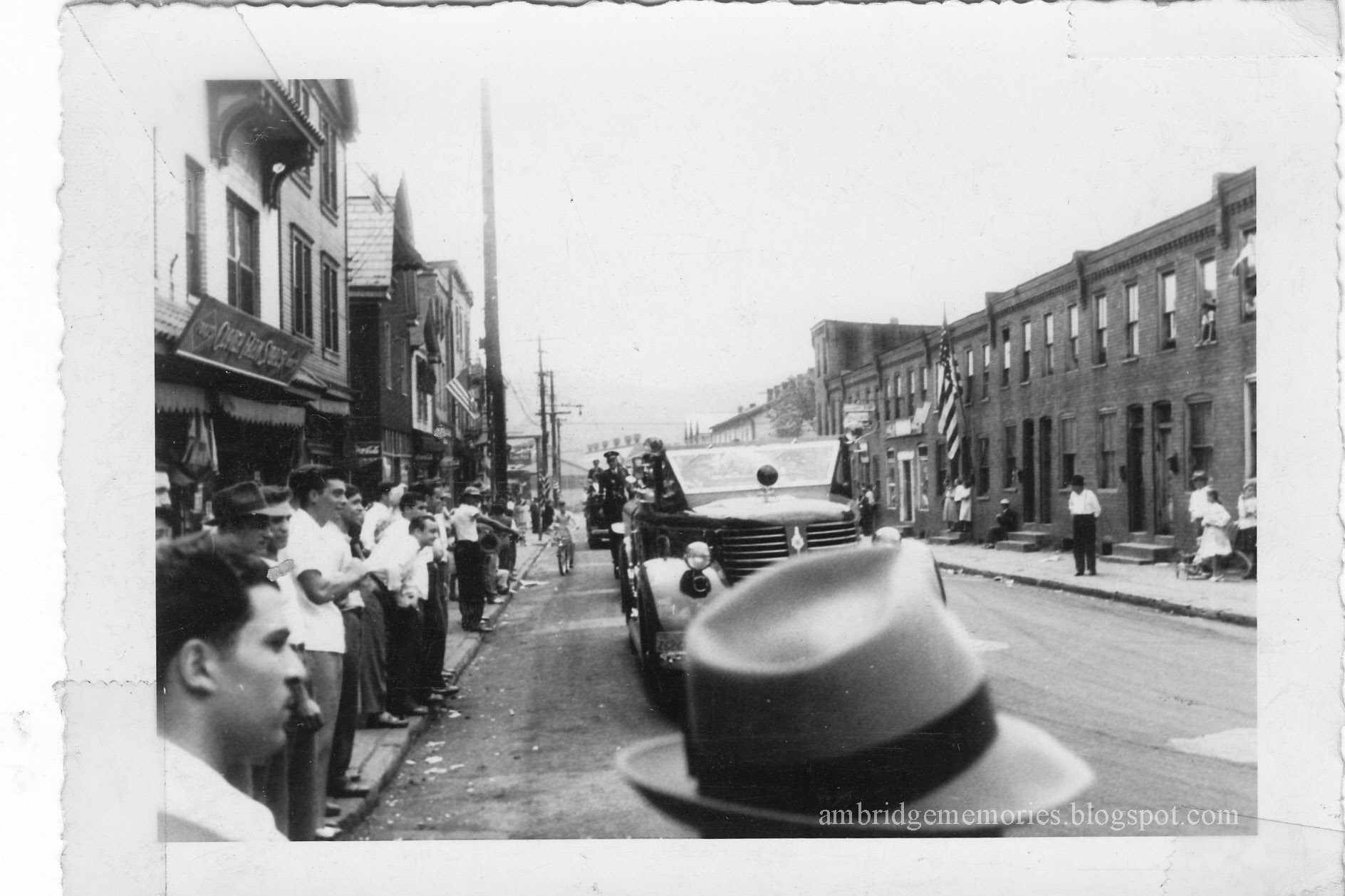
Firetruck
parade traveling along the 200 block of First St.
a row of Marshall Alley buildings on right
on left: Grosdeck's Clover Farm Store, 290-292 First St.


8th St. Toppers float
 making the turn from First St. onto Merchant St.
In background:
Canteen Luncheonette, 300 First St.,
Blossom Grill 296 First St.


Motorcyclist and police cars traveling east on 200 block of First St.
in background at end of street: American Bridge Co.


1916 model car
unidentified driver and passengers
right side: Karas Place, Balkan Restaurant, 291 First St.


Unidentified kilted bagpipers
right side: Karas Place, Balkan Restaurant, 291 First St.


Unidentified Navy flagbearers
200 block First St.
far background, end of street: American Bridge Co.


Conway Airport, Ben Mauro Co. Aviation Division entry
unidentified passenger
200 block First St.
on right: Karas Place, Balkan Restaurant, 291 First St.


Unidentified majorettes
buildings in background: 100, 102, 104, 106 Merchant St.


Taylor's Dairy truck with unidentified clown
200 block First St.
on right: Karas Place, Balkan Restaurant, 291 First St.


Ambridge B.P.O. Elks float
in background: Karas Place, Balkan Restaurant, 291 First St., 
to the right: end units of two rows of Marshall Alley buildings


Unidentified majorettes and drum major
unidentified location


CIO Local 1211 entry
making turn from 200 block First St. onto Merchant St.


Unidentified drum major and majorettes, unidentified spectators
unidentified location


Unidentified majorettes
in background: Karas Place, Balkan Restaurant, 291 First St.


Unidentified color guard and band
200 block First St.


Hot Tamales
representing American Bridge Co. and CIO Local 1270
200 block of First St.


Unidentified rider
Hot Tamales, American Bridge, CIO Local 1270 float
CIO Local 1270 car
on right:
Jimmy's Place, 294 First St.
Blossom Grill, 296 First St. 


Fraternal Order of Eagles 1365
200 block First St.
row of Marshall Alley homes on right


Pittsburgh Mercantile Co. float
on right:
Karas Place, Balkan Restaurant, 291 First St.


Unidentified rider
background: Jimmy's Place, 294 First St.


United Polish Societies entry making turn onto Merchant
On right: Blossom Grill, 296 First St.
buildings on left: on corner: 101 Merchant St.; behind, 303 and 305 First St. 


Unidentified float and revelers 
First and Merchant Sts.
buildings in background: on corner, 100 Merchant St.; behind, 303 and 305 First St.


Unidentified revelers
First and Merchant Sts.
buildings in background: on corner 100 Merchant St.; behind, 303 and 305 First St.
_____

* Not a typo. Patrick Escoto and his father spelled their last names differently.

Sunday, June 20, 2021

Allison's Feed Store, 1904 - 1922


Allison's Feed Store
northeast corner 8th St. and Glenwood Ave.
circa 1915
courtesy Louis Vukovcan family

Robert G. Allison was already advertising his feed and flour business in 1904, the year before Ambridge was incorporated.

R. G. Allison ad
Ambridge-Economy Citizen
Sept. 2, 1904

Allison's first location was in the part of Ambridge that was still referred to as Economy, north of what is now 8th St. But he stayed there for less than a year before moving to a building he'd built in the 300 block of Maplewood Ave., near the intersection of what is now 4th St., located conveniently near the new railroad depot and station on the east side of the new American Bridge plant.

R. B. Allison
Stock Feed & Grains
ad
Pittsburgh Gazette Times
February 8, 1914

Eventually, Allison's business outgrew the Maplewood location, and in 1914, he bought property on the northeast corner of 8th St. (then called Bryden Rd.) and Glenwood Ave. He selected that property because it was located next to the spur rail line that had been built through Ambridge. The "Belt Line" ran from French Point, serviced a rapidly growing number of businesses across Ambridge, and eventfully ended at 8th St. next to Allison's new building. (While the spur line no longer exists, an end-of-the-line "bumper" on the east side of 507 8th St. still does.)

Notice
Weekly Northwestern Miller
Jan. 12, 1916

In 1922, the building Allison built on 8th St. was sold to William Wall, who had decided to close the bakery he'd operated in Ambridge since 1910. 

"R. G. Allison Sells Feed and Seed Store"
The Citizen
July 18, 1922
courtesy Jefrey Wall

At the end of the above article, Allison described his future plans: "When asked what he purposed doing, Mr. Allison replied, 'Nothing at present, except collect up my accounts.'" 

William Wall, then later his sons, continued to operate the business as a feed and grain store until the demand for those dwindled. The Wall family then switched to primarily selling lawn and garden supplies in that building until they closed the business in 1997. 

Below is the what Allison's 8th St. building currently looks like. You can see the spur line bumper to the right of the building. Several small businesses are currently located in the building.

Former Allison's Feed Store
507 8th St.
June 20, 2021
credit: P. J. Shotter

Here's a closer shot of the bumper:

Train bumper
east side of 307 8th St.
June 20, 2021
credit: P. J. Shotter

Sunday, April 11, 2021

Pfeifer Building, 447 Merchant St., 1929


Business and home of R. L. Pfeifer 
Funeral Director
447 Merchant St.
ad
Daily Citizen 
August 10, 1929

Did you ever notice that the Vocelli Pizza building at 447 Merchant St. has "Pfeifer" spelled out in bricks near the top of the façade and wonder why?

Vocelli Pizza
447 Merchant St.
April 9, 2021
credit: P. J. Shotter

Well, about 100 years ago, that building was home to the business of R. L. Pfeifer, a funeral director who also provided ambulance service. The building was also home to Pfeifer and his family.

R. L Pfeifer ad
Economy Centennial Souvenir Program
Economy of Old and Ambridge of Today
June 1924

Robert L. Pfeifer, a WWI veteran, began his funeral business in Ambridge in 1920, and reportedly became a popular and very active part of Ambridge's community. Pfeifer belonged to a number of civic and fraternal organizations in Ambridge including the Rotary, Canady-Hull American Legion Post 341, Masons, Odd Fellows, Elks, and Moose. And he was an active member of Ambridge's Volunteer Fire Department where he held several offices over the years.

Pfeifer also was respected within his profession, serving as president of both the Western Pennsylvania Funeral Directors Association in 1936 - 37 and Beaver County Funeral Directors Association. 

Pfeifer died of a heart attack in 447 Merchant on September 11, 1938, after working almost all night to prepare a body for burial, even though he'd not been feeling well. He would have been 40 on September 13. 

His obituary in the September 12 Daily Citizen was headlined "R. L. Pfeifer, Noted Citizen, Dies Suddenly. Death of Funeral Director, 40, Shock to Ambridge."

Wednesday, March 31, 2021

Great St. Patrick's Day Flood, 1936: Ambridge stories


Unidentified boy looking at train on flooded railroad tracks,
east side of American Bridge Co., at the Ambridge Station 
St. Patrick's Day Flood, 1936
postcard
personal collection


The cause of the 1936 St. Patrick's Day floodthe biggest natural disaster in the history of the Pittsburgh regionhas been blamed on weeks of abnormal weather. First a prolonged cold spell allowed an unusual amount of snow and ice to accumulate. Then, just before St. Patrick's day, a sudden rise in temperature caused a rapid melt. And if those weren't problematic enough, an hours-long downpour added to the amount of water that had already been rising out of local streams and along the banks of Pittsburgh's rivers. Previously unimaginable destruction and death followed in Pittsburgh and many other river communities. 

During the overnight hours of March 17, the Ohio River began to rise in Ambridge. Although located along the river, Ambridge was relatively lucky thanks to its natural topography and to the American Bridge Company's occupation of most of the riverfront. American Bridge, though, wasn't so lucky.

The "crackerbox" tenements that had once stood on the river bank between 9th and 10th street, and flooded in 1907, were gone by 1936. Reportedly, only some of the Ambridge houses on Bank St. along Big Sewickley Creek were flooded. (But neighboring Fair Oaks, on the opposite, lower bank of the creek, wasn't as fortunate. See the photo below.) The rest of Ambridgehomes, businesses, and, with the exception of American Bridge, industrieswere high enough above the flood water that they were spared. 

Flooding in Fair Oaks along Big Sewickley Creek, 
opposite Ambridge
photo was taken from the upper part of Ambridge's Glenwood Dr.,
houses in the foreground are on Valley Rd.
March 1936
courtesy Ambridge Borough


Importantly, no Ambridge resident was reported as drowning in the deep, swift, muddy, and debris-filled floodwater. 

However, Ambridge experienced the same disruption of transportation, news, electricity, gas, phone, and telegraph service as other communities, not only along the river, but beyond.

Duquesne Light Co. substation
across Big Sewickley Creek from Ambridge,
Beaver St., Fair Oaks
March 1936 flood
courtesy Ambridge Borough

Roads were blocked by water, mud, or rockslides, making travel in or out of Ambridge pretty much impossible. Trucks that usually delivered food and other vital supplies could not make the trip into Ambridge. Rail service was suspended; a train was stranded on flooded tracks at the Ambridge station. 

Electric service was iffy and eventually limited to Ambridge's water plant, dairies, bakeries, and the phone company. Streets were unlit; buildings were lit by candles, flashlights, lanterns, and fireplaces for several days. Burgess P. J. Caul issued a special notice on March 20: 

Gas service in Ambridge from 8th St. south was shut off for several days as a safety precaution. As a result, many homes and businesses were unheated and stoves inoperable. 

Ambridge schools were closed until March 23 because they had no lights and heat.

Phone service was limited to emergency calls to the police and fire departments, doctors, drug stores, industrial plants, news offices, and other places that might need to be contacted if there was an emergency.

A big worry was that the Ambridge Water Works, with its location near the river, and already surrounded by water, might flood. Users were urged to conserve water. Ambridge's industrial plants were closed in the hopes that would ensure enough water for residential use. Fortunately, the Water Works survived the flood without contamination from the Ohio.

The only plant in Ambridge that remained open in the immediate aftermath of the flood was National Electric Co., so it could make critically needed replacement electrical equipment for damaged public utilities. But the company had to rely on its own power and water supplies. Electricity wasn't available from Duquesne Light Co. or water from the borough. 

Mail could not be delivered for two days. Outgoing mail couldn't leave Ambridge either.

The Ohio River finally crested in the Ambridge area at noon, March 18, measuring 44.3 feet at Lock No. 4 in Legionville in Harmony Township, more than 18 feet above flood stage. The flood water continued downstream, making its way towards other river towns in Beaver County, West Virginia, and Ohio. 


The flood at American Bridge Company

American Bridge Co.
Ohio River flood
March 18, 1936
postcard
personal collection

Ambridge's American Bridge, the largest structural steel fabricating plant in the world, seems to have been caught off guard by the amount of water the Ohio was rushing towards it that fateful St. Patrick's Day.

Men working at American Bridge the night of March 17 tried to save some of the plant's important property as the river began to push its way in, but the water came in so fast, and rose so high, the men had to abandon the plant at 3 AM. Plant electricians continued to work in the plant's powerhouse until 8 AM when they had to be rescued by boat. Power to the plant was finally shut off. The water continued to rise. 

On the morning of March 18, men who reported for work were sent home. American Bridge's barge yard and main shops were reportedly covered by two feet of water, a foot higher than during the disastrous 1907 flood. As a result, the plant couldn't operate and so was shut down. The local plant manager said all they could do was wait until the water receded to assess the damage. However, the damage was expected to be more than the "thousands of dollars" incurred during the '07 flood. That expectation turned out to be true, but did not do justice to the final cost of returning American Bridge to operating condition as the water continued to rise to a record eight feet.

On March 19, American Bridge officials said that the plant was still under four or five feet of water, after dropping about three feet from its high mark at 8 PM the day before. Repairs in the plant couldn't begin until the water receded. (Daily Citizen, March 20, 1936)

By March 20, water at American Bridge had receded "to the top of the lower level of the boat yard ways." Cleanup by several hundred employees began that morning. The "reclamation" and "re-conditioning" started in offices, shops, and yards where mud and debris had to be removed. Replacement of records and files destroyed by the flood began. Motors were taken to Ambridge's National Electric Co. plant to be cleaned and dried.

Once the power was turned back on, more workers would be added to complete the cleanup which would require "weeks" to finish. 

Cleanup continuing through April 6, when the all departments finally reopened. However, only the barge yard and a limited number of other departments were back to full operation. Other departments still were unable to fully open because the power plant, while working again, couldn't yet provide enough power. (Daily Times, April 8, 1936)


The Daily Citizen publishes despite obstacles

Getting news in 1936 wasn't always quick and easy in ordinary times, but for a while during and after the flood, finding out what was happening was much more difficult than usual. 

Most people relied on local newspapers and, maybe a radio if they, or a neighbor, were lucky enough to own one during the depression years. 

But without electricity, radio stations couldn't broadcast. Pittsburgh's powerhouse station KDKA could only broadcast intermittent alerts and emergency information. And without electricity, Ambridge residents couldn't hear radio news anyway. Battery operated radios weren't common then, and the batteries required electrical recharging. 

Ambridge's Daily Citizen found gathering and printing the news to be quite a challenge, but they, with the generous help of newspapers from neighboring towns, made a valiant effort.

The morning United Press news report usually delivered to Ambridge's train depot didn't come on March 18. UP's Pittsburgh office was flooded, so the Citizen had to get most of its stories via long distance calls from Cleveland, Ohio. When UP finally was able to contact the Citizen "by special wire," the reporter had to read the information by flashlight. 

With its gas service cut off, the Citizen couldn't operate the gas-heated linotype machines used for most of its printing. But the Sewickley Herald offered the use of their linotypes, enabling the Citizen to print "a limited amount of copy." The Citizen noted the published paper's unusual appearance, since it was set with the different typefaces used by both newspapers. Beaver's Daily Times also helped by sending "five galleys of their early copy."

Yet another problem arrived two days later when the Citizen's printing plant lost electric power, stopping its ability to print. But the Citizen was able to publish a four page edition, thanks to the Beaver Falls News-Tribune, which allowed the Citizen to use its equipment.

But that wasn't the end of the problems created by the flood. Four days into the flood, all of Beaver County lost electric power, and none of the papers in Beaver County could print. But the Citizen's staff still was determined to print a paper. Here's how they accomplished that with ingenuity, some unusual help from two people in Ambridge, an Ambridge industrial plant which had its own electrical supply, an extraordinary effort by the paper's staff, and finally, the help of a newspaper in neighboring Butler County:
A small motor was dismantled from a washing machine, loaned by [Ambridge business owner] C. F. Milleman, and attached to one of linotype machines.

At 2 o'clock this morning, employees practically dismantled the mangle and sewing machine of Mrs. Anna Ross, 184 Sixth Street, in order to procure the pully and gadgets found necessary for the completion of the primitive but nevertheless effective contrivance. Operators worked all night preparing for today's issue by the light provided by two kerosene lamps, a lantern and flashlights. The entire force was kept busy this morning setting much of the copy by hand. The Citizen's portable saw was moved to the plant of the National Electric Company where their power was used in order to trim all advertising cuts.

Forms and type were then transported by [automobile] to Butler, where the paper was printed on the Butler Eagle press. 

The Ambridge marauders and one man's excuse

A number of out-of-town papers wrote about a mob from Ambridge that had gone to neighboring Leetsdale, a community that had suffered a great deal of flood damage, in order to loot. Leetsdale residents objected. A riot ensued. Leetsdale's police chief had to call the National Guard to help.

Here's the Pittsburgh Post-Gazette's March 21 account of the story:


I haven't yet found Ambridge's version of the whole Leetsdale looting story in the Daily Citizen, although according to the March 24 issue, one of the arrested Ambridge men offered an explanation of his actions to a judge:
Joe Gilbert, Bank street, Ambridge, was held under $2,500 bond at a hearing before Judge Ralph Smith, in Allegheny court yesterday on a charge of larceny, and he was committed to the Allegheny county jail.

Gilbert was one of the men arrested by the Leetsdale police for looting in the flooded area. According to Gilbert's story, he had no intention of stealing, but had come across a garage lodged against a tree in the garden flats 300 yards away from any house, and that looking in, he saw a raincoat and a jack, which he thought he was entitled to, since he had found them. Judge Smith, however, thought otherwise
.
The March 23 Citizen did say in an article about Leetsdale's flood damage and cleanup that eight of the nine Ambridge men who had been arrested were sent home "with a warning not to be caught back in Leetsdale again" and added:
Twenty-two Leetsdale residents, mostly members of the fire department, were deputized as special police by the [Leetsdale] Burgess and were armed with sawed off shot guns with orders to shoot in the legs anyone caught below the railroad tracks after dark. 

The missing Ambridge boy

Another Ambridge story that made a lot of out-of-town papers was about a missing 16 year-old boy who hadn't come home after visiting his grandmother in South Heights, across the Ohio, a few days after the flood had arrived in Ambridge. Naturally, his parents were frantic and search parties sent out, but they failed to find the boy. However, the story ended with a weird twist. Here's what the Daily Citizen wrote in its Monday, March 23 issue:
After three days of frantic searching for Elmer Bauder, 16-year old son of John Bauder, 554 Maplewood avenue, missing since Friday [March 20], word was received this morning that he was all-right and he had started on a trip.

Friday morning, young Bauder invited Frank McGeorge to go to South Heights to his grandmother's to get a warm dinner. When told that he would be over there for two or three hours, McGeorge declined saying that he had to be home in an hour. He asked Bauder if the "gang" would see him that night and was given the assurance that they would.

He went to the home of his grandmother, Mrs. Elmer Laughner, where he did have dinner. He was given $3 to buy galoshes and went to Beck's store for this purpose. They did not have the kind he wanted and he said he would wait until he returned to Ambridge. At 1:30 o'clock he walked out of the store and that was the last that was known of his whereabouts.

Police were notified and searches of parties of three and four have combed Ambridge and the South Heights districts. Yesterday, the state police sent out a teletype of his description. He disappearance also had been broadcast over the radio.

This morning, John Bauder, received a postal card, postmarked midnight Friday from the Oakland Branch of the Pittsburgh postoffice. It read:

"Dad, don't worry. I'm alright. I'm going someplace. I'll be back home shortly. Tell Grandmother Laughner I'm away on a trip with the DeMolays" signed, "Red."

The reference to the trip with the DeMolays was made because of the illness of Mrs. Laughner and he evidently did not want his grandmother to worry about him.

It is thought that the youth got a ride to Pittsburgh on a delivery truck and, having $8 in his pocket, decided to go to Johnstown to view the results of the flood. Another conjecture is that he is heading south with the intention of visiting Lawrence Shomo, who is attending Atlanta Military Academy at Port Defiance, Virginia, and then continuing to St. Petersburgh to visit his uncle, who owns a drug store there.

There had been no trouble between the boy and his relatives so it evidently had not been premeditated as he was not dressed up when he left home Friday.
I was told that Elmer eventually returned home, but as of yet, I don't know when. Or what his parents had to say to him when he did.


The floating garage
The floating garage crashing against a pier of the Ambridge-Aliquippa bridge let go an automobile which quickly sank while another [automobile] was lodged safely in the remaining part of the building as it moved down steam. (Daily Citizen, March 20, 1936)
_____

The information in this article came from reporting in Ambridge's Daily Citizen newspaper unless another source is named.