Showing posts with label stores. Show all posts

Sunday, December 11, 2022

Ambridge's Hayes Flower Shop

Hayes Flower Shop
624 Merchant St.
ad
Daily Citizen
August 10, 1929

The Hayes Flower Shop was a long-time Ambridge business. I don't know when the shop opened, but it had an ad, shown below, in Old Economy's 1924 Centennial book, Economy of Old and Ambridge of Today. At that time it was located at 455 Merchant St., an address that no longer exists.

Hayes' Flower Shop ad
Economy of Old and Ambridge of Today
June 1924

The flower shop later moved to a storefront at 624 Merchant in the Prince Theatre building. That new location was the only storefront in the Prince building to the right of the theater's entrance. I don't know when the flower shop moved into that space. That address also no longer exists.

I know the shop was still in business in 1937 because it placed the ad below in the St. Veronica High School Senior Class play program. But I don't know when it closed.

Hayes Flower Shop ad
St. Veronica High School
Senior Class play program
May 24, 1937
courtesy St. Luke Parish Valley archives

If I find out when the flower shop opened, moved from one location to the other, or closed, I'll update this post.
_____ 

If you have any additional information about the Hayes Flower Shop, or any businesses which later occupied that storefront, perhaps with a different building number, please post a comment. Or let me know via email or on the blog's Facebook page.

I still don't know when the Prince Theatre's former entrance and storefronts were razed. Based on the information in the blog's post about the history of the Prince Theatre, maybe in the 1980s? I'd appreciate any information.

Wednesday, July 6, 2022

Five young men, 5th and Merchant Sts., 1947


3rd from left, Pete Lusty
2nd from left, John Smetanka
other young men unknown
1947
courtesy Dave Lusty

Dave Lusty, AHS '72, sent me this photo of his father, Pete Lusty, and four of his buddies, posing on the west side of Merchant St. near 5th St. in 1947. Pete Lusty would have been 20 years old at the time.

John Smetanka is the only of the four other young men that Dave could identify. If you know who any of the other three are, please leave a comment or contact me.

Note the streetcar tracks on Merchant St. Street cars through Ambridge were replaced by buses in 1934, but the tracks on Merchant St. weren't covered until 1958.

On the east side of Merchant, you can see the Penn Theatre's marquee. To the theater's right: The Penn Grill restaurant and Denmark's shoe store,

The building with the clock is the Economy Bank of Ambridge which was across 5th St. at 500 Merchant.

The Penn Theatre closed in the early 1950s, and the Melody Ballroom opened in the theater's former location in September 1953. The ballroom, Penn Grill, and Denmark's were all badly damaged in a big July 1954 fire. Another massive fire damaged the businesses that occupied the former theater in February 1963: the Bride and Deb Shop on the corner, Penn Grill, and Hankins Shoe Store. 

The former Penn Theatre building was razed after the 1963 fire, replaced by a parking lot. More recently, that corner was the location of the now-closed PNC Bank in 1984

The Economy Bank building was razed in 1984. WesBanco's drive though is now located where the bank once stood. 

Friday, June 3, 2022

Mikush Home Appliance Center, Ambridge's last appliance store


Mikush Home Appliance Center
811 Merchant St.
August 11, 2021
credit: P.J. Shotter

Once, in the 1950s - 1960s, the Mikush Appliance store was one of a number of stores on Ambridge's Merchant St. where a shopper could buy major appliances like washers and dryers, stoves, refrigerators, and dishwashers. Some others were Kubek's, Capital, Timney's, and Kelly & Cohen. Ambridge's Sears also did a big business selling appliances. Plus some furniture stores--including Ambridge, Economy, Modern, Goorin & Harris, and Darcel's--also sold them. 

But starting in the 1950s, all of Ambridge's stores were hit hard by a series of blows: the opening of Northern Lights Shopping Center in Baden; the extension of Ohio River Blvd. from Ambridge's 8th St. to Baden, eliminating the need to drive through downtown Ambridge; and then the biggest blow of all: the collapse of the U.S. steel industry and closing of the area's plants and mills in the 1980s. The growth of big box stores in the area didn't help.

So one by one the places that sold appliances in Ambridge closed, until only one remains: Mikush Appliance. 

I believe that Mikush Appliance is now the second oldest retail store in Ambridge, with only Stangl's Bakery being older. Perhaps their longevity is related to the fact that the two stores have been family owned and operated since the businesses began.

Mikush Appliance's story
Andrew Mikush Sr.
courtesy Bob Mikush

In 1929, a Yugoslavian immigrant with a third-grade education, Andrew G. Mikush Sr. [Andrew Sr. elsewhere in this blog post], began going door-to-door selling merchandise that now seems rather unusual: appliances.

But in the days before many families owned cars, selling appliances door-to-door must have been a savvy business idea for Andrew Sr.'s employer, Milleman's, a long-time Ambridge store that sold pianos and appliances.

Andrew Sr., who had worked as a delivery man for Milleman's, turned out to be a quite successful salesman. According to his grandson, Bob Mikush, people trusted his grandfather to understand their needs, undoubtedly helped by his self-taught ability to speak the languages of many of Ambridge's immigrants including Greek, Italian, Polish, and several other Slavic languages. 

Andrew Sr. had a talent for repairing appliances too and developed a reputation not only as an honest seller, but also a skilled appliance repairman, an important skill during the depression years when many people couldn't afford to buy a new appliance when the one they owned stopped working.

In 1932, with Mr. Milleman's support, Andrew Sr. was able to open a business at 926 Duss Ave. (which many might remember as the location of J. Strock Memorials for many years). There he sold and repaired a variety of new and used appliances and their parts: washers, ironers, stoves, vacuums. And, according to his business card, he also sold radios and pianos.  

Thanks to his impressive success, Andrew Sr. was given the Maytag appliance franchise in Ambridge, making the business one of Maytag's earliest dealers. 

Andrew Mikush Sr.'s business card
926 Duss Ave.
courtesy: Bob Mikush

Andrew Sr. wanted to move his business from Duss Ave, to Merchant St., but despite the Great Depression, Merchant St. was busy, and there wasn't any available space he could lease.

Still, Andrew Sr.'s business didn't remain on Duss Ave. for long. By the late 1930s, Andrew Sr. had moved his business to 601 Melrose Ave., a block east of Merchant. While the primary reason the business thrived was probably Andrew Sr.'s reputation for personal customer service, he also seems to have had a knack for promoting special bonuses for buyers. 

Andrew Mikush
classified ad
Daily Citizen
December 3, 1937

Andrew Mikush Sr.
behind counter of store at
601 Melrose Ave.
courtesy Bob Mikush


Andrew Mikush
"All Makes of Electrical Appliances"
601 Melrose Ave.
ad
"Minstrel Varieties" program
Ushers Club of St. Veronica's Church
April 1949
courtesy Good Samaritan Parish Archives

Although I don't know yet exactly when Mikush Appliances was finally able to move into a store on Merchant St., based on the ads above and below, the move to 818 Merchant St. was apparently sometime between April 1949 and December 1950. (I'll update this article if I find a more exact date.)

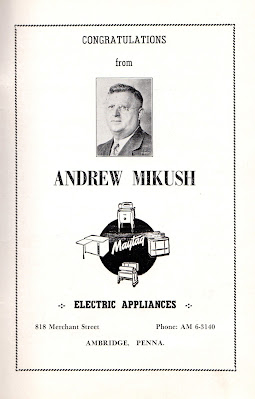
Andrew Mikush
Electric Appliances
818 Merchant St.
ad
Holy Trinity Dedication program
December 17, 1950


Andrew Mikush Sr. posing behind business' float
for the Ambridge Golden Jubilee parade
on float, grandchildren Roberta Mikush (now Sciulli)
and Andrew "Whitey" Mikush
in front of 818 Merchant St. store
July 1955
courtesy Borough of Ambridge


Andrew Mikush Sr. in front of Mikush Maytag Appliances
818 Merchant St.
Daily Citizen Trade Area Directory
1956


Andrew Mikush Appliance ad
Daily Citizen Trade Area Directory
1956

In 1962, Andrew Sr. retired and handed the store over to his son, Andrew R. Mikush Jr.

Andrew Mikush Jr.
ad
Bridger yearbook, 1971

A January 31, 1969, Beaver County Times article about Mikush Appliance's history and award-winning service, mentioned that the business soon would be moving to a larger building, purchased the previous year. The new location, at 811 Merchant St., previously Jay's Floor Covering store, would undergo extensive remodeling before a grand opening. Mikush Appliances has done business there ever since.
 
Mikush family in appliance store
811 Merchant St.
credit: Beaver County Times, March 23, 1997

Caption under photo above:
The Mikush family has been in business in Ambridge since the 1930s. From left are Whitey Mikush, Bob Mikush, Andrew Mikush and Bryan Mikush.
Andrew Jr. retired in 2001. His grandson, Bryan, now owns and operates the business.

Over the years, Mikush Appliances was recognized on several occasions by Maytag for their outstanding sales and service including the Maytag Red Carpet Service Excellence Award and the Outstanding Maytag Dealer Award. Bob Mikush also was invited to speak at the National Home Appliance Center Convention--twice. Even TV's lonely Maytag Repairman visited.
 
The lonely Maytag Repairman (actor Gordon Jump) visits Mikush Appliances
On left: WMBA announcer Dave Justice
On right: Andrew Mikush, Jr. and Al Serak
June 14, 1996
courtesy Bob Mikush

Recently, there's been a twist to the Mikush Appliances story: Despite the signs on the business that still say "Maytag," the store stopped selling Maytag appliances a few years ago. Bob Mikush said that after Maytag was sold to Whirlpool in 2005, the quality of appliances sold under the Maytag name just wasn't up to Mikush Appliances' standards that customers expected. 

Yet, amazingly, despite the competition from today's big box stores and the development of new shopping areas like Cranberry and Robinson Township, the store still sells appliances, although the models on display aren't as numerous as they once were. Most of its business is now in repairs and selling parts. But personal customer service is still its focus.


Some other things that make Mikush Home Appliance Center special:

- The business truly has been a family business for four generations. In addition to the founder Andrew Sr., Mikush family members who have been involved in the business include: Andrew Sr.'s sons, Andrew Jr. and Steve; grandsons Andrew (Whitey) and Bob and granddaughter Roberta; and great-grandson Bryan.

Roberta Mikush Sculli provided this memory:

My mom maintained the flower container outside the store, vacuumed and kept the store clean. When we were located across the street, I remember my grandmother coming to serve lunch. It was a full lunch like they ate in Europe. They ate their main meal at lunch.  My grandfather locked the front door and we all ate together.

- Bob Mikush will repair lamps at the store.

Bob Mikush with lamps needing repair
November 25, 2015
courtesy Ambridge Area Chamber of Commerce


- The store has decades of both Maytag and Ambridge memorabilia on display.

- Bob Mikush is a wonderful source of information about Ambridge's history.

- The business has been a frequent supporter of many Ambridge events, schools, and organizations.

Tuesday, December 14, 2021

Marketing the new town of Ambridge: Part 1: Porter Locomotive is coming! Porter Locomotive is coming! But did it?


Real Estate Trust Co. ad for Economy-Ambridge
"The H. K. Porter Company"
"Locomotive Shops to Employ 2,000 to 3,000 Men"
Pittsburg Press,
April 18, 1906

In 1903, the American Bridge Company started building the world's largest structural steel fabricating plant along the east side of the Ohio River. The building site was on land that had once belonged to the Harmony Society, which by then, had faded away, becoming history.

In the former Harmonist village of Economy, north of the new plant, a small number of non-Harmonist businesses and employees of the Society remained. But beyond the village, there was mostly undeveloped land: fields, orchards, vineyards, and pastures, occasionally punctuated by coke ovens and oil and gas wells.

Now think of what the American Bridge Co. had to do to start a thriving industrial town from basically scratch.

Sure, the company might have no problem attracting the massive labor force needed to build, then work in, their new plant. But think of everything those workers would need. Homes, food, supplies, transportation, banks, postal service, schools, churches. And what about infrastructure? Who would build streets, sidewalks, sewers, a water system? How do you attract professionals needed to care for the sick or bury the dead?

American Bridge did pretty much what's still done today. It hired a real estate company. And that company advertised.

The Real Estate Trust Co. of Pittsburgh, which had a branch office at the corner of Park Rd. and 5th St. in Ambridge, was given the task of selling the new town of Ambridge to potential businesses, investors, and residents. Early on, the company published a multi-page sales brochure, "Ambridge, Reasons for Her Coming Greatness," with descriptions and photos of the very early stages of the building of the American Bridge plant and Ambridge's infrastructure.

In May 1904, the real estate company placed two full-page ads in the Pittsburg* Press, touting the marvels of the new "manufacturing city" of Economy. The "Ambridge" name hadn't caught on yet.

The first ad, full of hyperbole and fantastic predictions, offered a free train excursion to see "the greatest industrial and city building progress in modern times." I highly recommend reading the ad; it's not only entertaining, but offers a jaw-dropping view of the early plans for Ambridge's development. (The ad's easiest to read if you visit the digital Pittsburg Press from May 3, 1904.)

Ad for "The Marvel City"
Pittsburg Press
May 23, 1904

The following day, the Press featured another full-page ad.

Ad for "The Marvel City"
Pittsburg Press
May 24, 1904

This second ad still contained some of the same amazing predictions about the future Ambridge as the previous day's ad did. But I think the seconds ad's most astonishing selling point was that it featured former Harmony Society trustee, "world's famous bandmaster," John Duss, saying his "greatest achievement" was selling "miles of level plateau to capitalists." (Click here to read the ad in the digital Pittsburg Press.)

In the spring of 1906, the same real estate company started placing a series of smaller ads in the Pittsburg PressPittsburgh Post, and Pittsburgh Gazette, this time focusing not on what Ambridge was going to become, but rather on what Ambridge already was.

The exception to these ads featuring Ambridge's already-existing amenities, buildings, and infrastructure were the earliest five that I found. Those five ads announced that the famous Porter Locomotive Co., which made small industrial locomotives used in places like mills, lumberyards, and mines, had plans for a huge new plant in Ambridge.

These Porter Locomotive ads were the only ones I've found in the series that were about an industry that was yet to come to Ambridge. And the only ads to feature the same reason Ambridge was wonderful more than once. Later, Porter Locomotive's coming to Ambridge was mentioned in several subsequent ads which I plan to feature in separate posts.


Real Estate Trust Co. ad for Economy-Ambridge
"Porter Locomotives Will Haul Money into Economy-Ambridge"
Pittsburgh Post,
April 20, 1906

Real Estate Trust Co. ad for Economy-Ambridge
"Porter Locomotive Shops"
"Double The Capacity of The Company's Present Shops"
Pittsburg Press,
April 22, 1906


Real Estate Trust Co. ad for Economy-Ambridge
"A Wonderful Engine"
"Economy = Ambridge"
Pittsburgh Post
April 24, 1906


Real Estate Trust Co. ad for Economy-Ambridge
"Realty Values in Economy-Ambridge Forge Ahead"
"one of the largest locomotive works in the world will commence operations"
Pittsburgh Post
April 26, 1906


Did Porter Locomotive ever come to Ambridge?

Over many months I've looked for information about the Porter Locomotive plant in Ambridge, so highly anticipated in 1906 and '07.

To be sure, Porter Locomotive's plans to move its existing Pittsburgh plant to a new plant in Ambridge wasn't just some advertising hoopla dreamed up by the Real Estate Trust Company to sell property. Not only was there information about the planned move in several newspapers, but also, thanks to Sarah Buffington, Old Economy Village's curator, I now have a copy of a 1906 deed showing that the H. K. Porter Co. bought property, not exactly in Ambridge, but rather a bit north, in Harmony Township's Legionville.   

And yes, in 1959, the H. K. Porter Corp. purchased Ambridge's National Electric plant. But by then Porter was no longer making locomotives, and National Electric, which produced electrical products, wasn't located on the property that Porter Locomotive bought in Legionville in 1906.

It looks to me as if Porter Locomotive's Pittsburgh plant remained opened. And that Porter Locomotive may have opened additional plants in locations other than Ambridge. 

I found no information about Porter Locomotive ever building a plant, hiring workers, or producing locomotives in Legionville or Ambridge. Did any of that ever happen?

I've seen Porter Locomotive listed among Ambridge's industries in several places, but none provide more information than the name, and perhaps, mention that it was north of Ambridge. Although I checked with a couple of the writers who had said Porter Locomotive was in Ambridge, they couldn't offer me more information.

So, did Porter Locomotives ever build a plant and manufacture locomotives in or near Ambridge? I don't have the definitive answer to that yet. But right now, I'm inclined to say "no."

I do know that in 1917, Porter sold at least some of the Legionville property to the Firth Sterling Steel Co., and that Firth Sterling later sold the property to several buyers, but that's about it. One of the buyers was Spang Chalfant Co. which according to a March 21, 1939, Daily Citizen article, bought 55 acres on the flat area between the railroad and the Ohio River, previously an "old dairy farm."

There may be people who can tell me about Legionville's history during 1906 - 1917, and I know there are people who know a lot about the history of the Porter Locomotive Co. If anyone can help with additional information about what happened with the plan to move Pittsburgh's Porter Locomotive plant to Legionville, I'd be grateful.
_____

* For a time, the Pittsburgh Press spelled its name "Pittsburg Press," the no "h" spelling dictated by the United States Board on Geographic Names. Other Pittsburgh papers kept the "h". Eventually, the Pittsburgh Press added the "h" back.

Sunday, June 20, 2021

Allison's Feed Store, 1904 - 1922


Allison's Feed Store
northeast corner 8th St. and Glenwood Ave.
circa 1915
courtesy Louis Vukovcan family

Robert G. Allison was already advertising his feed and flour business in 1904, the year before Ambridge was incorporated.

R. G. Allison ad
Ambridge-Economy Citizen
Sept. 2, 1904

Allison's first location was in the part of Ambridge that was still referred to as Economy, north of what is now 8th St. But he stayed there for less than a year before moving to a building he'd built in the 300 block of Maplewood Ave., near the intersection of what is now 4th St., located conveniently near the new railroad depot and station on the east side of the new American Bridge plant.

R. B. Allison
Stock Feed & Grains
ad
Pittsburgh Gazette Times
February 8, 1914

Eventually, Allison's business outgrew the Maplewood location, and in 1914, he bought property on the northeast corner of 8th St. (then called Bryden Rd.) and Glenwood Ave. He selected that property because it was located next to the spur rail line that had been built through Ambridge. The "Belt Line" ran from French Point, serviced a rapidly growing number of businesses across Ambridge, and eventfully ended at 8th St. next to Allison's new building. (While the spur line no longer exists, an end-of-the-line "bumper" on the east side of 507 8th St. still does.)

Notice
Weekly Northwestern Miller
Jan. 12, 1916

In 1922, the building Allison built on 8th St. was sold to William Wall, who had decided to close the bakery he'd operated in Ambridge since 1910. 

"R. G. Allison Sells Feed and Seed Store"
The Citizen
July 18, 1922
courtesy Jefrey Wall

At the end of the above article, Allison described his future plans: "When asked what he purposed doing, Mr. Allison replied, 'Nothing at present, except collect up my accounts.'" 

William Wall, then later his sons, continued to operate the business as a feed and grain store until the demand for those dwindled. The Wall family then switched to primarily selling lawn and garden supplies in that building until they closed the business in 1997. 

Below is the what Allison's 8th St. building currently looks like. You can see the spur line bumper to the right of the building. Several small businesses are currently located in the building.

Former Allison's Feed Store
507 8th St.
June 20, 2021
credit: P. J. Shotter

Here's a closer shot of the bumper:

Train bumper
east side of 307 8th St.
June 20, 2021
credit: P. J. Shotter

Friday, November 8, 2019

Mohn's Grocery, Clover Farm Store

Mohn's Grocery
Clover Farm Store
location unknown
Old Economy Village archives, MG-332
used with permission

The above photo came from the Old Economy Village archives and was sent to me by Amy Andre who asked me if I had any information about the Mohn's Grocery store. An "Ambridge + four-digits" phone number is on the store's sign, but was the store in Ambridge and if so, where? Or perhaps was it in an Ambridge-area community that had phone numbers on the Ambridge phone exchange, like Fair Oaks (Leet Township) or Leetsdale?

Amy wrote:
I am a descendant of the Mohn family and was doing research at the Old Economy historical society on the Henry Mohn/Melina Feucht family and found this photo.
In a later email, Amy provided the following information:
There are still Mohn family members in Ambridge and Leetsdale but I don't know any of them, even though they would be cousins of mine. Henry Mohn's wife Melina Feucht was associated with the Harmonist's Society. Her father and sisters were members of the society. Melina's father is buried in the Harmonist's cemetery at Old Economy Village. It would be interesting to find out which Mohn owned the Mohn Grocery Store. 
My line of the Mohn family is Frederick Mohn and his wife Esther Keck. Frederick was born in Germany as was his wife Esther. The Keck family settled in Doreyville, Allegheny, PA. Frederick's children were born in Haysville, Leetsdale and Allegheny City (now Pittsburgh's North Side. Frederick did have some siblings that came with him to America and settled in the same areas.
Unfortunately, I have exhausted all the research materials I have at hand and have come up with nothing helpful. Can anyone help?

Here are two clues to narrow your search if you start one:
Clover Farms, a cooperative grocery chain, began in 1926.
It appears from ads that the "Ambridge + 4 digits" phone numbers began to be used in the 1940s.

I know there were once Clover Farm Stores in Ambridge: one was at 798 15th St. but I don't know the grocery's name; however that building looks nothing like the store in the photo. The Csurny's Clover Farm store was at 6th St. and Glenwood Ave. and Grosdeck's Clover Farm Store was at 290 - 292 1st St.

Update June 8, 2020: The location of Mohn's Grocery has been found! The grocery was hiding in plain sight, with an exterior so altered, it would be impossible to identify--unless you knew where to look.*

Turns out I was right when I wondered if the store might have been in Leetsdale.

Here's what Mohn's Grocery looks like now:

175 Broad St.,
Leetsdale PA
May 28, 2020
credit: Thomas Beerman

Thomas Beerman, the current resident of the building, recently left a comment about this post:

"This is the house I now live in ! It is located on broad st in leetsdale, still have the old meat hooks, our kitchen was the meat cooler!" In a second comment, he added that his family had lived in the building since the Mohn's Grocery closed in the 1950s.

Those comments were later followed by several emails in which Thomas told me that he had come across this blog post about Mohn's Grocery while he was looking for information about the furniture store that was once next door, now a warehouse. And he sent me the above photo of the former grocery as it looks today.

He said his mom and dad, 
Jean and Leo Beerman, bought the store in 1947 while it was still operating, but the grocery "went out of business when the steel mills went on strike! [My dad] turned [the building] into 2 apartments and then one house when times were rough." He added that the store's meat hooks that once were in his kitchen were now in his garage.

After I told him I would be interested in seeing what the meat hooks now looked like, he was gracious enough to send me a photo:


Meat hooks from former Mohn's Grocery
garage at 175 Broad St.
Leetsdale PA
May 28, 2020
credit: Thomas Beerman

I love when an history mystery gets solved! Especially since this one has a happy ending in that the Mohn's Grocery building still exists.

Although I still don't have any information about whether the Leetsdale Mohn's Grocery was owned by someone related to Henry Mohn, whose wife had connections with the Harmony Society.
_____

* In the past, I've come across other old buildings "hiding in plain sight," for example Ambridge's Kingdom Hall or Blaine House, an early home of George (Father) Rapp, later used by the Harmony Society as a school.

Saturday, October 5, 2019

Lower 100 block of Merchant St. circa 1905

Tenement building
circa 1905
lower 100 block of Merchant St., west side
courtesy Good Samaritan Parish Archives

I assume that not many photos were taken of early Ambridge and of those, precious few have survived. So I was very excited to see this absolute treasure of a photo, recently donated to the Good Samaritan Parish Archives by Diane Crevar Petcash. Diane is the great-granddaughter of Ambridge department store owner Stephen P. Kristufek. Stephen, frequently referred to as S. P., was the younger brother of the more well-known Ambridge builder, banker, realtor, insurance broker, and councilman Charles Kristufek.

The photo's most prominent building is a large three-story wooden tenement. There's a two-story dwelling to its right, and on the far right side, there's a market that sold groceries and meat. Merchant St. is unpaved. And of course, you can't miss the horse that may be pulling a wagon. None of the people in the photo have been identified.

Diane's great-grandfather S. P. Kristufek, and his wife Mary, owned one of Ambridge's most successful pioneer businesses, the S. P. Kristufek store, at the triangular intersection of Merchant St. and Beaver St./Rd. (labeled Duss Ave. on some early maps of Ambridge.) S.P.'s store had an interesting history, and if you haven't read the blog post about it yet, you may want to click on the link at the start of this paragraph.

Diane provided the 1905 date of the photo, but didn't know the location of the buildings. Amazingly, Maria Notarianni, who heads the Good Samaritan Archive committee, was able to locate where the buildings had been, on the 1911 Sanborn Insurance map of Ambridge:

The map shows S.P.'s store was across Merchant from the small apartment building and the market in the photo. On the snip of the map below, the tenement is the large yellow building marked "Tenements" just above the three rows of pink Marshall Alley dwellings. S. P.'s store is the triangular building at the intersection of Merchant and "Duss" on the map.

lower part of 100 block of Merchant St.
Sanborn Insurance map of Ambridge
 1911

The tenement is gone, probably long before the First St. area was cleared for redevelopment in the early 1970s, but I can't say that with certainty. So if you remember the tenement--or a different building in the tenement's location (115 Merchant St.)--please let me know when that was.

Diane believes that the tenement had some connection to S. P. Kristufek, since the photo of it was passed down to her along with other family photos, but didn't know what that connection was. I'm doubtful that a relatively wealthy family like S.P.'s would live in a tenement. Except for the time between S.P.'s first store's destruction by fire and his building a second store at the same location, he probably lived above his store, as is mentioned in a newspaper article about an attempted burglary of his second store.

So, what was the connection between S. P. and the tenement? Did S. P. Kristufek build and then perhaps later rent out the tenement when more people moved to Ambridge than he could provide with room and board in his store's building? Was the building occupied by some of S. P.'s more distant family members? Is it possible that S.P.'s family just wanted a photo of the buildings across the street from their store--and because the family was relatively wealthy, could afford to have one taken? I hope more research into Ambridge's earliest years will provide the answer.
_____

Before writing this, I contacted another of S. P. Kristufek's great-grandchildren, Josh Selley, to see if he had any information about the tenement and its connection to S. P. He did not.

Sunday, August 4, 2019

The Prince Theatre Building

Prince Theatre Building
600 block of Merchant St., East (even numbered) side
1951
courtesy Jeffrey Snedden

This wonderful photo of Ambridge's Prince Theatre Building came from Jeffrey Snedden, the writer of the "Histories and Mysteries" column in the Beaver County Times. Ambridge's Dollar General store and its parking lot are now where this building once was.

Although the long-closed theater auditorium, which was behind the row of storefronts on Merchant St., was razed in 1991, the storefronts remained for a number of years, but were gone by 2008.

In the photo you can see the Prince Theatre's marquee and entrance to the theater at 638 Merchant St., as well as the stores that lined the theater's facade. To the theater's right is Maynard's Jewelry, 628 Merchant St. On the theater's left is a storefront that says "Children's Wear." That would have been Stork's Nest, owned by Sally Rubenstein, wife of Ambridge High School's legendary football coach, Moe Rubenstein, 650 Merchant St.

That sliver of white on the far right of the photo was Timney's Appliances, 612 Merchant St., razed in July 2013. Its location is now also part of the Dollar General building.

On the second floor of the building there's a sign advertising "Signs of all kinds" and at the far end, another sign for "Guardian Loans."

Right now, I can't say with confidence what businesses were in the three storefronts to the left of Stork's Nest at the time the photo was taken, but I think I see a barber pole between the last two. If I can later confirm what those businesses were, I'll update this post.

New information about the Prince Theatre.

Here's some information I learned about the Prince since my blog post about the theater on April 30, 2016. To put the new information in context, I recommend you read that earlier blog post as well as this one.

The Prince was opened in late 1919 by G. W. Prince and at that time, it was managed by Marcus (Ben) Nadler who later owned the theater. In January 3, 1920, The Citizen announced that the Prince would temporarily close, but planned to give occasional performances. No explanation for its closing was provided.

According to the April 21, 1923, issue of the Pittsburgh Moving Picture Bulletin, the Prince had been "closed for the past two years," but was scheduled to reopen on Sept. 1, 1923, after Ben Nadler remodeled and enlarged the theater from 450 to 700 seats.

It's not clear to me yet whether the planned 1923 remodeling was ever completed or perhaps delayed, or if the theater was remodeled again three years later, or torn down and replaced.

In August 1925, S. P. Nadler (not Ben Nadler) announced on behalf of the Ambridge Amusement Co. that it would tear down the then-existing Prince Theatre and replace it with a "modern building" the following spring .(The Citizen, August 5, 1925)

But then, the April 16, 1926, Citizen reported that remodeling, not a demolition, of the Prince had begun. The theater would be 25 feet longer, 14 feet higher, and a balcony added. After the remodeling, which would cost about $85,000, the theater would seat about 1500. The theater would be closed for several months until the work was completed.

The reason the theater may have closed in 1931, as mentioned by Mike Kubek when reminiscing about working at the Prince in a 1989 Beaver County Times article, remains a mystery yet to be solved.

When I wrote the original article about the Prince, I didn't know if the theater ever re-opened after 1950's record-breaking Thanksgiving snowstorm. However, based on the photo, the answer is "yes, it did."  Maybe. The posters on the theater announce that the theater was showing Werewolf of London, originally released in 1935, and The Phantom of Paris, originally released in 1942 as The Mystery of Marie Roget. Those two movies were re-released as a double feature in 1951 according to several sources. But I'd feel more confident if I could find confirmation of the information in one of the 1951 local papers.

[Update August 5, 2019: Jeffrey Snedden found and sent to me the local newspaper reporting I was hoping to find, confirming that the Prince reopened in 1951. I'm always grateful for your help, Jeffrey.

From the Pittsburgh Post-Gazette, February 21, 1951:


End of update]

And while I still don't know exactly when the Prince closed, I know that it didn't survive beyond 1951 thanks to the December 15, 1951 Billboard Magazine which said the theater had become a Timney's store annex.

I also am still seeking information on when the Prince Theatre building was razed. I do know by 1980 it was a vacant lot.
_____

Part of the photo at the top of this post was published in a Beaver County Times article about old Beaver County theaters, April 30, 1978. The caption accompanying the photo said it had come from the collection of Al Tomaszewski. That cropped photo was in my April 30, 2016 blog post about the Prince.

Sunday, June 16, 2019

Ambridge's Sears, Roebuck and Co.

Sears, Roebuck and Co.
653 - 655 Merchant St.
Daily Citizen
August 25, 1954

Ambridge's Sears, Roebuck and Co., opened in 1931, was the first Sears in Beaver County. The store was originally located in "modest rooms adjoining 817 Merchant St." In 1934 the store acquired additional space nearby. (Daily Times, April 9, 1937)

Then in 1937, Sears leased an even larger location in the Fraternal Order of Eagles Temple at 653 - 655 Merchant and moved there. (The Eagles purchased their current location at 401 Maplewood Ave. in 1948.)

Here's that beautiful Eagles building, built in 1923, shown in the 1924 Economy Centennial program book.

Eagles Temple
653 - 655 Merchant St.
Economy of Old and Ambridge of Today
June 1924

The Ambridge Furniture Co., and later Reichart's Furniture, had occupied the Eagle's building before Sears moved into it. Unfortunately, I don't have any description or photos of what the facade looked like when those businesses were in the building, but according to a news article, the black shiny trim shown in the first photo above was added when Sears moved in. Other changes made with the Sears move were larger display windows and new entrances. (Daily Times, April 9, 1937)

Sears leased three floors in that building; the Eagles retained space on the upper floor. The basement and first floor were used by Sears for sales and display; the second floor was for business offices and storage. This Sears primarily sold "hardgoods." On the first store shoppers could find hardware, electrical equipment, washers, sweepers, radios, and sporting goods. The basement was the floor for plumbing and heating supplies, stoves, paint, and farm equipment, still an in-demand line of products for area farmers. The only clothing the store routinely carried was work clothes. But just about anything else a shopper might want could be ordered from the wide range of items in Sears' legendary catalog and later picked up at the store.

When Sears moved into 653 -655 Merchant, it also opened an auto service building behind the store in the rear of 650 Maplewood Ave.

Sears, Roebuck and Co. ad
Daily Times
April 9, 1937

Over the years, the Ambridge Sears store pretty much stuck to selling the same types of merchandise. But it did add newly popular items from time to time:

Sears ad for TVs
Beaver Valley Times
July 5, 1951

And I guess there was always a demand for "memorial markers." But they weren't anything I expected the Ambridge Sears catalog department to be advertising.

Sears ad for tombstones
Beaver Valley Times
March 24, 1951

Sears also offered home remodeling services like roofing and siding.

Sears roofing service ad
Beaver Valley Times
October 1, 1951

Here are two of the ads Sears ran during Ambridge's Golden Jubilee celebration in 1955. I know some people will say, "Wow, look at those prices!" But don't forget how much lower wages were in 1955 too:

Sears "Old Fashioned Bargain Days" Sale ad
Beaver Valley Times
June 29, 1955

Sears "Old Fashioned Bargain Days" Sale ad
Beaver Valley Times
June 29, 1955

And during the Christmas Season, the Ambridge Sears always had a Toy Town where you could tell Santa, in person, which of the toys you wanted:

Sears Toy Town ad
Beaver Valley Times
December 6, 1957

I'm including this 1957 Sears sale ad because I think it's the most unsettling business ad I've come across so far during my Ambridge history research.

Sears "Operation 'H-Bomb' Sale!"
Beaver Valley Times
May 28, 1959

I know some people now believe that Sears moved to Northern Lights when the shopping center opened in 1956 - 57, but that's not true. Sears remained in Ambridge until mid-October 1963, one week before it opened the new store the company had built on the far northwest side of Northern Lights where Giant Eagle is now. That new store was a larger department store that carried a more extensive line of merchandise than the Ambridge store had, including: clothing for women, men, and children, shoes, white goods (linens, towels, drapes), housewares, furniture, jewelry, cosmetics, perfume, and candy. Plus there was a snack bar.

The Ambridge Sears "Removal Sale" was held not only in its store, but also at a "storeroom" at 639 Merchant St., "next to Isaly's."

Sears "Removal Sale" ad
Beaver County Times
October 18, 1963

The year Sears after moved out, Bargain Furniture Mart, which already had a small store at 651 Merchant, expanded into 653-635. It was Bargain Furniture that remodeled the facade of the building by covering the lower front with a white "chipped ceramic" and the upper floors with the trendy-in-1964-green corrugated steel that still covers the building. Bargain Furniture also added the big 37 1/2 foot sign, the largest in Ambridge, that originally spelled out "Bargain" on lighted four-foot blocks.

I'm sorry about the quality of the photo below, but it's the only photo I currently have of the exterior of Bargain Furniture Mart's 653 - 655 Merchant St. store. You can see its smaller store to the left with the "Sale" sign on the window. That store became Bargain Furniture's Early American furniture showroom.

Bargain Furniture's new building with new facade and sign
653 - 655 Merchant St.
Beaver County Times
October 15, 1964

I hope to write about the businesses that occupied 653 -655 Merchant, both before and after Sears was there, in a future blog article. Watch for it.