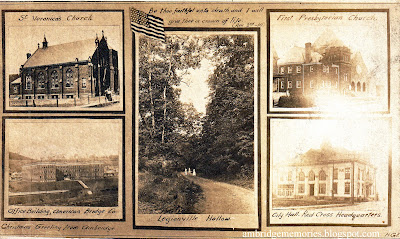
"Christmas Greeting From Ambridge" unposted vintage postcard circa 1918 personal collection
In the left bottom corner of this card it says, "Christmas Greeting from Ambridge."
Shown on the card with photos' captions:
Left, top: St. Veronica's Church; bottom: Office Building American Bridge Co.
Right, top: First Presbyterian Church; bottom: City Hall, Red Cross Headquarters
Center: Legionville Hollow
Because the other four photos show notable Ambridge buildings, the choice of a scene showing three women strolling in a wooded Legionville Hollow lane as the larger center photo seems to me like an unusual choice. Maybe the scene held some special importance. Or maybe it was simply pretty. Or maybe it just fit better in the vertical space.
The American flag and bible verse at the top seem surprising for a Christmas card: "Be thou faithful unto death, and I will give thee a crown of life." (Rev. 2nd - 10). So merry. But I don't claim any expertise in vintage Christmas postcards, so maybe those are typical for the time.
This divided back postcard, now faded on the right side, was unmailed and had nothing written on the back. I based the "circa 1918" date, in part, on the photo of the First Presbyterian Church showing the church's "auditorium" that was dedicated in December 1917, after it was added to the right side of the earlier "chapel."
The flag, bible verse, and the "City Hall" (Ambridge's first Municipal Building) being described as the Red Cross Headquarters added to my thinking that this postcard might date from one of the U.S.'s WWI years (1917 - 1918), but I can't say with certainty. As do the dresses worn by the women in the Legionville Hollow photo.
Business and home of R. L. Pfeifer Funeral Director 447 Merchant St. ad Daily Citizen August 10, 1929
Did you ever notice that the Vocelli Pizza building at 447 Merchant St. has "Pfeifer" spelled out in bricks near the top of the façade and wonder why?
Vocelli Pizza 447 Merchant St. April 9, 2021 credit: P. J. Shotter
Well, about 100 years ago, that building was home to the business of R. L. Pfeifer, a funeral director who also provided ambulance service. The building was also home to Pfeifer and his family.
R. L Pfeifer ad Economy Centennial Souvenir Program Economy of Old and Ambridge of Today June 1924
Robert L. Pfeifer, a WWI veteran, began his funeral business in Ambridge in 1920, and reportedly became a popular and very active part of Ambridge's community. Pfeifer belonged to a number of civic and fraternal organizations in Ambridge including the Rotary, Canady-Hull American Legion Post 341, Masons, Odd Fellows, Elks, and Moose. And he was an active member of Ambridge's Volunteer Fire Department where he held several offices over the years.
Pfeifer also was respected within his profession, serving as president of both the Western Pennsylvania Funeral Directors Association in 1936 - 37 and Beaver County Funeral Directors Association.
Pfeifer died of a heart attack in 447 Merchant on September 11, 1938, after working almost all night to prepare a body for burial, even though he'd not been feeling well. He would have been 40 on September 13.
His obituary in the September 12 Daily Citizen was headlined "R. L. Pfeifer, Noted Citizen, Dies Suddenly. Death of Funeral Director, 40, Shock to Ambridge."
"2 Packards-1 Franklin East Corner 6th & Duss Ambridge"
circa late 1920s
Laughlin Memorial Library archives
Sometimes, when doing historical research, I find unexpected details that lead me in unexpected directions. And the photo above led to one of those times.
I don't know much about this particular photo other than the information that the late local historian Bill Bowan wrote at its bottom. "Early 20's - 2 Packards-1-Franklin East Cor 6th & Duss Ambridge." I don't know the identities of the people in the photo. I don't know why the three cars are parked where they were. And I don't know how Bowan came to own the photo.
And because I know so little, I thought I just would post the photo, say something about the photo's location, and that would be that.
"That" didn't turn out to be "that," but here's what I know about the location:
The houses in the photo's background look like 600 and 602 Beaver Rd. which are still there, so the photo was taken looking east. While 600 Beaver Rd. is on the 1923 Sanborn Insurance map, 602 is not. So I began to question the "Early 20's" date Bowan had written on the photo.
Maria Notarriani told me that the 602 Beaver Rd. house was built in 1926 according to Beaver County tax assessment records, so 10 years after the house at 600 Beaver was built:1916.
So the photo must have been taken later than the "early 1920's." Perhaps the late '20s?
Photos are often misdated--sometimes by a month or two, sometimes by many years. And I didn't believe the the date was critical to the history of the photo. So, blog post finished! But no.
Because while looking at the building on the left side of the photo, I had noticed that its Duss Ave. side slanted upward, and rather steeply too. While the left lower corner of the photo is both faded and out-of-focus, the incline of that corner building's ground floor is obvious. Hmm. Interesting. And me being me, I couldn't just ignore that.
Which leads me to ask: Does anyone have any information on the grading of the 600 block of Duss and/or the histories of the buildings on the east side of that block, especially the buildings closest to the Duss and 6th St. intersection?
Because at the time the vintage photo at the top of this post was taken, the 600 block of Duss Ave. sure wasn't as level as it is today:
600 block of Duss Ave. looking North
Google Street View
August 2011
And I've always wondered why the ground level of some of the buildings in the 600 block of Duss, especially those closest to 6th St., looked odd, like they perhaps weren't built at the same time as the upper floors. Consider:
This is what the building on the corner of 6th and Duss, 600 Duss, currently looks like. Although it looks quite changed from the building on the left of the photo at the top of this post, tax records say it was built in 1920, so it must be the same building.
600 Duss Ave.
Google Street View
August 2011
The odd ground floors are especially evident in these buildings:
Left: Ross Auto Body, 606 Duss Ave.
Right: Filipino American Club of Ambridge (formerly Sons of Italy Lodge), 604 Duss Ave.*
Google Street View August 2016
Tax records also show that 603 Beaver Rd.,* the street address used by the Sons of Italy Lodge, was built in 1915. The 606 Duss building was built in 1920 according to tax records, although the 1923 Sanborn Insurance map only shows an empty lot on Duss at that site. (The map does show a building on Beaver Rd. that currently would abut, or connect to, the rear of 606 Duss.)
So the evidence seems to point to two possibilities: the buildings' current Duss Ave. ground floors were once below-ground basements; or newly constructed ground floors were added after that part of Duss was graded. Well, I guess there's a third possibility: the buildings' owners just wanted an unusual facade on the lower floor.
One other oddity about the 600 block of Duss that may be related to grading: while the houses on both sides of the street abut the sidewalk, those on the east (even-numbered) side have a raised porch with the entrance to the house about a floor above the sidewalk. While on the west (odd-numbered) side, the buildings' porches/entries are basically level with the sidewalk. That suggests to me that when the even-numbered homes were built, they were located on a hill; then later, the base of that hill was removed, and the bottoms of the porches were extended down to street level. But I'm not wedded to that theory.
I previously wrote about a vintage photo of 5th St. and Duss Ave. being graded, but I was unable to determine when that grading was done, except that the photo was taken between 1919 and 1928. I also don't know how much of Duss was graded then. So I don't know at this time whether the grading shown in that photo was related to any grading done in the 600 block.
_____
* When the building at 604 Duss was the Sons of Italy Lodge, it used the address 603 Beaver Rd., where there was a more formal entrance. The Filipino American Club, now located in the same building, gives its address as 603 Duss Ave., not 604, even though it's on the east, even-numbered side of Duss Ave.
I expect that one day someone is going to wonder why a building on the even-numbered side of Duss has an odd-numbered address. Just like I once wondered why the former Sokol at 424 Duss has an even-numbered address even though it's on the odd-numbered side of the street. Turns out the reason is that the original address of the Sokol building was 424 Melrose Ave. Later, in 1951, a large second floor social hall, entered on Duss, was added.
Sears, Roebuck and Co.
653 - 655 Merchant St. Daily Citizen
August 25, 1954
Ambridge's Sears, Roebuck and Co., opened in 1931, was the first Sears in Beaver County. The store was originally located in "modest rooms adjoining 817 Merchant St." In 1934 the store acquired additional space nearby. (Daily Times, April 9, 1937)
Then in 1937, Sears leased an even larger location in the Fraternal Order of Eagles Temple at 653 - 655 Merchant and moved there. (The Eagles purchased their current location at 401 Maplewood Ave. in 1948.)
Here's that beautiful Eagles building, built in 1923, shown in the 1924 Economy Centennial program book.
Eagles Temple
653 - 655 Merchant St. Economy of Old and Ambridge of Today
June 1924
The Ambridge Furniture Co., and later Reichart's Furniture, had occupied the Eagle's building before Sears moved into it. Unfortunately, I don't have any description or photos of what the facade looked like when those businesses were in the building, but according to a news article, the black shiny trim shown in the first photo above was added when Sears moved in. Other changes made with the Sears move were larger display windows and new entrances. (Daily Times, April 9, 1937)
Sears leased three floors in that building; the Eagles retained space on the upper floor. The basement and first floor were used by Sears for sales and display; the second floor was for business offices and storage. This Sears primarily sold "hardgoods." On the first store shoppers could find hardware, electrical equipment, washers, sweepers, radios, and sporting goods. The basement was the floor for plumbing and heating supplies, stoves, paint, and farm equipment, still an in-demand line of products for area farmers. The only clothing the store routinely carried was work clothes. But just about anything else a shopper might want could be ordered from the wide range of items in Sears' legendary catalog and later picked up at the store.
When Sears moved into 653 -655 Merchant, it also opened an auto service building behind the store in the rear of 650 Maplewood Ave.
Sears, Roebuck and Co. ad Daily Times
April 9, 1937
Over the years, the Ambridge Sears store pretty much stuck to selling the same types of merchandise. But it did add newly popular items from time to time:
Sears ad for TVs Beaver Valley Times
July 5, 1951
And I guess there was always a demand for "memorial markers." But they weren't anything I expected the Ambridge Sears catalog department to be advertising.
Sears ad for tombstones Beaver Valley Times
March 24, 1951
Sears also offered home remodeling services like roofing and siding.
Sears roofing service ad Beaver Valley Times
October 1, 1951
Here are two of the ads Sears ran during Ambridge's Golden Jubilee celebration in 1955. I know some people will say, "Wow, look at those prices!" But don't forget how much lower wages were in 1955 too:
Sears "Old Fashioned Bargain Days" Sale ad Beaver Valley Times
June 29, 1955
Sears "Old Fashioned Bargain Days" Sale ad Beaver Valley Times
June 29, 1955
And during the Christmas Season, the Ambridge Sears always had a Toy Town where you could tell Santa, in person, which of the toys you wanted:
Sears Toy Town ad Beaver Valley Times
December 6, 1957
I'm including this 1957 Sears sale ad because I think it's the most unsettling business ad I've come across so far during my Ambridge history research.
Sears "Operation 'H-Bomb' Sale!" Beaver Valley Times
May 28, 1959
I know some people now believe that Sears moved to Northern Lights when the shopping center opened in 1956 - 57, but that's not true. Sears remained in Ambridge until mid-October 1963, one week before it opened the new store the company had built on the far northwest side of Northern Lights where Giant Eagle is now. That new store was a larger department store that carried a more extensive line of merchandise than the Ambridge store had, including: clothing for women, men, and children, shoes, white goods (linens, towels, drapes), housewares, furniture, jewelry, cosmetics, perfume, and candy. Plus there was a snack bar.
The Ambridge Sears "Removal Sale" was held not only in its store, but also at a "storeroom" at 639 Merchant St., "next to Isaly's."
Sears "Removal Sale" ad Beaver County Times
October 18, 1963
The year Sears after moved out, Bargain Furniture Mart, which already had a small store at 651 Merchant, expanded into 653-635. It was Bargain Furniture that remodeled the facade of the building by covering the lower front with a white "chipped ceramic" and the upper floors with the trendy-in-1964-green corrugated steel that still covers the building. Bargain Furniture also added the big 37 1/2 foot sign, the largest in Ambridge, that originally spelled out "Bargain" on lighted four-foot blocks.
I'm sorry about the quality of the photo below, but it's the only photo I currently have of the exterior of Bargain Furniture Mart's 653 - 655 Merchant St. store. You can see its smaller store to the left with the "Sale" sign on the window. That store became Bargain Furniture's Early American furniture showroom.
Bargain Furniture's new building with new facade and sign
653 - 655 Merchant St. Beaver County Times
October 15, 1964
I hope to write about the businesses that occupied 653 -655 Merchant, both before and after Sears was there, in a future blog article. Watch for it.
If you lived in Ambridge from the late 1940s through the early '70s, you probably remember the triangular S.N.D. building at the intersection of Merchant St. and Beaver St.
Slovenian Auditorium 120 Merchant St. ad Daily Citizen Trade Area Directory 1956
Al said, "I think they were used when someone had bought you a drink, but you already had one. Not certain though." Does anyone know for sure of the tokens' purpose?
S. Jurkowski Beer Distributor ad Daily Citizen Trade Area Directory
1956
Paul Jurkowski (AHS Class of '67), the little boy second from the right in the photo, was able to provide the names of the Jurkowski family members standing in front of the beer trucks, but not the other people. If you know who they are, please let me know.
Left to Right:
Rusty Jurkowski (died 1999),
Raymond Jurkowski (St. Veronica HS, 1967),
Stanley Jurkowski, Sr (died 1962),
unknown,
unknown,
unknown,
Paul Jurkowski (AHS 1967),
Stanley Jurkowski, Jr (died 1973)
Paul sent me a brief history of the distributorship's locations:
The business was originally at 545 Eighth St. (now a vacant lot on the west side of the Kasper funeral home) prior to moving to [606] Duss Ave., and then 1154 Merchant St. The primary customers were the ethnic social clubs in Ambridge, the 1956 trade directory lists the great majority of them.
An aside, I once delivered a barrel of beer to the wrong Ukrainian club!....only in Ambridge!
Here's a more recent photo of 606 Duss Ave. Ross Auto Body shop was in the building for a long time. Does anyone know what, if anything, is in the building now?
606 Duss Ave. March 30, 2014 Credit: Nancy Knisley
_____
For a list of Ambridge's ethnic social clubs, see the Ambridge List of Lists on this blog. The list may not be complete, but it is extensive.
When I began visiting Laughlin Memorial Library's archives to look through the late Bill Bowan's photo albums, I never expected to find a photo with a relative in it. But in two old newspaper clippings of photos of a boy scout troop, I did. Maybe.
I don't know when the photos were taken or when and where these clippings were published. Bowan's hand-written notes about them say "1938" for both photos, but the one without "1938" in the publisher's caption has "1941" handwritten on the front of it. If you know anything about the origin of these photos, please let me know.
Bowan's notes identified some of the scouts in the photos. I was surprised when I saw "Leon Gaus" listed among the names. Leon Gaus was the name of my maternal grandfather's younger half-brother. Although my grandfather spelled his last name "Gause," his siblings spelled it "Gaus."
I am assuming the "Leon Gaus" in these photos is my Great-uncle Leon, but I don't have anything to confirm that. However, if there might have been another Leon Gaus in the area, my Great-uncle Leon was born in 1924, which puts him at the right age to be a boy scout in the late 1930s or early 1940s.
Lion's Club Boy Scout Troop
1938
newspaper clipping
courtesy Laughlin Memorial Library archives
Original caption: THE LION'S CLUB Boy Scout Troop as they were in 1938. Members and leaders were attending an outdoor meeting.
Bowan's notes about this photo title it "1938 - Lake Lynn W. Virginia"
The list of identities as provided by Bowan:
1. Gaus Leon
2. Levy Rob
3. W. Chiappala
4. Frank Paulakovich
5. Eddie Hrico
6. Pete Sudar
7. James Pappas
8. Mike Lazorishak
9.
10.
11. Geo Salata
2 - Kneeling
1. Vince Sniady
2. Casmir Drugoz
3. Harry Kuntz
4.
5.
6.
7.
8. Bill Poutas
3. Standing
1. Benny Barsyz
2.
3.
4.
5.
6.
7. Walter Joyce
8.
9. Doc Hall
10. Frank Kloiber?
11.
At the bottom right of the note "Mike Rusko" is printed.
Here's the second news clipping photo. Note "1941" written in the bottom right corner.
Leonard Rothermel and Boy Scout Troop
circa 1938 - 1941
newspaper clipping
courtesy Laughlin Memorial Library archives
Original caption: LEONARD ROTHERMEL, Ambridge High School teacher, and Boy Scout Troop of long ago. At the top of Bowan's notes about the photo above, he wrote something I can't decipher. It looks like"Economy Golden Rose" followed by what appear to be page numbers. Anyone know what that might mean?
He identified the scouts in the photo, which he titled "Rothermel Scout Troop 1938," as follows:
1st row:
1. Frank Kloeber
2.
3. Steve Lubic
4.
5. Chas. Grosdeck
6. Andy Shulick
2nd row:
1. Bill Tartar
2. Rich Powell
3. Jim Pappas
4. Ed Matzie
5. Leon Gaus
6. Paul Pawlack
7. Bernard Hrico
3rd row:
1. Mike Orend
2. Ed Hrico
3. Mike Rusko
4. Hugh Thom
5. Paul Mikesner
6. Eddie Beaman
7. Vincent Sniady
8. Herbert Hopkins
9. Leonard Rothermel
If you recognize any of the unidentified scouts in these photos, or know more about the Lion's Boy Scout troop, please let me know.
_____
The parking meter token below is somewhat of a mystery.
Ambridge parking meter token
side 1
Ambridge parking meter token
side 2
The reason the token is a mystery is because it indicates it was distributed by the Ambridge District Chamber of Commerce. Only I can't find any information about a "District Chamber of Commerce" in Ambridge PA ever existing.
If I have ever come across a reference to an Ambridge District Chamber of Commerce, I don't remember it. Or thought it significant enough to note.
The only mentions of an Ambridge District Chamber of Commerce I've found during several online searches were by people selling tokens like the one above.
I would have guessed that the token was from the mid-to-late 1950s, when Ambridge businesses were facing strong competition from the new Northern Lights Shoppers City with its 5000 spaces of free parking. But all I've found from that time are mentions and ads of the "Ambridge Chamber of Commerce."
I checked with Bob Mikush, whose family business, Mikush Maytag Home Appliance Center, has been a member of the Chamber of Commerce for generations. He said he'd never heard of a District Chamber of Commerce.
I mentioned the token to Kimberly Villella, the president of the Board of Directors of the latest iteration of Ambridge's Chamber of Commerce, the Ambridge Regional Chamber of Commerce. Kim said that her research of the history of the Ambridge Chamber didn't find an Ambridge District Chamber of Commerce.
So far, Kim and I have found four Chamber of Commerce groups that have been in Ambridge over the years, none with "District" in their names: The Ambridge Chamber of Commerce; The Greater Ambridge Chamber of Commerce; the Ambridge Area Chamber of Commerce; and the Ambridge Regional Chamber of Commerce.
So was the "Ambridge District Chamber of Commerce" on the token a mistake? Or, as unlikely as it seems, could the token possibly be from an Ambridge District of another town like Gary, Indiana?
If you know anything about an Ambridge District Chamber of Commerce, or when the token might have been used, please help solve the mystery and let me know.
The ad below shows part of the 300 and 400 blocks of Duss Ave. in a 1930 ad for somewhat decorative fluted utility poles. Those steel poles are no longer there, replaced by not-remotely-decorative wooden poles at some point.
Union Metal distribution poles ad Electrical World
October 4, 1930
Here's a close up look at the photo, captioned "Union Metal 30-foot poles installed at Ambridge, Pa., by Duquesne Light Co.":
300 - 400 blocks of Duss Ave. Electrical World October 4, 1930
One of the advantages of the poles according to the ad was "No underground construction was necessary as street lighting circuits are carried inconspicuously overhead." As opposed to the current method of making utility cables less conspicuous by burying them underground, as Ambridge is considering doing on Merchant St. as part of its latest streetscape improvement project.
Moose Lodge fire
1300 Merchant St.
September 19, 1937
courtesy John Dunn collection
Many of us remember when the Moose Lodge occupied the building that is now Franzee's and Javy's Banquet Hall at 1300 Merchant St. But that wasn't the original Moose Lodge at that location. This was:
"Moose Club," Economy Centennial Souvenir Program, Economy of Old and Ambridge of Today, 1924
That building had started its life as the Grand Hotel, built in 1903, by Frank Workman of Rochester. The hotel was cited in a Real Estate Trust Co. sales ad in the May 15, 1906, Pittsburgh Press as an example of the "high class" buildings being built on Merchant St. at the time.
Real Estate Trust Co. ad, excerpt Pittsburgh Press
May 15, 1906
The ad begins:
This Modern Hotel at Economy-Ambridge Typifies City's Progress.
The Hotel Grand, picture above, is located at Merchant and 13th Streets, in the Economy part of Economy-Ambridge. As may be seen from the picture, the building is a brick 4-story structure and is far ahead of hotels usually built in industrial towns. It is an example of the high class of buildings that have been erected during the past two years along Merchant Street, the remarkable business avenue of Economy-Ambridge. The growth of this street in modern business buildings is without parallel in Western Pennsylvania. No frame structures are allowed and every building erected has been a substantial contribution to the appearance of the street and to the improvements of the community.
Grand Hotel
Economy PA
postcard dated June 30, 1906
During Ambridge's early years, the Grand Hotel/Hotel Grand was one of the three large hotels in the northern part of the current Ambridge Borough that was still called Economy; the other two were the Ambridge Hotel at the northwest corner of 8th and Merchant Sts. and the Old Economy Hotel on the southwest corner of 14th and Merchant.
The September 20, 1937, Ambridge Daily Citizen, described the building as "long a landmark and once a thriving hotel." The paper went on to say, "The place was operated as a hotel and bar with varying success until the advent of national prohibition. At the time it passed into the hands of the Loyal Order of the Moose, its present owners."
The Daily Citizen wrote of the fire:
Starting on the fourth floor of the old structure about 3:30 p.m. fire, fanned by a stiff wind, ate rapidly through the dried wood of the building, completely gutting the third and fourth floors before firemen of three communities--Ambridge, Sewickley and Leetsdale --brought the flames under control. Almost 20 people were driven out of neighboring houses by danger of fire spreading.
It took seven hours for firefighters to get the flames under control.
Moose Lodge fire
1300 Merchant St.
September 19, 1937
courtesy John Dunn collection
The Daily Citizen reported:
Thousands of spectators jammed the streets as firemen fought the blaze, adding traffic congestion to the general confusion....Police worked feverishly to hold back crowds from the burning building as fire-warped walls crumbled and fell to the street below.
Moose Lodge fire
1300 Merchant St.
September 19, 1937
courtesy John Dunn collection
The occupants of an adjoining house--Michael Kentsler,* his wife, a son, and ten roomers--had to vacate the house for the night because of concern about fire-weakened walls collapsing. Firemen pulled down the building's badly damaged wall on the Merchant St. side as a safety measure the night of the fire.
Fire-damaged Moose Lodge
1300 Merchant St.
September 19, 1937
courtesy John Dunn collection
Fortunately, at the time of the fire, the building was vacant except for the Grand Restaurant, owned by Gus Kellas, on the building's ground floor. While the fire itself didn't reach the restaurant, it was severely damaged by water, smoke, and falling debris. The Grand Restaurant later moved across the street to 1231 Merchant.
I don't know if the cause of the fire was ever determined.
_____
There was some discrepancy in the reporting about the fire. For example, the September 20, 1937, Daily Times reported that the fire had started on the third floor at 7 P.M., and that the volunteer fire departments of Baden and Fair Oaks also helped fight the fire.
*Spelled "Kensler" in the Daily Times article. I don't know which spelling is correct.
Even though the Grand Hotel/Moose Lodge building was gone long before I was born, I have a special fondness for it, and previously wrote about it in my February 24, 2014, blog article "Ambridge History: The Grand Hotel and the Moose." If I hadn't done some research trying to find out about the building shown in an old undated news clipping, I might never have caught the Ambridge history bug.
On October 5, 1933, one of the country's most violent anti-union confrontations took place in Ambridge. Striking workers from several Ambridge industrial plants were attacked by a large squad of armed sheriff's deputies in front of Spang-Chalfant in the 2300 block of Duss Ave. The October 6, 1933, Pittsburgh Post-Gazette described the area as a "bloody battleground." The fight left one bystander dead, and a large number of picketers, bystanders, as well as some deputies, injured.
News accounts of the violent event vary in their details, some of it conflicting, but the story below provides the basics.
"One dead, fifteen wounded in strike clash"
armed deputy sheriffs attacking picketers
Spang-Chalfant plant
October 5, 1933
Library of Congress photo
The strike tension began days earlier on October 2, 1933, when workers at Ambridge's large National Electric plant voted to strike to demand recognition of their union, the Steel and Metal Workers' Industrial Union (SMWIU), and a wage increase.
At the same time, Ambridge's Central Tube Co. was closed for an "employer's' holiday,"--workers had been locked out after they had demanded that the company recognize the same union.
Beaver County Sheriff Charles O'Loughlin, formerly the head of the Aliquippa J & L's Coal and Iron Police, already had deputies at both plants by the evening of October 2.
On October 3, National Electric's workers marched to the plant, and the company asked for time to think about their demands. Workers decided against returning to work, and the mill remained closed.
By then, workers at other Ambridge area plants--Spang-Chalfant, Wycoff Drawn Steel, H. H. Robertson, and A. M. Byers--had joined the strike.
On the afternoon of October 3, a delegation of union members, led by Spang-Chalfant workers, went to the Spang-Chalfant plant, where they were met by company police armed with rifles, machine guns, and tear gas guns.
The October 4, 1933, Post-Gazette, reported, "There was only one slight outburst of disorder in the Ambridge picketing, but Sheriff Charles J. O'Loughlin of Beaver county prepared for possible trouble by detailing part of his squad of 200 deputies, armed with riot and machine guns and tear gas bombs, to strike duty in Ambridge."
Despite the picket line in front of the plant, Spang-Chalfant remained open. Some workers tried to cross the picket line to go to work, but were attacked by the picketers. In response, the picketers were attacked with gunshots and tear gas from within the mill; one picketer was wounded.
On October 5, a large number of the special deputies recruited by Sheriff O'Loughlin began to march, carrying their weapons, to the Spang-Chalfant plant. They were led by the sheriff and County Detective Robert Branyan, and accompanied by Ambridge Burgess P. J. Caul and county District Attorney, A. B. de Castrique.
The deputy sheriffs, identified by white handkerchief arm bands, first stopped in front of Wycoff, on Duss Ave. immediately to the south of Spang-Chalfant. After the deputies were ordered to break up the picket line, one of them hit a picketer with a club. Hundreds of spectators began to run, joined by some of the picketers, although many remained on the line and heckled the deputies. The deputies responded by shooting tear gas into the crowd, which ran from the area.
Having cleared Duss Ave. in front of Wycoff, the deputies continued their march to Spang-Chalfant. I don't need to described what happened once they got there, because there is a still-existing British Pathé newsreel of the deputies' confrontation with picketers, who, if armed at all, held clubs and rocks. Here's that newsreel:
When the deputies starting shooting into the crowd, they didn't discriminate between picketers, news reporters and photographers who had come to record the scene, or the spectators who had gathered to support the picketers or simply watch the action.
The Post-Gazette reporter described the scene as the deputies pushed into the crowd standing in front of Spang-Chalfant:
Townspeople, caught in the melee, as well as strikers and deputies were injured as bullets, sticks and stones, flew through the air in the several skirmishes of the drive. An undetermined number of combatants and spectators were overcome by fumes of tear-gas bombs as the hastily sworn-in deputies cut their way through the strikers. It took almost half an hour to complete the drive through the mill district. Stubborn resistance was offered at many of the mill entrances where pickets had gathered in numbers. But the relentless march pushed on. Tear gas bombs and bullets whistled through the crowds of strikers, spectators, women and children who thronged the streets. The various groups of pickets stood their ground but briefly and then ran for shelter. Bystanders, blinded by the tear gas and frightened by the rattle of gun-fire, rushed pell-mell from the scene, tripping over each other in their frantic dash to safety. Women, many of them with babies tightly clasped in their arms, others clutching hands of young ones barely able to toddle, ran screaming from the fire-zone.
A spectator, Adam Pietrusieski, who owned a confectionary store at 310 Fourteenth St. in Ambridge, was shot and killed, leaving a wife and three children. Published reports of where Pietrusieski was standing when he was shot and where he died, vary, as does the spelling of his last name.
Sheriff and deputies standing over body of Adam Pietrusieski Pittsburgh Post-Gazette
October 6, 1933
Post-Gazette caption:
Sheriff Charles O'Loughlin (center) and two of his deputies come too late to the aid of Adam Petesuski, 42, a spectator of the pitched battle, who was found dying in the street as the smoke and tear gas of yesterday's encounter before the Spang-Chalfant steel plant in Ambridge cleared away. He died soon after this picture was made before he could be taken to a doctor.
Others seriously hurt in the melee were taken to hospitals. One estimate says approximately 100 people were injured, many shot in the back.
The Ambridge Daily Citizen, Pittsburgh Post-Gazette, and Pittsburgh Press provided extensive coverage of the strike and ensuing violence, but the news spread nationally. Patty Parra found these photos in a Salem, Ohio newspaper:
photos of Spang-Chalfant strike battle Salem News
October 9, 1933
courtesy Patty Garrity Parra
Salem News caption:
Graphic pictures from the strike front at Ambridge, Pa., where a clash between steel strikers of the Spang-Chalfant mill and 200 deputies resulted in the fatal shooting of one man and the wounding of 15 others. At top, heavily armed deputies and pickets face each other an instant before the deputies opened fire. Below, the battle in progress. Note man at right taking aim with a shotgun, while teargas routs strikers. In inset, a deputy bends over the buckshot riddled body of Adam Petesuski, slain strike picket.
The sheriff and Ambridge officials congratulated themselves for breaking the strike, a job well done, but an investigation of the violence by Pennsylvania Governor Pinchot's "Special Policing in Industry" committee that was created afterward, helped to end the use of "company deputies" like those involved in the Ambridge attack.
Update September 4, 2017, Labor Day:
I now own some vintage press photos of the armed sheriff's deputies--the strikebreakers--in action. The photo below, shot facing the south, shows the tear gas shot by deputies billowing across the 2000 block of Duss Ave. Note the "School Slow" sign. The tear gas was blowing towards Anthony Wayne Elementary School, located behind the houses on the east side of Duss. October 5, 1933, was a Thursday, so a school day. The deputies obviously didn't care. The back of the photo says: "Gas across Duss Ave. Ambridge to break up strikers as deputies charged."
Tear gas shot by strikebreaking deputies blows across the 2000 block of Duss Ave.
October 5, 1933
The photo below shows that same block today. The house on the east side of Duss with the second story porch and its neighbor on the corner are still there. The building on the far right of the 1933 photo, behind the deputy, is gone. But the homes beyond it remain.
2000 block of Duss Ave. looking south
Google Street View
The next photo shows some armed deputies walking south in the 2100 block of Duss Ave., approaching a group of strikers. That would place them just north of the Wykoff Drawn Steel mill. Spang-Chalfant was three blocks further north. Accounts of the strike say that the deputies marched north on Duss., broke up a gathering of strikers at the Wykoff mill, then proceeded up Duss to the Spang-Chalfant mill. So did these strikebreakers turn around to scare-off the strikers a second time? Or did some of the strikebreakers initially march south on Duss, as well as north, to surround the strikers? I don't have the answer to that. The note on the back of the photo says only: "Armed deputies driving strikers ahead of them on Duss Ave." The large white building on the right side of the photo is the original Anthony Wayne Elementary School. The house to its left is 2109 Duss Ave., and is still there, as is the smaller building on the left side of the photo.
Strikebreaking deputies approaching strikers
2100 block of Duss Ave.
October 5, 1933
Here's what that area looks like today, with the much altered Anthony Wayne building peeking from behind Vance's Auto Service:
2100 block of Duss Ave. looking south
Google Street View
____
I've wanted to write about the 1933 Spang-Chalfant strike violence for a long time, but I felt I couldn't do the story justice. As my stack of research grew, I realized that if I waited until I felt I could tell the entire story as well as I wanted to, I might never write it.
This article is but a part of what I've learned so far about the working and economic conditions in Ambridge leading up to the strike, the use of special "company deputies" to break strikes and intimidate union supporters, anti-union sentiments held by Ambridge and county officials, as well as the sometimes conflicting details of the attack and further anti-union action taken by Ambridge officials, borough police, the sheriff, and his deputies.
Before Alexander Laughlin, Sr., the owner of Ambridge's Central Tube Company, built the magnificent Laughlin Memorial Library as a tribute to his late son, Alexander Laughlin, Jr., the Ambridge Woman's Club had established reading rooms to serve the community.
Update: October 25, 2016:
In the Daily Citizen's 50th Anniversary edition, June 25, 1954, it reprinted this old news snippet from 1920:
The I.O.O.F. which recently purchased the Hotel Ambridge has offered to rent the bar room for a library room at $60 per month and the executive committee of the Woman's Club voted to accept.
I'd guess the bar room became available after prohibition began in January 1920.
Another historic Ambridge building is now gone, razed in April of this year. The three-story building at 451 - 453 Merchant St., notable for its height as well as its brown brick facade, was not a victim of fire, as some old Ambridge buildings have been over the years, but of neglect.
The photo below shows what the front of the building looked like in 2013. It's the tall building to the right of the white Vocelli Pizza (Pfeifer) building.
400 block of Merchant St., west side
June 23, 2013
According to Beaver County tax records, 451 - 453 Merchant was built in 1908, on two lots then numbered 434 and 436 Merchant (Ambridge's building numbering was changed in 1917) and was often referred to as the "May Building."
Here are two early postcards showing the building. You can pick it out in photos and postcards because it's the tallest building on the block and has distinctive brickwork near the top and between the second and third floors, but I've noted it for easy identification.
400 block of Merchant St. looking south
postcard
postmarked April 2, 1908
400 block of Merchant St. looking north
postcard
postmarked August 25, 1909
The information I've been able to gather about the building's occupants over the years is sketchy at best.
In the early years, the first floor was divided into two storefronts. According to a 1911 Sanborn Insurance map, the storefront on the left side of the building was a hardware and stove store; the right storefront was a bowling alley. The map shows that the second floor was occupied by "F. O. M." I've been unable to find out what that is, but I'm guessing it was a fraternal organization. The I. O. O. F. (Independent Order of Odd Fellows) was on the third floor.
The 1917 Sanborn map shows that the left storefront was then a toy store, but the other occupants were still the same.
Here are some of the other businesses and organizations that have occupied 451 and 453 over the years. Dates just give some general idea of when the business/organization may have been in the building; the years of actual occupancy might have been different.
1920s through 1940s: Ambridge News Depot owned by J. C. Feick;
1920s - ?; Ambridge Order of Owls, 2nd floor;
Late 1940s: Penn Roof Ballroom;
Late 1940s: Today's Charm School;
Late 1940s to ?: Gray's Auto Store, in 453 Merchant;
Late 1940s to early 1950s? Baron's Hardware Store, in 453 Merchant;
Mid-1950s - ? : Manhattan News Dealers;
1953 until ? : Fort Pitt Televisions & Appliances, in 453 Merchant;
1960s era, closed 1965: Lenrick Sales, in 451 Merchant;
? upper floors leased as apartments
1969 - 2007 used by Karnavas Co. for storage
If you know of any other uses for the building, or can help with dates, please leave a comment. I will update this article if I find any additional information on the building's occupants.
The 451-453 building was one of five bought by Steve Hallas in 2007. In an an article about Hallas' plans to save the buildings, 451 was described as "an empty, bland brown building, next to Vocelli's Pizza, that once housed a ballroom and stage. The three-story building has been used for storage for 30 years." The article goes on to say that Hallas planned lofts in four buildings, including 451. I cannot find any information indicating what, if any, rehab work Hallas did in the building.
Note: For the rest of this article, I'm going to refer to the building only as 451.
In 2014, the Merchant St. side of 451 was an eyesore. Some window glass on the upper two floors was missing, and the windows on the ground floor were boarded up.
451 Merchant St.
March 30, 2014
Cornice
451 Merchant St.
March 30, 2014
But the rear view of the building showed it was more than an eyesore; it was a danger. The roof was caving into the interior.
451 Merchant St., rear
March 22, 2014
By April 3, 2016, when I was visiting Ambridge, the roof looked like this:
Collapsing roof
451 Merchant St., rear
April 3, 2016
The following day, April 4, I was going to the Maple Restaurant, 463 Maplewood Ave., when across the empty lot next to the old Ohio River Motor Coach building, I was surprised to see this:
Razing of the rear of 451 Merchant St.
April 4, 2016
Then I went around to the front of the building, which looked like this. Windows all boarded up, and a chain link fence ready to be erected.
451 Merchant St.
April 4, 2016
After that, as long as I was in Ambridge, I'd swing by 451 Merchant, sometimes twice a day, to take photos of the progress of the demolition. Here are some of my photos:
451 Merchant St., rear
April 5, 2016
451 Merchant St., rear
April 5, 2016
451 Merchant St., rear
April 6, 2016
451 Merchant St., rear
April 8, 2016
451 Merchant St., rear, ground floor with view of Merchant St.
April 8, 2016
By April 12, the entire first floor was gone.
451 Merchant St., rear, with view of Merchant St.
April 12, 2016
451 Merchant St., front, bottom floor gone
April 12, 2016
Look! You can see the hills across the Ohio River in the photo below!
451 Merchant St., front, bottom floor gone
April 12, 2016
Two days later, the view of Merchant St. from the rear of the building was larger. The plywood had been removed from the second floor windows in front of the building.
451 Merchant St., rear, with view of Merchant St.
April 14, 2016
In the front of the building, the plywood was being removed by the worker in the bucket from the third floor windows, then the worker would smash the glass. I watched as some of the glass came crashing down to the sidewalk below. That was kind of exciting.
Plywood covering upper windows being removed
451 Merchant St.
April 14, 2016
View thorough 451 Merchant St. first floor
April 16, 2016
View through 451 Merchant St., first floor
April 16, 2016
I took my last photos of 451 Merchant on April 16, as I had to end my visit to Ambridge the next day. But other photographers sent me the photos of the continuing progress of the demolition shown below. And for that I am very grateful.
Rusty gas cooktop?
with rubble at 451 Merchant St.
April 16, 2016
credit: P. J. Shotter
Rubble on ground below upper floors
451 Merchant St.
April 16, 2016
credit: P. J. Shotter
Rubble on ground below upper floors
451 Merchant St.
April 16, 2016
credit: P. J. Shotter
451 Merchant St.
April 22, 2016
credit: Jim Ernst
451 Merchant St., first floor
April 22, 2016
credit: Jim Ernst
By April 30, only a small amount of rubble remained in the space formerly occupied by 451 Merchant St.
Remains of 451 Merchant St.
April 30, 2016
credit: Maria Notarianni
Remaining rubble, 451 Merchant St.
April 30, 2016
credit: Maria Notarianni
Steel beam from 451 Merchant St., north side of lot
April 30, 2016
credit: Maria Notarianni
Wall adjoining Vocelli's Pizza building
451 Merchant St., south side of lot
April 30, 2016
credit: Maria Notarianni
And here's what the cleaned-up lot looked like at the end of May:
Empty lot, 451 Merchant St.
May 29, 2016
credit: P. J. Shotter