Showing posts with label Old Economy. Show all posts

Sunday, December 29, 2019

Ambridge's Harmony Hotel. And the other Ambridge Harmony Hotel

"Harmony Hotel"
Manuscript Group 354: Old Economy Village Collection
Photo Number 635b
courtesy of Pennsylvania Historical and Museum Commission
Old Economy Village
used with permission

Just a short distance northwest of the well-known and highly regarded Economy Hotel,* once located on the southwest corner of what is now 14th and Merchant Sts., there was a smaller, less impressive hotel. The Harmony Hotel, sometimes belittled as the "Tramp Hotel" or the "Hotel of the Unfortunates," hasn't been in business for many years, although its building still stands at 277 Fourteenth St.

Why those disparaging nicknames? According to Sarah Buffington, Old Economy Village curator:
"The guests at the Economy Hotel were told to arrive promptly at 4:30 for supper, so as not to keep others waiting. The staff was fed after the hotel guests, and then the 'tramps' were fed afterward. These homeless people were allowed to stay for one night, but were then told to move along. The Harmony Society kept track of them so that they wouldn’t overstay their welcome."
The date of the photo above is uncertain, but it probably dates from the late 1800s, before there was an Ambridge, or early 1900s. The building dates from much earlier, back to the establishment of Economy, and wasn't originally used as a hotel. Although it doesn't look like the typical, brick Harmonist house, it was the early home of Frederick Rapp, adopted son of George (Father) Rapp. Frederick Rapp later moved to a brick house that is on the grounds of Old Economy Village.

The three people in the photo are unidentified. but according to Buffington, the woman and girl may be Carrie Staples, a widow, and her daughter Katherine. Staples was a boardinghouse keeper there at the time of the 1910 census. 

The photo below shows a recent Google Street View of the former Harmony Hotel building:

277 Fourteenth St.
Google Street View
October 2013

What is not visible from Fourteenth St. is a large addition--that appears to me to be at least as large, or maybe larger, than the original house--built on the back of the building, probably around the time it became the Harmony Hotel. Buffington said the addition "is very much set up like an old hotel." You can see the addition from Boyleston St. Here's a satellite view of 277 Fourteenth St.:


277 Fourteenth St.
Google Satellite View

The other Harmony Hotel in Ambridge

To confuse Ambridge history more than it often is, there was another Harmony Hotel, across town from the one on 14th St. This Harmony Hotel, at 300 Merchant St., was built and operated later than the hotel on 14th St., but was also viewed as disreputable, especially by the American Bridge Co.

This Harmony Hotel was the bane of the American Bridge Co. for years. The company didn't want its employees drinking, and so devised deed restrictions that said that the area within the original boundaries of Ambridge was supposed to be "dry"--alcohol free--for 50 years. However, the Harmony Hotel, mere blocks from the company's plant and office, sold liquor. Legally. That was possible because the Harmony Hotel wasn't in Ambridge; it was in Harmony Township, at that time, just a walk across Merchant St. from Ambridge. Which I'm guessing made its site a very attractive spot for a bar...er...hotel.

The building shows up on the 1911 Sanborn Insurance map as the location of the planned "Hotel May," named for its builder. Sometime between then and 1915, the name was changed to Harmony Hotel. The battle between its owner and American Bridge Co. over the hotel's liquor license appears to have begun early. Here's part of the remarks made by F. T. Cadmus, the plant superintendent, from the Daily Times, October 22, 1915:


The liquor license battle continued in 1916 when the hotel was owned by George T. Davis. In an article in the Pittsburgh Post-Gazette, March 14, 1916, Davis' attorney claimed that the American Bridge superintendent, Cadmus, had warned employees of the company that they would be fired if they were seen in the barroom of the Harmony Hotel.

So American Bridge must have been pleased by this announcement in the January 2, 1917, Daily Times:


A "temperance hotel" may not have proved to be as popular as the barroom at the Harmony Hotel may have once been, because in 1920, Divine Redeemer Church, across Merchant from the hotel building, bought it and converted it into a parochial grade school. After the church built a new school in 1961, the building was sold to the Karnavas Vending Co.

Karnavas Vending Co.
former Harmony Hotel
former Divine Redeemer School
300 Merchant St.
Google Street View, Oct. 2017
_____

*Later renamed the Old Economy Hotel in the late 1800s.

Sunday, February 10, 2019

The curious carved pillars on Wagner Ave.

Pillar with the date "1884" on Wagner Ave.
April 16, 2016
credit: Nancy Knisley

Pillar with letters on Wagner Ave.
April 16, 2016
credit: Nancy Knisley

The 200 block of Ambridge's Wagner Ave. is a narrow, one-way street in the historic district, running between Church St. and Merchant St. The block is lined with a few modest non-Harmonist houses and not heavily traveled. If you did drive through it, you might not have even noticed the two tall stone pillars, one on either side of the steps in front of 269 Wagner.

269 Wagner Ave.
Google street view
October 2013

But if you were one of the street's occasional pedestrians, and particularly observant, you might have been struck by the odd pillars and stopped to take a better look. They are worn and look old and unlike anything else in Ambridge. On them, near the top, are carvings of six pointed stars, near the bottom are what appear to be letters. In addition, below their stars, the right pillar has the date 1884; the left, the letters "H" and "L" separated by a symbol. What do the carvings and letters mean? And why are the pillars in the tiny front yard of 269 Wagner where they seem out of place?

Here's what I know:

John Frederick (Fred) Knoedler, a stonemason by trade, helped carve the pillars. Fred and his wife, Katherine Kroll Knoedler, were long time employees of the Harmony Society, performing a variety of duties, but not Harmonists themselves.

The pillars originally stood in front of Economy School, built by the Harmony Society for the area's children. The letters "H" and "L" on one pillar stood for Jacob Henrici and Jonathan Lenz, the two Harmony Society trustees at the time the school was built in 1884, the year on the second pillar. (Beaver County Times, August 20, 1974)

The Economy School was built at the corner of what is now the northeast corner of Church and Laughlin Sts. You can see it in the left foreground of the photo below. The building to the right is the Blaine House, used as a school before the Economy School was built. The building in the background between the Blaine House and Economy School is Ambridge's Fourth Ward School.

"All Three Economy Schools"
Manuscript Group 354: Old Economy Village Collection
Photo Number 2404
courtesy of Pennsylvania Historical and Museum Commission
Old Economy Village
used with permission

The photo below shows students in front of the Economy School in 1898. You can see the pillars on the sides of the student group.

"Economy School - 1898"
Manuscript Group 354: Old Economy Village Collection
Photo Number 2369
courtesy of Pennsylvania Historical and Museum Commission
Old Economy Village
used with permission

The former Economy School building is now an apartment building:

Former Economy School building, now converted to apartments
1514 Church St.
April 6, 2016
credit: Nancy Knisley

After the Economy School was closed, its pillars were relocated, although I don't know when they ended up in front of 269 Wagner, once the home of Fred and Katherine Knoedler's daughters, Christiana Knoedler and Katherine Brown.

Christiana Knoedler standing with one of the pillars in front of her Wagner Ave. home
Beaver County Times
 August 20, 1974

Sunday, November 18, 2018

Old Economy Hotel, 14th and Merchant Sts.

"14th St. showing Old Economy Hotel, Economy Pa."
postcard circa 1907
photo circa late 1880s

This postcard shows the intersection of the streets that are now 14th and Merchant Sts. looking west, so towards the river. The large three-story building on the left is the long-gone Old Economy Hotel.

The postcard was never mailed, so there's no postmark, but a postcard like it in the Old Economy Village Archives was dated and mailed in 1907.

Built by the Harmonists, the hotel was one of the oldest buildings in the new borough of Ambridge.

Old Economy Hotel ad
Ambridge-Economy Citizen
December 16, 1904

In its day, the hotel was well-regarded by visitors to Economy and a stopping point for travelers and bicyclists. A number of famous people stayed at the Old Economy Hotel including Lafayette, Rudyard Kipling, and about-to-be President William Henry Harrison on the way to his inauguration. In Christiana F. Knoedler's book, The Harmony Society, she says, "The Economy Hotel was noted for its famous chicken-and-waffle suppers. It was also a haven for sleighing parties organized by young Sewickley people on snowy winter nights."

Oddly for a such a widely-known landmark building, exactly what happened to the hotel remains a mystery, even to the experts at Old Economy Village. Sarah Buffington, the OEV curator, told me that the hotel was either destroyed by fire or simply razed "perhaps in 1905."

But I found that as late as 1906, the hotel was fighting the loss of its liquor license in court. At the time of the court case, liquor could only be served in the Economy section of Ambridge--the area north of 8th St. The part of Ambridge south of 8th St. was legally dry. The court decision notes that until 1905, the Old Economy Hotel was the only licensed hotel in Ambridge. However, in 1905, two new hotels were built and given liquor licenses. Those were the Ambridge Hotel and the Grand Hotel. That decision rested on the fact that the Economy area only needed two licenses, and the public would be better served by giving those to the "modern" new hotels rather than to the more than 50 years-old Old Economy Hotel. (McCrory's License, Pennsylvania Superior Court Reports, Vol. 31)

I've wondered if the Old Economy Hotel's loss of its liquor license led to a drop in business resulting in its closing and eventual demolition.

In the late 1960s, the Pennsylvania Museum Commission proposed rebuilding the hotel on its original site. A photo identical to the above postcard's was published in a March 29, 1968, Beaver County Times article about the state's plan. The caption for the photo said that it was taken in the late 1880s. The plan to rebuild the hotel was never carried out.

I'm still hoping to find more information on what happened to the hotel and when it disappeared from 14th and Merchant.

At present, Elderberry Court, an assisted living facility, is where the Old Economy Hotel once stood.
_____

Update November 21, 2018: Here's a scan of the reverse of the postcard, showing it has an undivided back. This type of postcard, which did not permit a message on the address side, was allowed by U.S. Postal regulations beginning December 24, 1901. Postcards with divided backs were allowed beginning March 1, 1907.

Reverse of postcard

The Old Economy Village Archives has at least three postcards with the same photo as the one at the top of this post..

Two are black-and-white. As mentioned in the article, one is dated and postmarked 1907; the other has an undated message on the front, but the address side isn't shown, so I don't know if there's a postmark or not. However, OEV gives the date of this postcard as 1906 - 1908.

The third postcard has the same photo, but it's been hand-colored. OEV says this postcard is also from 1906 - 1908.

In addition, the OEV Archives has an undated black-and-white photograph of the scene on the postcard. The only difference I can see is that the photo shows more of 14th St. above Merchant St. in the foreground. [End of update.]

[Update November 25, 2018: I don't know (yet) when the name of the hotel was changed from Economy Hotel to Old Economy Hotel. It might have been in the late 1880s, the era attributed to the postcard's photo by the Beaver County Times. However, I have found a series of ads in the Pittsburgh Press from the late 1890s promoting the Old Economy Hotel. Here's one of them:

"Notice to Cyclists"
Old Economy Hotel ad
Pittsburgh Press
September 2, 1896

The original print in the Press is very small, and enlarging it only made the text blurry, so here's what it says:
NOTICE TO CYCLISTS--Cyclists and others will find good roads and superior accommodations at the Old Economy hotel: for summer we offer to families pure air and home comfort, and to the tired business man, the delights of a country residence within a few miles of his business, railroad facilities unsurpassed; chicken and waffle suppers specialty.--ALF. M. McCashey, Proprietor
End of update]

Monday, December 4, 2017

Ambridge memorabilia: National Air Mail Week cacheted envelope, 1938


Ambridge National Air Mail Week postal cover
May 19, 1938

I've added postal cachets to my growing list of "random things I now know something about only because I've been researching Ambridge's history":

This envelope, postmarked May 19, 1938, in Ambridge, was part of a U.S. Postal Service week-long promotion of air mail. I think most of us now assume that mail going any distance travels by air. But not so in 1938, when mail primarily traveled by trucks, trains, and ships. Cross-country or overseas letters could take weeks to arrive at their destination.

The Postmaster General at the time, James Farley, declared May 15 - 21, 1938, "National Air Mail Week" (NAMW) to mark the 20th Anniversary of the first scheduled delivery of mail by plane. All local postmasters were encouraged to create a unique commemorative NAMW “cachet”-- that design on the left side of the envelope--to mark the event. And they were supposed to bring attention to the benefits of air mail. Citizens were urged to send at least one letter by air mail during the NAMW celebration.

May 19, the day of the postmark on the never-mailed envelope above, was the day chosen for special NAMW events. Among the events were one-time-only NAMW plane flights, with planes carrying mail between the many towns celebrating NAMW. Many of those towns didn't have airports, but landing strips for small planes were prepared on local streets and fields.

Ambridge's NAMW cachet, featuring Old Economy Village, was one of an estimated 10,000 that were used in towns across the country. I don't know if a plane landed in Ambridge on May 19, 1938, but I'm going to try to find out. I'll update this post if I find any more information.

Here's a closeup view of the Ambridge cachet:

Ambridge NAMW cachet

Tuesday, August 16, 2016

Lover's Lane becomes muddy Fourteenth St.

When Ambridge was still Economy, owned by the Harmony Society, a path existed on what is now 14th St. between the current Duss Ave. and Beaver Rd.

The path was lovely and tree-lined, first with the mulberry trees the Harmonists used for their silk-making, and later, apple trees. While it was formally called Mulberry Lane, then Apple Lane, it was popularly known as Lover's Lane. The Harmonists may have practiced celibacy, but that apparently didn't stop young people from romantic strolls.

Lover's Lane, Economy, PA
State Library of Pennsylvania
Old Economy Village archives

"Lover's Lane" was so beloved that a number of early postcard views of it were published.

Lover's Lane, Economy, Pa.
postcard
postmarked January 22, 1909

But that sylvan scene ended with the development of Ambridge. According to a December 26, 1916, Daily Times article, after the Liberty Land Company opened Apple Lane as a street in 1903, "the old apple trees began to decay and become scraggy. Now they are nearly all dead."

The photo below shows 14th St. after some houses were built on the former Lover's Lane, and utility poles were up, but the street was unpaved, and at the time of the photo, covered with rutted mud. Only a few straggly trees remained, near the top of the street. Above current Beaver Rd., the hill, then a part of Harmony Township, was still bare except for some trees.

The shot was taken looking east, from just above Duss Ave. The building in the right foreground appears to be the 14th St. side of the building on the southeast corner of 14th and Duss, before a rear addition was added. That building, 1398 Duss Ave., was built in 1914 according to Beaver Co. tax records.

Fourteenth St.
looking east from just above Duss Ave.
circa 1914 - 1920
John Dunn Collection

While I didn't look at the tax records for every house I could see in the photo, the records of the houses I did look up show they were built between 1906 and 1920.

Today, the street is paved with bricks, and trees again line the street, although not mulberry or apple trees.

Fourteenth St. looking east from Duss Ave.
April 16, 2016

You can read more about Economy's Lover's Lane in my February 14, 2014, blog post.

Saturday, October 24, 2015

When Ambridge was "The Marvel City" and John Duss the musician was a selling point

On March 23, 2015, I posted "The selling of 'The Marvel City,'" about a May 23, 1904, Pittsburg Press* ad in which a real estate company touted to potential investors the wonders of the "grand central City of Economy" and then-embryonic Ambridge. If you haven't read that blog post, I urge you do to so, and click on the link there to the ad itself, which is astonishing in its aggrandizement of the Ambridge-Economy area, both as it was then, and as it was predicted to become.

That ad was followed the next day by a second, equally astonishing, I think, but for a different reason. This ad repeats some of the hyperbole of the previous day's ad, but features "the masterly musical triumphs" of John Duss in its sales pitch.

Praise of John Duss--one of the last trustees of, and when he died in 1951, the last surviving member of, The Harmony Society--the world's famous bandmaster," topped the ad, applauding the "music of prosperity" he brought to the "Marvelous New City of Economy" by selling off the Society's land. And behind a sketch of the new American Bridge plant, there's a huge one of Duss the conductor.

I suspect few people today remember Duss for his musical talents. I know how surprised I was when I first read about his career as conductor and composer shortly after I started this blog.

I've wondered if Duss, who surely thought very highly of his musical abilities, helped compose the ad.

Ad for "The Marvel City"
Pittsburg Press
May 24, 1904

You can read the ad much better in the online digitized edition of the Pittsburg Press by clicking here.

History has not been exactly kind to the reputation of Duss, accused of misappropriating the Society's money to support his lavish lifestyle, including taking "the New York City Metropolitan Opera Orchestra on a coast-to-coast tour as their 'guest conductor'–at the community's expense." His wife's decision to dissolve the Society and keep its assets led to an 11-year legal battle.

I've read some of the reviews written during Duss' musical career, and they range from raves, to pans of his performances and compositions as mere vanity projects. A good summary can be found at the Pittsburgh Music History site, which includes his dismissal by some critics as a "narcissistic buffoon."

Among Duss' contributions to Ambridge's music scene was the composition of a St. Veronica's mass that he conducted in the church in 1916. He conducted the music, much of it composed by him, during the Economy Centennial in 1924. Years after his "last public appearance as a conductor" at St. John's Lutheran Church in 1929, Duss exhibited his musical talents, whatever they may have been, at a 1947 concert at Old Economy.
_____

* Using the spelling "Pittsburg" used by the newspaper at that time.

Sunday, August 2, 2015

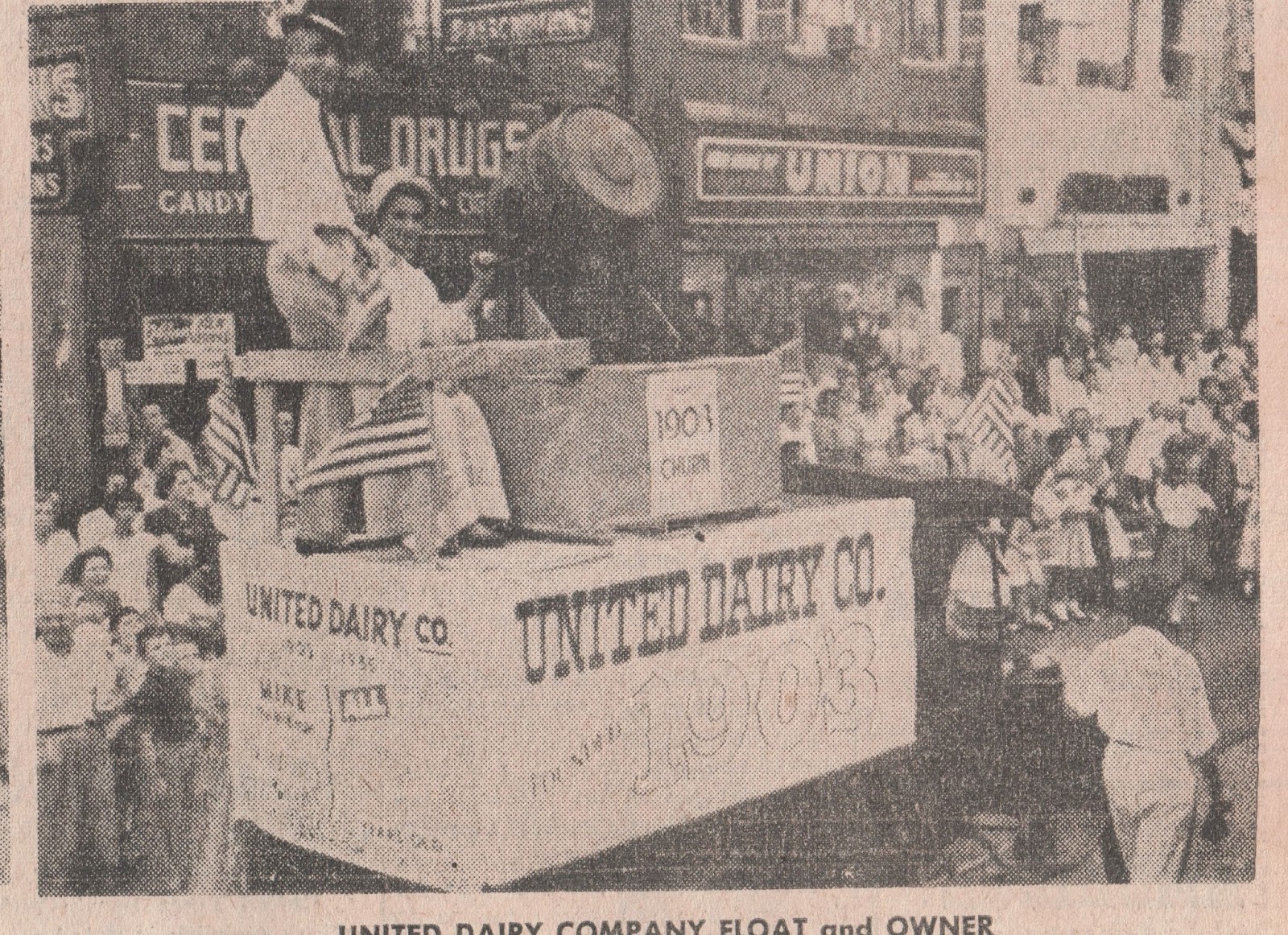
Golden Jubilee: the "mammoth spectacle" parade

Saturday, July 2, 1955, was hot. Really hot. The Beaver Valley Times reported that it was 94 degrees that day. Not ideal weather for a parade, especially one that was both long and late.

Ambridge loved parades and used to have several every year for all sorts of reasons. But the Golden Jubilee's was the parade that outdid them all, the biggest parade Ambridge ever had. "A mammoth spectacle," said The Daily Citizen.

The parade was long in distance marched, about two miles. It started at 1st and Merchant Sts., traveled north through town on Merchant, up the 14th St. hill to Duss Ave., then turned left, ending at Anthony Wayne School at 21st St. and Lenz Ave. But the distance ended up being even longer for some marchers. Butch O'Keefe remembers marching in the parade as a cub scout, getting to the end of the parade, then after the group disbanded near 24th St., having to walk back to his home at 4th St. and Maplewood Avenue!

The parade was also long in the sheer number of marchers--150 "marching units" and 17 "musical organizations"--enough so it took two to three hours for the parade to pass a point along the route. That, plus the enormous crowd of an estimated 75,000 - 100,000 spectators, may have contributed to some of the bands arriving late, delaying the beginning of the parade some two hours after its scheduled start at 2:30 P.M.

Merchants along the parade route were irritated because the parade delay killed the anticipated big crowds during the final day of their Old Fashioned Bargain Days sales event. Traffic was a mess for miles. The July 4 Pittsburgh Post-Gazette reported that traffic was backed up from Ambridge to Freedom, so five to six miles. And the parade was further delayed at times while lines of waiting traffic was allowed to cross Merchant at 8th St.*

The poor marchers in their full dress or heavy wool band uniforms! The heat and length of the parade caused some marchers to drop out along the parade route. Others passed out. At least 65 people, both marchers and spectators, reportedly were "overcome by the heat."

Here are some photos from the parade. Thanks to Maria Notarianni for sending me some of these from the Good Samaritan archives:

Golden Jubilee flag presentation
Beaver Valley Times
July 5, 1955

Original text:
FLAG PRESENTATION -- Mrs. Joseph Bucka, John Bauder, Ambridge Golden Jubilee chairman, and Walter Kasper, jubilee parade chairman, present the jubilee flag to Burgess Walter Panek. Mrs. Bucka made the flag, which was carried in the parade by Alvin (Mote) Bergman, long distance walker, who walked at the parade's head. The flag will be turned over to Lawrence Thurman, curator of Old Economy, who will place it in the Great House museum.
Bergman had been scheduled to walk 50 miles circling Ambridge's business area before the parade, but I didn't find any confirmation that he did that.

Ambridge High School Band
Golden Jubilee parade
Beaver Valley Times
 July 5, 1955

Original text:
PASS IN REVIEW -- Ambridge High School Band passes the reviewing stand at the intersection of Sixth and Merchant Streets, Ambridge, during the Ambridge Golden Jubilee parade Saturday afternoon. Approximately 75,000 persons witnessed the spectacle. At least 65 watchers and parade participants passed out from the intense heat. The parade lasted three hours.

"Ambridge High Band with Leader"
Golden Jubilee parade
Daily Citizen
July 5, 1955

"Aliquippa High Band Color Guard"
Golden Jubilee parade
Daily Citizen
July 5, 1955

"Ambridge I.O.O.F. Float"
Golden Jubilee parade
Daily Citizen
July 5, 1955

Davy Crockett was a really popular character in the mid-50s thanks to Disney's Davy Crockett TV show, so it's no surprise that he made an appearance in the parade. But it's young Davy, since it looks like the boy in the front of the wagon is the one wearing Davy's trademark coonskin hat.

"Old Dobbin with Davy Crockett"
Golden Jubilee parade
Daily Citizen
July 5, 1955

"George Washington Carver Band"
Golden Jubilee parade
Daily Citizen
July 5, 1955

"Fraternal Order of Eagles and '49ers Float"
Golden Jubilee parade
Daily Citizen
July 5, 1955

Pioneer Fife and Drum Corps
Golden Jubilee parade
Beaver Valley Times
July 5, 1955

Original text:
FIFE AND DRUMMERS -- Members of the Pioneer Fife and Drum Corps, Pittsburgh, march past the reviewing stand in the Ambridge Golden Jubilee parade Saturday. Band members are nearly all over 65 years of age. Several of this group passed out from the heat. Survivors played a concert at the intersection of Fourth and Merchant Streets after the parade.

Old Economy float
Golden Jubilee parade
Pittsburgh Post-Gazette
July 4, 1955

Original text:
Float showing how the Harmonites lived at Old Economy, Ambridge's historical shrine, passes in review during the borough's Golden Jubilee parade on Saturday.

Clan Grant Scottish Kilt Bagpipe Band
Golden Jubilee parade
Beaver Valley Times
July 5, 1955

Original text:
THE KILTIES ARE COMING -- Clan Grant Scottish Kilt Bagpipe Band, Donora, struts its stuff in the Ambridge Golden Jubilee parade Saturday. There were two kiltie bands in the parade. The other was the Clan Douglas Band of Turtle Creek.

"Scottish Kilt Band from Donora"
Golden Jubilee parade
Daily Citizen
July 5, 1955

"Italian Federation Societies Float"
Golden Jubilee parade
Daily Citizen
July 5, 1955

"Polish Army Veterans and Auxiliary"
Golden Jubilee parade
Daily Citizen
July 5, 1955

"Spang Chalfant Sponsored Float"
Golden Jubilee parade
Daily Citizen
July 5, 1955

"Ambridge Turners Float and Gymnasts"
Golden Jubilee parade
Daily Citizen
July 5, 1955

"United Daily Company Float and Owner"
Golden Jubilee parade
Daily Citizen
July 5, 1955

"Thirty Ton Tank Gets Attention"
Golden Jubilee parade
Daily Citizen
July 5, 1955

Although the parade may have been the highlight of the Golden Jubilee, it was not the final event. More to come on the "Frontiers of Freedom" historical pageant and the events that closed out the celebration including "All Nations" Day at Borough Park and the high school, plus the rather exciting mock battle in Borough Park on "Armed Forces" Day.
_____

* At the time of the parade, Ohio River Blvd., then part of Route 88, ended at 8th Street in Ambridge. Route 88 was once the primary route on the east side of the Ohio River from Pittsburgh through Beaver County. After Ohio River Blvd. ended at 8th St., Route 88 continued up the 8th St. hill, then north on Duss Ave. to Baden and northern Beaver County.

Saturday, February 14, 2015

Economy's Lover's Lane

Lover's Lane, Economy, PA
State Library of Pennsylvania
Old Economy Village archives

The Harmonites, noted for their celibacy, may have refrained from sex, but that doesn't mean they refrained from romance. And apparently romance was common enough that 14th Street between Duss Avenue and Beaver Road became known as Lover's Lane.

Lover's Lane, Economy, Pa.
postcard
postmarked January 22, 1909

The December 26, 1916, Daily Times, explained how Economy's Lover's Lane got its nickname:
On Sundays in the olden time the young people of the village were not allowed to leave the town, not even to visit the farmers on the outlying districts and so by degrees they began to appropriate this grassy, shaded lane, where they strolled by twos, dreamed dreams, and said pleasant nothings fraught with much meaning as has been the custom of lovers for centuries and so "The Lane" became "Lover's Lane." 

Lover's Lane, Economy, PA
State Library of Pennsylvania
Old Economy Village archives

The 1924 Economy Centennial Souvenir Program, Economy of Old, Ambridge of Today, compiled by Elise Mercur Wagner, described Lover's Lane: "Heavily shaded on both sides with trees, with a wide path of well-trodden grass between, it was the favorite walk of young people at eventide."

That program says that Lover's Lane's real name was "Mulberry Lane." Among their many industries, the Harmonites had a silk mill, and mulberry leaves from the trees they planted were used to feed the silkworms they raised. But the mulberry trees weren't well-suited to the area's climate, and the "cocoonery" was shut down in the 1850s.

Apple trees replaced the mulberries in the Lover's Lane area, and Mulberry Lane became Apple Lane. The handwritten note on the photo below says, "Apple trees planted in the 1870's to replace a row of mulberry trees (Morus Multicaulia) east of the silk factory at 14th St."

Apple Lane, Economy, PA
State Library of Pennsylvania
Old Economy Village archives

Apple Lane, Economy, PA
State Library of Pennsylvania
Old Economy Village archives

The 1916 Daily Times article says that once Economy was sold, and the Liberty Land Company opened the formerly-gated Apple Lane as a street in 1903, "the old apple trees began to decay and become scraggy. Now they are nearly all dead."

The newspaper mourned the end of Lover's Lane which it called "one of the historic old land marks of Economy":
"Lover's Lane" in Economy carries with it more than historic interest to many who resided in the village before the modern spirit of progress had transformed a beauty spot into an ordinary city street.
The paper said Ambridge's street commissioner was in the process of removing the trunks and broken limbs, noting, "The street is nearly all built up now."
_____

Update December 19, 2018: I'm aware that the people in one of the photos above are not wearing Harmonist clothing. But even before the Harmony Society sold its property in Economy, it had hired workers who lived in the community, but were not Harmony Society members. And Sarah Buffington, curator at Old Economy Village, told me that the Harmony Society did not prohibit visitors from strolling in Economy.

Sunday, November 23, 2014

Fourth Ward and the Economy schools

Although I do read a bit about the history of the Harmony Society's Economy, I mainly focus my research and blogging on Ambridge and the post-Harmonist period. But sometimes the two overlap, as wonderfully illustrated by this photo:

Three Economy schools
State Library of Pennsylvania
Old Economy Village archives

Although I had probably seen this photo on one of my earlier explorations of the State Library of Pennsylvania archives, I didn't appreciate what it showed until I started doing research on "Ambridge's First Building" which I blogged about last week.

The Old Economy historian's letter cited in that blog post mentioned two photos of the Blaine House, described as a school. The Blaine House is the large building on the right above. The Harmonists moved Blaine House from its previous location near what is now First and Merchant Streets shortly after they arrived at what would become their last settlement, Economy, in 1824. Christiana Knoedler says in her 1954 book The Harmony Society that the Blaine House was used as a school for over 60 years. The Old Economy-Ambridge Sesqui-Centennial Historical Booklet, compiled and edited by Rev. Norman C. Young, May 1974, agrees, saying that the Blaine House was used as a school until 1884.

Those other two buildings in the photo were also schools. The one on the left is a later Harmony Society school. The building in the background with a tower peeking out between the other buildings is Ambridge's first school, originally named Economy Public School, later called Fourth Ward School.

All I know about the Economy school on the left side is this bit of information from the Sesqui-Centennial booklet: "In 1884 a building was built on Church Street near 16th Street and prior to 1904 classes were conducted in this farm building adjacent to the old 4th Ward Building. This building is now used as an apartment house." An apartment building still occupies that corner, although it doesn't look like the 1884 school building in the photo.

In the photo, the Blaine House school and the school on the left look like they were next to each other; however, Laughlin Street ran between them. I don't know when Laughlin Street was constructed, although I believe that it was one of the streets that were cut mid-block in the larger old Harmony Society blocks when Ambridge was being built. Perhaps Laughlin Street was built after the photo was taken, but if so, it must have been soon after, since the street is shown on a 1905 map of the area.

I knew that not everyone who lived in Economy had been a member of the Harmony Society, and ever since I started doing historical research on Ambridge, I'd wondered where the children from non-Harmonite families went to school before Ambridge existed. Some may have been home-schooled, but in addition, according to The Twentieth Century History of Beaver County Pennsylvania, 1900-1988 (edited by Cheryl Weller Beck, 1989), "A schoolroom was always in use in Old Economy and attendance was free to all children, not only the children of members of the Society." 

The Ambridge School District built its first school, called Economy Public School, in 1904. It's the middle school in the above photo. Located between Laughlin and 16th Streets, almost mid-way between Church and Merchant Streets, it was built the year before Ambridge was incorporated, designed by architect Elsie Mercur Wagner, who compiled the 1924 Economy Centennial Souvenir Program: Economy of Old and Ambridge of Today

I've wondered about why Ambridge chose to build its first school between Laughlin and 16th Streets. Undoubtedly a new school was sorely needed with the sudden influx of new families moving into Ambridge after American Bridge was built; however, most of them were settling on the other end of town, near the mill.

Below is a postcard postmarked in Youngstown, Ohio, in 1912, showing the Economy Public School built by Ambridge:

"Public School Building, Economy Pa."
Postcard
postmarked 1912

Although postmarked in 1912, the photo and card itself may well be pre-1907. Before 1907, the U.S. permitted only a mailing address on the back of postcards. This card has an undivided back with the notation, "This side for the address." The U.S. permitted divided back postcards beginning in 1907, allowing both a message and address on the reverse side of a card's image.

Any message on an undivided back card was often squeezed in the front's margins as it is here. The writing is very faded, but this is what I can make out:

On the left side:
Dear Miss Buchman, Kindly let me know how early in May you can [send?] for me. Bell phone 527.

On the right side:
Mrs. J. C. Campbell Lan[undecipherable] Gertie Rauch(?) phoned you about me. 

Fourth Ward School was used as a school until it was closed and razed in 1964. Its site was used for a playground for many years. The playground was razed to make room for the Old Economy Visitor Center which opened in August, 2003.

Old Economy Visitor Center
270 Sixteenth Street
April 1, 2014